

Guides
NGC First Releases vs Early Releases: What’s the Difference?
Sep
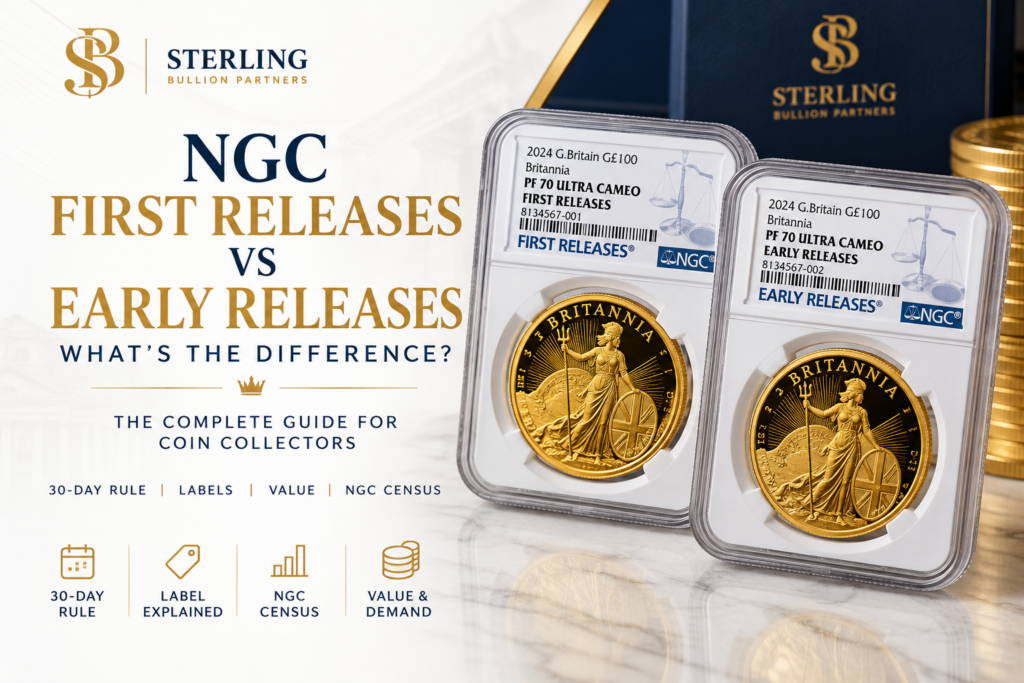
NGC First Releases and Early Releases are two designations commonly found on NGC-certified coins, including modern British gold coins, Sovereigns and commemorative issues.
Although the names sound different, NGC considers First Releases and Early Releases to be interchangeable designations. They use the same definition and relevant cutoff dates.
To qualify, an eligible coin must generally be received by NGC or an NGC-approved depository within the first 30 days following the coin’s release.
Importantly, neither designation means that the individual coin was one of the first coins physically struck by the mint.
For collectors comparing certification companies as well as individual designations, our guide to PCGS vs NGC explains the differences between the two major coin grading services.
⸻
At a Glance
NGC First Releases: A designation for eligible coins generally received by NGC or an approved depository within 30 days of release.
NGC Early Releases: Uses the same NGC definition and relevant cutoff dates as First Releases.
Are they the same? NGC considers the designations interchangeable.
Does First Releases mean first struck? No.
Does it affect the numerical grade? No. First Releases and Early Releases are separate from grades such as MS70 or PF70.
Are they shown separately in the NGC Census? Yes.
Does First Releases make a coin more valuable? Not automatically. Any premium depends on collector demand and the market for the particular coin.
According to NGC’s official guidance on coin designations, First Releases and Early Releases use the same definition and relevant cutoff dates.
⸻
What Does NGC First Releases Mean?
First Releases is an NGC designation available for selected coins that meet NGC’s release-date requirements.
According to NGC, eligible coins must generally be received by NGC or an NGC-approved depository within the first 30 days following the coin’s release.
When a qualifying coin receives the designation, FIRST RELEASES appears as part of the coin’s description on its NGC certification label.
The important distinction is that First Releases is not a numerical grade.
A coin could therefore be certified as:
NGC PF70 Ultra Cameo First Releases
In this example:
PF70 is the numerical Proof grade.
Ultra Cameo describes the strong contrast between the mirrored fields and heavily frosted devices of a qualifying Proof coin.
First Releases is the separate NGC releases designation.
Each tells the collector something different about the certified coin.
⸻
What Does NGC Early Releases Mean?
Early Releases operates under the same principle.
NGC awards the designation to selected coins that meet its applicable release-date requirements, generally requiring the coin to be received by NGC or an approved depository within the first 30 days of release.
A qualifying coin can then have EARLY RELEASES displayed on its certification label.
The important point is that Early Releases is not a lower level of designation than First Releases.
NGC states that Early Releases and First Releases are interchangeable and that the same definition and relevant cutoff dates apply to both.
NGC also uses First30 synonymously with Early Releases.
⸻
NGC First Releases vs Early Releases
|
Feature |
First Releases |
Early Releases |
|---|---|---|
|
NGC designation |
Yes |
Yes |
|
Generally requires receipt within 30 days |
Yes |
Yes |
|
Same NGC definition |
Yes |
Yes |
|
Same relevant cutoff dates |
Yes |
Yes |
|
Indicates one of the first coins struck |
No |
No |
|
Changes the numerical grade |
No |
No |
|
Can appear with MS70 or PF70 |
Yes |
Yes |
|
Listed separately in NGC Census |
Yes |
Yes |
|
Automatically makes a coin more valuable |
No |
No |
For grading purposes, there is therefore no hierarchy in which First Releases is considered superior to Early Releases.
If two otherwise identical coins are both graded PF70 Ultra Cameo, with one carrying First Releases and the other Early Releases, NGC has not given the First Releases coin a higher numerical grade.
⸻
Does NGC First Releases Mean First Struck?
No.
This is one of the most important misconceptions surrounding the designation.
First Releases does not mean NGC has established that the individual coin was among the first examples physically struck by the mint.
Instead, the designation relates to whether an eligible coin met NGC’s requirements based on its release date and receipt by NGC or an approved depository.
Those are two different things.
A mint may produce coins before their official release to the market. Unless there is specific documentation establishing the production sequence of an individual coin, a First Releases label should not be interpreted as evidence that the coin was literally one of the first struck.
NGC also points out that a coin’s release date can differ from the date appearing on the coin itself.
⸻
Is NGC First Releases Better Than Early Releases?
Not according to NGC’s designation standards.
NGC considers First Releases and Early Releases interchangeable.
Both use the same definition and relevant cutoff dates.
The distinction is therefore principally the designation displayed on the certification label rather than a different standard of grading or an indication that one coin is technically superior.
Collectors can still have preferences.
One collector may prefer the wording First Releases, while another may prefer a particular Early Releases label or presentation.
That preference can potentially influence secondary-market demand, but it should not be confused with the coin receiving a higher grade.
⸻
What Is the NGC First Releases 30-Day Rule?
For eligible issues, a coin must generally be received by NGC or an NGC-approved depository within the first 30 days following its release to qualify for First Releases or Early Releases.
NGC publishes cutoff dates for eligible coins.
This is particularly useful for modern world coins because the date printed on a coin does not necessarily establish when it was actually released.
Collectors should therefore use NGC’s published cutoff date for the particular issue rather than simply counting from the year shown on the coin.
NGC maintains its own Early Releases and First Releases cutoff dates for eligible world coins, including qualifying Great Britain issues.
Eligibility is ultimately determined by NGC.
⸻
First Releases vs PF70: What’s the Difference?
PF70 and First Releases describe completely different aspects of a certified coin.
PF70 is a grade.
NGC uses the internationally recognised 1 to 70 numerical grading scale. A grade of 70 represents the highest numerical grade on that scale.
First Releases is a designation.
It relates to whether an eligible coin met NGC’s applicable release requirements.
In simple terms:
PF70 = the coin’s numerical grade
First Releases = the coin qualified for the releases designation
This means two coins can both qualify for First Releases while receiving different grades.
For example:
PF69 Ultra Cameo First Releases
and
PF70 Ultra Cameo First Releases
Both coins qualified for First Releases, but only one achieved the highest numerical Proof grade.
The same principle applies to Mint State coins. Our MS69 vs MS70 guide explains what separates these two high numerical grades and why the difference can matter to collectors.
⸻
What Does PF70 Ultra Cameo First Releases Mean?
This combination appears frequently on modern NGC-certified Proof gold coins.
It actually contains three separate pieces of information.
PF70
PF identifies the coin as a Proof.
70 represents the highest numerical grade on NGC’s grading scale.
Ultra Cameo
Ultra Cameo applies to qualifying Proof coins.
NGC describes an Ultra Cameo Proof as having deeply mirrored fields and heavily frosted devices, producing bold contrast on both sides of the coin.
First Releases
First Releases confirms that the coin met NGC’s requirements for that releases designation.
Therefore:
PF70 = numerical grade
Ultra Cameo = Proof contrast designation
First Releases = releases designation
First Releases does not cause a coin to receive PF70 and PF70 does not automatically mean a coin qualifies for First Releases.
⸻
Does First Releases Make a Coin More Valuable?
Not automatically.
There is no universal percentage or fixed premium that applies to every coin carrying a First Releases designation.
Whether a particular designation commands a premium is ultimately determined by collector demand and the market for the individual coin.
The value of a certified coin can be influenced by several factors:
- original mintage
- numerical grade
- certified population
- collector demand
- First Releases or Early Releases designation
- particular certification label
- current availability
- historical significance
- comparable market sales
For some issues, collectors may prefer a First Releases example and the market may place a premium on it.
For others, the difference may be negligible.
The designation should therefore be considered alongside the characteristics of the underlying coin rather than treated as a guarantee of additional value.
⸻
Does First Releases Mean a Coin Is Rare?
No. First Releases by itself does not establish rarity.
This is where it is important to distinguish between several different measurements.
Mintage tells you how many examples of a coin were produced.
Limited Edition Presentation can tell you how many examples were made available in a particular product or presentation.
NGC population records how many examples NGC has certified within particular categories at the time the Census is checked.
First Releases population relates specifically to NGC-certified coins carrying that designation.
These numbers are not interchangeable.
For example, a coin could have a relatively substantial original mintage but only a small number of examples certified PF70 Ultra Cameo First Releases.
That could create certification or condition scarcity within that particular category, but it does not change the coin’s original mintage.
Our guide to Coin Population vs Mintage explains the difference in detail and why both figures need to be considered when assessing the scarcity of a graded coin.
⸻
Are First Releases and Early Releases Listed Separately in the NGC Census?
Yes.
Although NGC considers the designations interchangeable, First Releases and Early Releases are listed separately in the NGC Census.
This is an important detail when analysing population figures.
The same underlying coin may have certified examples appearing across:
- non-designated examples
- First Releases
- Early Releases
- different numerical grades
- other qualifying designations
A low population within one particular designation therefore does not necessarily mean that only that number of the underlying coin has been graded by NGC.
Collectors should establish exactly which population category they are looking at before drawing conclusions about scarcity.
Our guide What Is a Coin Population Report? explains how NGC and PCGS population data works, what the figures can tell collectors and the limitations that should be understood when interpreting them.
⸻
First Releases vs Early Releases for British Gold Coins
First Releases and Early Releases are particularly relevant to collectors of modern British gold coins because NGC certifies many Royal Mint issues with these designations.
Examples can include:
- Gold Sovereigns
- Britannia gold coins
- commemorative £5 gold coins
- Proof Sovereigns
- modern Royal Mint limited-mintage issues
When comparing two graded British gold coins, however, the releases designation should not be considered in isolation.
A more complete comparison considers:
the underlying coin
original mintage
Limited Edition Presentation
numerical grade
NGC population
First Releases or Early Releases designation
current availability
market price
This provides considerably more information than simply assuming that a First Releases label makes one coin better than another.
⸻
NGC First Releases vs Early Releases: Which Should You Buy?
If two otherwise comparable coins are available, there is no technical grading reason to assume a First Releases coin is better than an Early Releases coin.
NGC considers the designations interchangeable.
The more useful comparison is:
Coin → Mintage → Grade → Population → Designation → Price
If a PF70 First Releases coin carries a substantial premium over an otherwise equivalent PF70 Early Releases example, the question is whether collector demand and market evidence justify paying that premium.
For many collectors, the quality and scarcity of the underlying coin, its numerical grade and its certified population may be more important than choosing between the words First Releases and Early Releases.
⸻
Frequently Asked Questions
Are NGC First Releases and Early Releases the same?
NGC considers First Releases and Early Releases interchangeable. They use the same definition and relevant cutoff dates.
What does NGC First Releases mean?
It is an NGC designation for selected coins that generally must be received by NGC or an NGC-approved depository within the first 30 days following release.
What does NGC Early Releases mean?
Early Releases is an NGC designation operating under the same definition and relevant cutoff dates as First Releases.
Does First Releases mean the coin was one of the first struck?
No. First Releases relates to NGC’s release and receipt requirements. It does not establish that the individual coin was one of the first physically struck by the mint.
Is First Releases better than Early Releases?
No grading hierarchy exists between them. NGC considers the two designations interchangeable.
What is the NGC First Releases 30-day rule?
Eligible coins must generally be received by NGC or an NGC-approved depository within the first 30 days following the coin’s release. NGC publishes applicable cutoff dates.
Does First Releases affect the grade?
No. First Releases is separate from the numerical grade. A coin can qualify for First Releases and subsequently receive grades such as PF69, PF70, MS69 or MS70 depending on its condition and type.
What does PF70 Ultra Cameo First Releases mean?
PF70 is the numerical Proof grade, Ultra Cameo describes the contrast between the mirrored fields and frosted devices and First Releases is the releases designation. They are three separate certification characteristics.
Is NGC First Releases worth more?
Sometimes, but not automatically. Any premium depends on collector demand and the market for the particular coin, grade, label and designation.
Does First Releases mean a coin is rare?
No. The designation does not establish the original mintage or overall rarity of a coin.
Are First Releases and Early Releases shown separately in the NGC Census?
Yes. NGC lists them separately in its Census even though the two designations use the same definition and relevant cutoff dates.
What is NGC First30?
NGC states that First30 is another designation used synonymously with Early Releases.
⸻
Final Thoughts
The difference between NGC First Releases and Early Releases is much smaller than the names might suggest.
NGC considers the two designations interchangeable. They use the same definition and relevant cutoff dates, with eligible coins generally required to reach NGC or an NGC-approved depository within the first 30 days following release.
Neither designation means that the individual coin was necessarily one of the first examples physically struck.
They should also not be confused with the coin’s grade.
For example, an NGC PF70 Ultra Cameo First Releases coin combines three separate certification characteristics: the PF70 numerical grade, the Ultra Cameo designation and the First Releases designation.
For collectors comparing certified gold coins, First Releases or Early Releases can therefore be useful information, but it is only one part of the picture.
The underlying coin, original mintage, grade, certified population, availability and market price should all be considered before deciding whether a particular example represents the right coin to acquire.
