

Guides
Coin Population vs Mintage
Aug
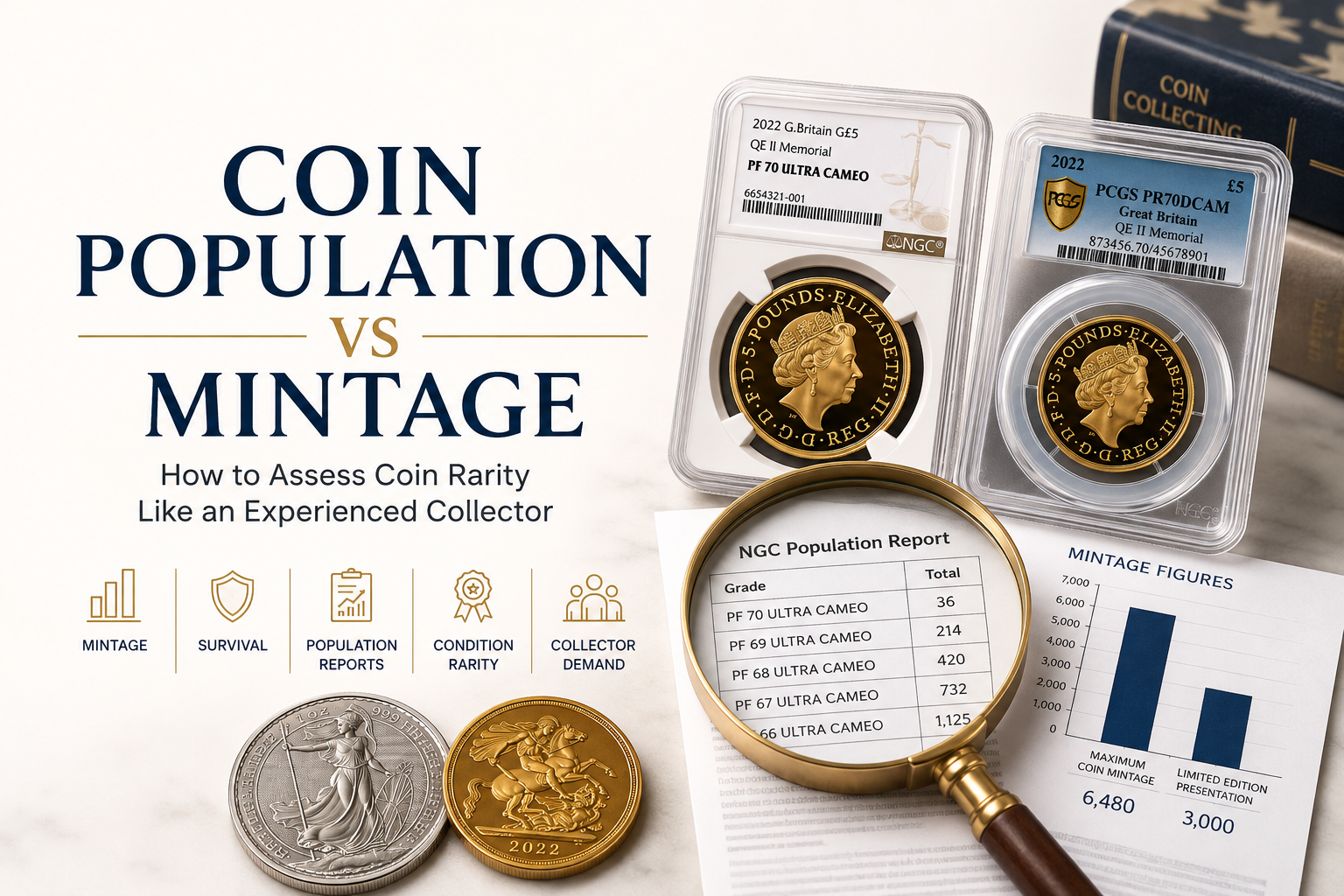
Coin Population vs Mintage: How to Assess Coin Rarity Like an Experienced Collector
Learn the difference between coin population and mintage, why they measure completely different things, and how experienced collectors use both to assess the true rarity of a collectable coin.
In This Guide
Every certified coin comes with numbers.
Maximum Coin Mintage.
Limited Edition Presentation.
Population reports.
PF70 totals.
Registry rankings.
The challenge isn’t finding these numbers.
It’s understanding what they actually tell you.
This guide explains how experienced collectors interpret those figures to assess a coin’s rarity more accurately.
By the end of this guide you’ll understand:
- What coin mintage actually measures.
- How NGC and PCGS population reports work.
- Why mintage and population should never be compared directly.
- Why survival matters just as much as production.
- How to assess a certified coin using the same structured approach adopted by experienced collectors.
Why Collectors Often Misunderstand Rarity
Imagine you’re comparing two modern Royal Mint Proof coins.
Both have a Maximum Coin Mintage of 500.
One currently has 18 PF70 Ultra Cameo examples certified by a grading company.
The other has 240 PF70 Ultra Cameo examples.
At first glance, the answer seems obvious.
Surely the first coin must be much rarer?
Not necessarily.
Those two numbers tell us different things.
Neither tells us:
- how many coins still survive;
- how many remain in their original Royal Mint packaging;
- how many have been graded by another certification company;
- or how many collectors are actively trying to acquire one.
This is one of the biggest misconceptions in modern numismatics.
Many collectors compare mintage and population as though they are competing statistics.
They aren’t.
Instead, they represent different stages in the life of a collectable coin.
Understanding those stages is the key to assessing rarity properly.
The Journey of a Collectable Coin
Every collectable coin follows a journey.
Understanding that journey makes it much easier to interpret the numbers published by mints and grading companies.
Royal Mint Issues the Coin
│
▼
Maximum Coin Mintage
│
▼
Coins That Survive
│
▼
Coins Submitted for Grading
│
▼
Population Reports
│
▼
Condition Rarity
│
▼
Collector Demand
│
▼
Market Value
Each stage answers a different question.
|
Stage |
What It Tells You |
|---|---|
|
Maximum Coin Mintage |
How many coins could originally be issued. |
|
Estimated Survival |
How many are believed to remain today. |
|
Population Reports |
How many coins have been certified by a grading company. |
|
Condition Rarity |
How many examples exist in a particular grade. |
|
Collector Demand |
How many buyers are competing for the available supply. |
One of the biggest mistakes collectors make is jumping straight from mintage to value.
Experienced collectors don’t.
Instead, they work through each stage before deciding how scarce a coin is likely to be.
Key Takeaway
A coin’s rarity is not determined by a single statistic.
Mintage, survival, certified population, condition rarity and collector demand each tell a different part of the story.
What Is Coin Mintage?
Coin mintage is the total number of coins struck by the issuing mint. For modern British collectable coins, this information is published by The Royal Mint and forms one of the first statistics collectors research.
For modern Royal Mint issues, you’ll also encounter the term Maximum Coin Mintage (MCM). This is the maximum number of that particular coin authorised for issue.
This figure establishes the maximum possible supply of the coin.
However, it does not tell us:
- how many examples survive today;
- how many have been professionally graded;
- how many exist in exceptional condition; or
- how many collectors are trying to buy one.
Think of mintage as the beginning of the story, not the ending.
What Can Mintage Tell You?
|
Question |
Answered by Mintage? |
|---|---|
|
How many coins were originally produced? |
✅ |
|
How many survive today? |
❌ |
|
How many have been graded? |
❌ |
|
How many PF70 or MS70 examples exist? |
❌ |
|
How many collectors want one? |
❌ |
This is why mintage should never be viewed in isolation.
It provides the starting point for assessing rarity—but it cannot provide the complete picture.
Why Mintage Still Matters
Although mintage doesn’t tell the whole story, it remains one of the most important statistics in numismatics.
All else being equal, a coin with a Maximum Coin Mintage of 250 has greater potential to become scarce than one with a Maximum Coin Mintage of 25,000.
However, all else is rarely equal.
Two coins with identical mintages can develop very different rarity profiles depending on:
- survival;
- grading activity;
- condition rarity; and
- collector demand.
This is why experienced collectors rarely stop their research after reading the mintage figure.
Maximum Coin Mintage vs Limited Edition Presentation
One of the most common sources of confusion among modern Royal Mint collectors is the difference between Maximum Coin Mintage (MCM) and Limited Edition Presentation (LEP).
Although the figures often appear together, they describe different things.
|
Term |
Meaning |
|---|---|
|
Maximum Coin Mintage (MCM) |
The maximum number of that coin authorised for issue. |
|
Limited Edition Presentation (LEP) |
The number of coins made available in a particular presentation or product format. |
|
Mintage |
The total number of coins struck. |
For example, a modern Proof coin might have:
- Maximum Coin Mintage: 6,480
- Limited Edition Presentation: 3,000
These figures are not contradictory.
The Limited Edition Presentation relates to one specific product presentation.
The Maximum Coin Mintage relates to the maximum number of that coin that may be issued.
Understanding this distinction prevents one of the most common mistakes made by collectors researching modern Royal Mint releases.
Why Final Sales Can Matter More Than Maximum Coin Mintage
A Maximum Coin Mintage tells you the highest number of coins that could be issued.
It does not necessarily tell you how many were actually sold.
For some modern Royal Mint collector coins, the final number purchased by collectors may be lower than the published Maximum Coin Mintage because not every product sells out.
The Royal Mint publishes annual commemorative coin sales figures, which can provide valuable additional context when researching certain modern releases.
However, it’s important not to confuse product sales with the final number of individual coins produced, particularly where the same coin was available in multiple presentation formats or sets.
When researching rarity, treat the Maximum Coin Mintage as your starting point, then look for any additional published information that helps complete the picture.
Collector’s Insight
A dealer advertising a coin with a Limited Edition Presentation of 500 is not necessarily saying that only 500 coins exist.
Always check whether the figure being quoted is:
- Maximum Coin Mintage
- Limited Edition Presentation
- Final published sales
- Confirmed final mintage (if available)
They are related figures, but they are not interchangeable.
Key Takeaway
Mintage explains where a coin’s story begins.
The next question is:
What happened after those coins left the Royal Mint?
That’s where population reports become invaluable.
What Is a Coin Population Report?
If mintage tells us how many coins were originally produced, a population report tells us how many coins have been certified by a grading company.
Although these figures are often mentioned together, they answer completely different questions.
A population report is maintained by independent third-party grading companies such as NGC (Numismatic Guaranty Company) and PCGS (Professional Coin Grading Service).
Every time a coin is submitted, authenticated and graded, that certification is added to the grading company’s database. Over time, this creates a detailed record showing how many examples of a particular coin have been certified at each grade.
For collectors, this information provides valuable insight into the availability of certified examples, particularly in the highest grades.
What Information Does a Population Report Show?
Although the layout varies slightly between grading companies, most population reports include:
- The coin type and date.
- The total number of certified examples.
- The number of coins at each grade.
- Special designations, such as Ultra Cameo, Deep Cameo, First Releases or Early Releases, where applicable.
- The highest grade currently recorded.
For example, a population report might look like this:
|
Grade |
Certified Examples |
|---|---|
|
PF70 Ultra Cameo |
18 |
|
PF69 Ultra Cameo |
146 |
|
PF68 Ultra Cameo |
24 |
|
PF67 Ultra Cameo |
3 |
This immediately tells us far more than simply knowing a coin has been graded.
It shows how the certified population is distributed across different grades, helping collectors understand how difficult it has been for submitted coins to achieve the highest grades.
What Can a Population Report Tell You?
|
Question |
Answered by a Population Report? |
|---|---|
|
How many coins has this grading company certified? |
✅ |
|
How many examples exist in each grade? |
✅ |
|
How many coins exist worldwide? |
❌ |
|
How many survive today? |
❌ |
|
How many coins remain ungraded? |
❌ |
This is why population reports are so valuable.
They answer questions that mintage cannot.
However, they also leave several important questions unanswered.
Population Reports Measure Certifications — Not Every Surviving Coin
This is one of the most important concepts in modern coin collecting.
A population report is not a census of every surviving coin.
Instead, it records the coins that have been certified by one specific grading company.
Imagine a modern Royal Mint Proof coin with a Maximum Coin Mintage of 1,000.
Several years later:
- many owners may still keep their coins in their original Royal Mint packaging;
- some may have submitted them to NGC;
- others may have chosen PCGS;
- and some may never have their coins graded at all.
Each grading company can only report the coins it has personally certified.
As a result, a population report provides an excellent picture of certified availability, but not of the total number of surviving examples.
Collector’s Insight
A simple way to remember this is:
Mintage measures production. Population measures certification.
They are related.
They are not interchangeable.
Why Do NGC and PCGS Show Different Population Figures?
New collectors are often surprised when the same coin has different population figures at NGC and PCGS.
This is completely normal.
Each grading company maintains its own independent certification database.
A coin submitted to NGC appears in the NGC Census.
A coin submitted to PCGS appears in the PCGS Population Report.
Unless a coin is later crossed over and certified by another grading company, each database only records the coins it has authenticated itself.
For this reason, many experienced collectors check both population reports when researching an important certified coin.
Why Population Reports Change
Unlike mintage figures, population reports are dynamic.
They change over time.
Every time additional coins are submitted for grading, the published populations may increase.
For example:
|
Date |
PF70 Population |
|---|---|
|
January |
18 |
|
July |
24 |
|
December |
31 |
No additional coins have been produced.
The increase simply reflects more coins entering the grading system.
This is particularly common with modern Royal Mint Proof coins, where collectors often submit coins months—or even years—after their original release.
Population reports should therefore be viewed as live research tools, rather than fixed historical figures.
Can Population Reports Ever Overstate the Number of Coins?
Population reports are among the most valuable resources available to collectors, but they do have limitations.
Occasionally, a collector may remove a coin from its holder and submit it again in the hope of achieving a higher grade.
Similarly, some coins move between grading companies through crossover submissions.
Although grading companies work to maintain accurate records, these situations mean a population report should be viewed as a record of certifications, rather than an exact count of unique physical coins.
For most collectors, this distinction has little practical impact.
However, understanding it helps explain why population reports should always be interpreted alongside other evidence.
Coin Population vs Coin Mintage
Now that we’ve explored both concepts separately, their differences become much clearer.
|
Coin Mintage |
Coin Population |
|---|---|
|
Published by the issuing mint. |
Published by a grading company. |
|
Measures original production. |
Measures certified examples. |
|
Usually fixed once production ends. |
Changes as more coins are graded. |
|
Includes every coin originally produced. |
Includes only coins submitted to that grading company. |
|
Does not record condition. |
Broken down by grade and designation. |
|
Helps assess original supply. |
Helps assess certified availability. |
Neither figure is more important.
Each answers a different question.
Together, they provide far more useful information than either statistic can provide on its own.
Remember This
|
Statistic |
What It Doesn’t Tell You |
|---|---|
|
Maximum Coin Mintage |
How many coins survive today. |
|
Estimated Survival |
How many have been graded. |
|
Population |
How many coins exist worldwide. |
|
PF70 Population |
Whether the coin is valuable. |
Understanding what a statistic cannot tell you is often just as important as understanding what it can.
Key Takeaway
Every genuinely rare coin is likely to have a relatively small certified population.
However, not every low-population coin is genuinely rare.
Population reports record certifications, not every surviving example.
To understand why that distinction matters, we need to explore the next stage in a coin’s journey:
Survival.
The Missing Piece: Survival
We’ve now looked at two important statistics:
- Maximum Coin Mintage
- Certified Population
Together, they provide valuable information.
However, there is still an important question they don’t answer.
How many examples are actually believed to survive today?
This is where the concept of survival becomes essential.
For many coins—particularly historic issues—survival can be just as important as original production when assessing rarity.
What Is Survival?
In numismatics, survival refers to the estimated number of coins that still exist today.
Unlike mintage, which is recorded by the issuing mint, survival is rarely known with complete certainty.
Instead, it is estimated using evidence such as:
- historical mint records;
- auction appearances;
- museum collections;
- dealer experience;
- grading data;
- known hoards; and
- historical losses through circulation or melting.
For older coins, survival estimates often provide a much better indication of rarity than original mintage alone.
What Can Survival Tell You?
|
Question |
Answered by Survival? |
|---|---|
|
How many coins were originally produced? |
❌ |
|
How many are believed to exist today? |
✅ |
|
How many have been graded? |
❌ |
|
How many PF70 examples exist? |
❌ |
|
How many collectors want one? |
❌ |
Survival fills an important gap between production and certification.
Why Mintage Doesn’t Always Reflect Today’s Rarity
Original mintage tells us how many coins entered the market.
It doesn’t tell us what happened afterwards.
Over time, coins may have been:
- melted;
- lost;
- damaged;
- heavily circulated;
- permanently held in museum collections; or
- retained in long-term private collections.
As a result, two coins with very different original mintages may be much closer in rarity today than their production figures suggest.
This is why collectors researching historic coinage often place significant emphasis on estimated survival.
Collector’s Insight
Think of it this way:
Mintage tells you where the story begins.
Survival tells you how much of that story remains today.
Modern Proof Coins Are Different
Although survival is extremely important for historic coins, modern Royal Mint Proof coins often behave differently.
Unlike circulation coins, Proof issues are usually:
- purchased by collectors;
- stored in their original presentation cases;
- carefully handled; and
- preserved for the long term.
As a result, survival rates for many modern Proof coins are likely to be much higher than for coins that have spent decades—or centuries—in circulation.
That doesn’t mean modern Proof coins cannot be rare.
It simply means the difference between Maximum Coin Mintage and Estimated Survival may be much smaller.
Understanding this distinction helps collectors compare modern and historic issues more realistically.
Survival Is Not the Same as Population
This is where many collectors become confused.
Consider the following example.
|
Statistic |
Figure |
|---|---|
|
Maximum Coin Mintage |
1,000 |
|
Estimated Surviving Examples |
980 |
|
NGC Certified Population |
320 |
|
PCGS Certified Population |
180 |
These figures are not competing.
Each one answers a different question.
|
Statistic |
What It Tells You |
|---|---|
|
Maximum Coin Mintage |
The maximum number originally authorised for issue. |
|
Estimated Survival |
Approximately how many examples still exist. |
|
NGC Population |
Coins certified by NGC. |
|
PCGS Population |
Coins certified by PCGS. |
Looking at all four together provides a much more complete understanding than relying on any single figure.
Remember This
A low population does not necessarily mean very few coins survive.
It may simply mean relatively few owners have chosen to submit their coins for grading.
Likewise, a high population does not automatically mean a coin is common.
It may simply reflect that the coin is popular with collectors and therefore submitted for grading more frequently.
Why the Numbers Don’t Tell the Whole Story
By now we’ve identified three important pieces of information:
- Original production.
- Estimated survival.
- Certified population.
Many collectors stop there.
Experienced collectors don’t.
Two coins can have almost identical:
- Maximum Coin Mintages;
- estimated survival;
- and certified populations;
yet still be viewed very differently by the market.
Why?
Because there are still two questions left to answer.
- How difficult is it to find the coin in the highest grades?
- How many collectors are actively trying to own one?
Those questions introduce two final concepts:
- Condition Rarity
- Collector Demand
Together, they help explain why some coins become genuinely difficult to acquire, while others remain relatively accessible despite impressive-looking statistics.
The Journey of a Collectable Coin
The easiest way to understand rarity is to view it as a journey rather than a single statistic.
Royal Mint Issues the Coin
│
▼
Maximum Coin Mintage
│
▼
Estimated Survival
│
▼
Coins Submitted for Grading
│
▼
Certified Population
│
▼
Condition Rarity
│
▼
Collector Demand
│
▼
Market Availability
Every stage adds another piece of information.
The more of those stages you understand, the more confidently you can assess a coin’s rarity.
Key Takeaway
Mintage tells you how many coins could exist.
Survival estimates how many still exist.
Population reports show how many have been certified.
Each statistic answers a different question.
Only by considering all three together can you begin to build an accurate picture of rarity.
In the next section, we’ll bring everything together into a practical framework that you can use whenever you’re researching a certified coin.
How Experienced Collectors Assess Coin Rarity
By now we’ve established that no single statistic can accurately describe a coin’s rarity.
A low mintage doesn’t automatically make a coin rare.
A low population doesn’t automatically make it valuable.
Even survival estimates only tell part of the story.
So how do experienced collectors bring all of this information together?
Rather than searching for one decisive number, they ask a series of simple questions.
Each answer adds another piece to the overall picture.
Only after considering all of them together do they begin to form an opinion about a coin’s rarity.
The Five Questions Every Collector Should Ask
1. How Many Coins Were Originally Produced?
Every assessment begins with the original production figure.
For modern Royal Mint issues, this is usually the Maximum Coin Mintage (MCM).
This establishes the maximum possible supply of the coin.
Although a low mintage gives a coin greater potential to become scarce, it should never be viewed in isolation.
Two coins with identical mintages may develop very different rarity profiles over time.
Questions to Consider
- Is this the Maximum Coin Mintage or the Limited Edition Presentation?
- Has a final mintage or sales figure been published?
- Was the coin issued individually, as part of a set, or both?
2. How Many Examples Are Believed to Survive?
The second question moves beyond production.
It considers how many examples are still believed to exist today.
For historic coins, survival can dramatically change our understanding of rarity.
Coins may have been:
- melted;
- lost;
- damaged;
- heavily circulated; or
- permanently removed from the market through museums or long-term collections.
For many modern Proof coins, survival rates are likely to be much higher because collectors generally preserve them carefully from the moment they are issued.
Questions to Consider
- Is this a modern collector coin or a historic circulation issue?
- Are survival estimates available from reputable sources?
- Have significant numbers been lost or melted?
3. How Many Examples Have Been Certified?
The third question examines the grading data.
Population reports published by NGC and PCGS provide valuable insight into the number of coins that have entered the certification system.
These reports help collectors understand the availability of certified examples.
However, remember what we’ve already established.
Population reports record certifications.
They do not record every surviving coin.
Questions to Consider
- How many examples has NGC certified?
- How many examples has PCGS certified?
- When were the populations last checked?
- Is the certified population increasing significantly over time?
4. How Many Exist in the Grade I Want?
This is where condition rarity becomes important.
A coin may be relatively easy to obtain overall, yet extremely difficult to find in the highest grades.
For example:
|
Grade |
Coin A |
Coin B |
|---|---|---|
|
PF70 |
18 |
185 |
|
PF69 |
420 |
210 |
Although both coins have substantial certified populations, the distribution is very different.
For Coin A, achieving PF70 appears to have been considerably more difficult.
Looking only at the total population would hide this important distinction.
Questions to Consider
- How many examples exist in the grade I want?
- What does the grade distribution look like?
- Is the highest grade genuinely difficult to achieve?
5. How Many Collectors Want One?
The final question cannot be answered by mintage or population reports.
It relates to demand.
Imagine two coins with almost identical:
- Maximum Coin Mintages;
- survival;
- certified populations; and
- grade distributions.
If one belongs to a hugely popular Royal Mint series collected worldwide while the other attracts relatively little interest, demand is likely to be very different.
Demand doesn’t change rarity.
It changes how many collectors are competing for the available supply.
That distinction is fundamental.
Questions to Consider
- Is this an established collecting series?
- Does the coin have historical significance?
- Are collectors actively seeking top-grade examples?
- How frequently do examples become available?
Bringing the Five Questions Together
Rather than relying on one statistic, experienced collectors build a complete picture.
|
Question |
Why It Matters |
|---|---|
|
How many were produced? |
Establishes the maximum possible supply. |
|
How many survive? |
Helps estimate today’s available supply. |
|
How many have been certified? |
Shows the availability of graded examples. |
|
How many exist in this grade? |
Measures condition rarity. |
|
How many collectors want one? |
Explains competition for the available supply. |
No single question provides the answer.
Together, they create a much more balanced and informed assessment of rarity.
Collector’s Insight
When researching a certified coin, don’t ask:
“Which statistic is most important?”
Instead ask:
“What does each statistic contribute to the overall picture?”
That’s the mindset that separates simply reading numbers from genuinely understanding what they mean.
Key Takeaway
The most informed collecting decisions are rarely based on a single statistic.
Instead, they are built by answering five simple questions:
- How many were produced?
- How many survive?
- How many have been certified?
- How many exist in the grade I want?
- How many collectors want one?
Answer those consistently, and you’ll assess rarity far more effectively than by relying on mintage or population alone.
Putting the Five Questions into Practice
Understanding mintage, population and survival is one thing.
Applying those concepts when researching a coin is another.
The following examples demonstrate how the five questions work together in practice.
Case Study One: Maximum Coin Mintage vs Limited Edition Presentation
One of the clearest examples of why Royal Mint terminology matters is the 2022 Queen Elizabeth II Memorial Half-Sovereign Gold Proof Coin.
The Royal Mint published the following figures:
|
Statistic |
Figure |
|---|---|
|
Maximum Coin Mintage |
6,480 |
|
Limited Edition Presentation |
3,000 |
At first glance, these figures appear contradictory.
They aren’t.
The Limited Edition Presentation (LEP) refers to the number of coins made available in that specific presentation, while the Maximum Coin Mintage (MCM) refers to the maximum number of that coin authorised for issue.
Both figures are correct.
They simply answer different questions.
If you compare modern Royal Mint coins using the wrong figure, you may reach completely different conclusions about their rarity.
What Have We Learned?
Before comparing two modern Royal Mint coins, always establish whether you’re looking at:
- Maximum Coin Mintage
- Limited Edition Presentation
- Confirmed final mintage (if published)
Case Study Two: Population Doesn’t Equal Survival
Imagine a modern Royal Mint Proof coin with:
|
Statistic |
Figure |
|---|---|
|
Maximum Coin Mintage |
4,655 |
|
PF70 Population |
36 |
Does that mean only 36 exceptional examples exist?
No.
It means one grading company has certified 36 examples in that grade.
There may also be:
- ungraded examples;
- coins certified by another grading company;
- coins still in Royal Mint packaging; and
- coins that have never been submitted for grading.
This illustrates why population reports should always be interpreted as records of certifications, not counts of every surviving coin.
What Have We Learned?
A low certified population may indicate scarcity in that grade.
It does not tell you how many examples exist worldwide.
Case Study Three: Why Grade Distribution Matters
Now compare these two grading profiles.
Coin A
|
Grade |
Population |
|---|---|
|
PF70 |
18 |
|
PF69 |
420 |
Coin B
|
Grade |
Population |
|---|---|
|
PF70 |
185 |
|
PF69 |
210 |
Looking only at the total population would suggest the two coins are fairly similar.
Looking at the grade distribution tells a different story.
Coin A has comparatively few PF70 examples.
Coin B has many more.
That doesn’t automatically make Coin A more valuable.
It does suggest that obtaining the highest grade has been considerably more difficult.
What Have We Learned?
Always examine the grade distribution, not just the headline population figure.
Before Buying a Certified Coin
Whenever you’re researching or buying a certified gold coin, work through these five questions.
✓ 1. How many were originally produced?
Look for:
- Maximum Coin Mintage
- Final mintage (if published)
- Limited Edition Presentation
✓ 2. How many are believed to survive?
Consider:
- the age of the coin;
- whether it circulated;
- and whether reliable survival estimates exist.
✓ 3. How many have been certified?
Check:
- NGC Population Report
- PCGS Population Report
Remember that both reports can change as additional coins are submitted.
✓ 4. How many exist in my preferred grade?
Don’t stop at the PF70 or MS70 population.
Review the full grade distribution.
Ask whether the highest grade appears genuinely difficult to achieve.
✓ 5. How many collectors want one?
Consider:
- popularity of the series;
- historical significance;
- collector demand;
- and how frequently examples appear for sale.
Demand doesn’t create rarity.
It determines how much competition exists for the available supply.
Common Misconceptions
“Low mintage automatically means a coin is rare.”
Not necessarily.
Mintage establishes the maximum possible supply.
It doesn’t tell you how many examples survive today or how many collectors want one.
“Population tells me how many coins exist.”
No.
It tells you how many examples have been certified by a particular grading company.
“Every PF70 coin is equally rare.”
Again, no.
The grade is the same.
The population at that grade may be very different.
“The smallest number is always the most important.”
No.
Experienced collectors consider every relevant statistic, not simply the smallest one.
Key Takeaways
If you remember only a handful of ideas from this guide, make them these.
- Maximum Coin Mintage explains how many coins could originally be issued.
- Estimated Survival considers how many are believed to remain today.
- Population Reports record certified examples, not every surviving coin.
- Condition Rarity measures how difficult it is to obtain a coin in a particular grade.
- Collector Demand influences competition for the available supply.
No single statistic determines rarity.
Each contributes another piece of the overall picture.
Frequently Asked Questions
Which is more important: mintage or population?
Neither.
Mintage explains original production.
Population explains certified availability.
Both become far more useful when considered alongside survival, condition rarity and collector demand.
Why do NGC and PCGS show different population figures?
Each grading company only records the coins it has certified.
A coin graded by NGC will not automatically appear in the PCGS Population Report, and vice versa.
Can population reports increase?
Yes.
As additional coins are submitted for grading, population reports are updated.
This is particularly common with modern Royal Mint Proof issues.
Does a low population guarantee a coin is valuable?
No.
A low population may contribute to rarity, but value also depends on demand, historical significance, condition and broader market factors.
Continue Learning
To build your understanding further, we recommend:
- What Is a Coin Population Report?
- PCGS vs NGC
- MS69 vs MS70: What’s the Difference?
- Bullion vs Certified Coins
- How Coin Grading Works
These guides explore each subject in more detail and will help you develop a deeper understanding of certified coins and modern numismatics.
Final Thoughts
Every collectable coin tells a story.
The mintage tells you how that story began.
Survival reveals how much of that original issue remains.
Population reports show how many examples have entered the grading system.
Condition rarity explains how difficult it is to obtain the finest examples.
Collector demand determines how many people are competing for the available supply.
No single statistic provides the complete picture.
But when considered together, they give collectors a far deeper understanding of rarity than any one number ever could.
The next time you research a certified coin, don’t ask:
“What’s the population?”
Instead ask:
“What does each number tell me?”
That’s the mindset that separates reading a specification sheet from genuinely understanding a collectable coin.
