

Guides
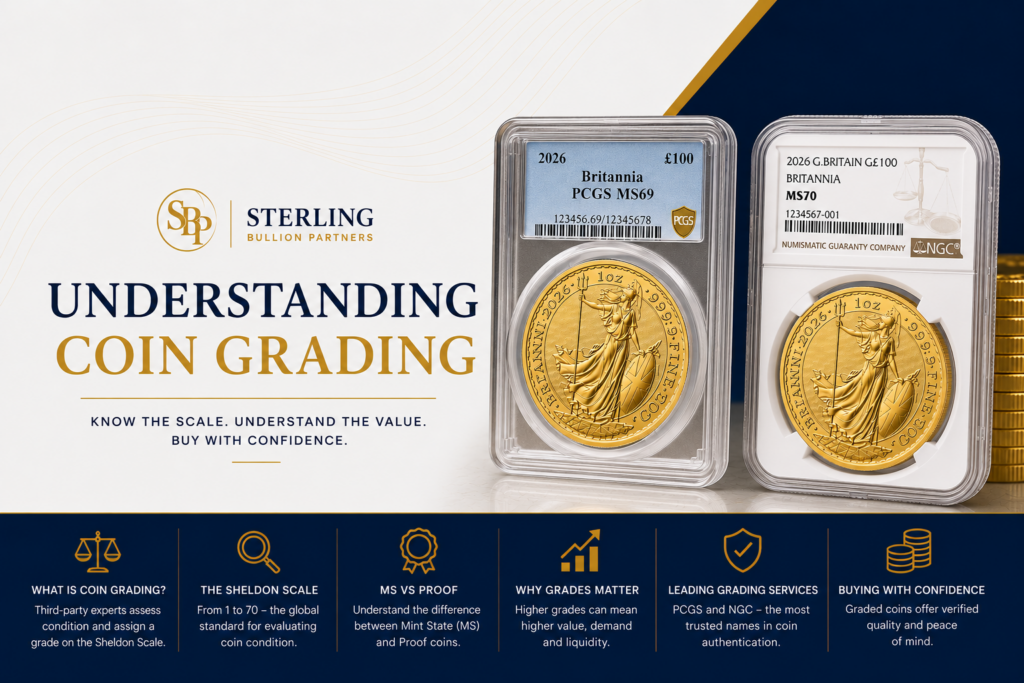
Understanding Coin Grading
Jul
Understanding Coin Grading
About this guide
This guide is part of Sterling Bullion Partners’ educational hub. It explains how coin grading works, why it matters, and how to navigate the world of graded coins. It is not financial advice. The guide was last reviewed on 9 July 2026 and reflects UK tax law and market practices at that date. Always seek professional advice and check current regulations before making decisions.
Who is this guide for?
This article is aimed at first‑time buyers, collectors and investors who want to understand how the condition of a coin affects its value. Whether you are comparing Mint State (MS) coins, considering paying a premium for a Proof (PF) example or simply trying to work out whether grading is worth the cost, this guide will give you the knowledge to make informed decisions.
Table of contents
- Why coin grading matters
- Origins of the 1–70 grading scale
- How the Sheldon scale works
- Key factors that determine a coin’s grade
- Strike types and prefixes: MS, PF and SP
- Mint State vs Proof coins
- Raw coins vs certified coins
- Third‑party grading services
- Submitting coins for grading
- Population reports and rarity
- Understanding MS69 vs MS70
- PCGS vs NGC
- When to grade and when not to
- Frequently asked questions
- Conclusion
Why coin grading matters
Quick answer. Coin grading assigns an objective score to a coin’s physical condition. This score helps buyers and sellers agree on a fair price and protects both parties by providing a standardised description of the coin’s state. Without grading, sellers could exaggerate the condition of a coin and buyers could overpay.
Did you know? The highest grade on the internationally recognised Sheldon scale is 70. According to the Numismatic Guaranty Company (NGC), a coin graded MS/PF 70 has no post‑production imperfections when viewed at 5× magnification . Coins graded MS/PF 69 may have tiny imperfections barely visible without magnification .
Common mistake. Many new collectors assume a coin described as “uncirculated” must be perfect. In reality, Mint State (MS) coins are graded on a scale from 60 to 70, and an MS‑60 coin may show numerous marks and abrasions . Always check the specific numeric grade rather than relying on generic terms.
Key takeaway. Grading provides a universal language for describing coins. Higher grades generally command higher prices because they reflect better preservation and eye appeal. Understanding the grading scale helps you avoid overpaying and recognise value.
Origins of the 1–70 grading scale
Modern coin grading uses the Sheldon scale, developed by numismatist William Sheldon in the 1940s. It assigns coins a numerical grade from 1 (poor) to 70 (perfect). The scale was adopted by professional grading services such as NGC and PCGS when they began operating in the 1980s and is now the industry standard . Collectors value the Sheldon scale because it allows coins to be compared across dealers and auctions.
The Royal Canadian Mint notes that grading helps give coins “an objective score” so buyers can judge the state of preservation and strike, even though grading can be subjective . Without an accepted scale, sellers might describe coins as “fine” or “extremely fine” without clarity. The 1–70 system solves this by assigning a unique number to each grade.
How the Sheldon scale works
The Sheldon scale covers every level of preservation, from coins that are barely recognisable to flawless specimens. Grades below 60 describe circulated coins, while grades 60–70 describe Mint State (uncirculated) or Proof coins .
Circulated grades (1–59)
- Poor (PO‑1) to Fair (FR‑2) – The coin is heavily worn, and design details are barely visible. These coins are often of historical interest but have minimal numismatic value.
- Good (G‑4 to G‑6) – Major design details are clear but worn. Legends may be partly readable.
- Very Good (VG‑8 to VG‑10) – Design elements are clear, though hair and ribbon details are flattened.
- Fine (F‑12 to F‑15) – Most devices and lettering are sharp, though light wear is visible. At F‑12, major elements are outlined. At F‑15, inner details are somewhat distinct .
- Very Fine (VF‑20 to VF‑35) – The coin shows moderate wear on high points but retains much detail. This is a desirable circulated grade.
- Extremely Fine (EF/XF‑40 to EF/XF‑45) – Only light wear is visible on the highest points. Most surfaces retain their original luster. Collectors often seek coins at this grade because they offer good detail without the premium of Mint State examples.
- About Uncirculated (AU‑50 to AU‑58) – Slight wear on high points but almost full details . These coins have nearly complete luster and are close to Mint State.
Uncirculated (Mint State) grades (60–70)
Uncirculated coins have no wear from circulation. Grades are determined by strike quality, number of marks, luster and eye appeal:
|
Grade |
Description |
|---|---|
|
MS‑60 |
Weak or average strike with no trace of wear but numerous abrasions, hairlines and large marks . |
|
MS‑61 |
Weak or average strike with no wear. More marks and larger abrasions than MS‑62 . |
|
MS‑62 |
Slightly weak or average strike; no wear; more or larger abrasions than MS‑63 . |
|
MS‑63 |
Slightly weak or average strike; moderate abrasions and hairlines . |
|
MS‑64 |
Average or better strike with several obvious marks or hairlines and minuscule imperfections . |
|
MS‑65 |
Well struck with moderate marks or hairlines . |
|
MS‑66 |
Very well struck with minimal marks and hairlines . |
|
MS‑67 |
Sharply struck with only a few tiny imperfections . |
|
MS‑68 |
Very sharply struck with only minuscule imperfections . |
|
MS‑69 |
Fully struck with nearly imperceptible imperfections . |
|
MS‑70 |
Perfect coin with no post‑production imperfections under 5× magnification . This grade is exceedingly rare, especially for older coins, because even minor abrasions disqualify a coin from MS‑70 status. |
Proof grades
Proof coins are specially struck using polished dies and planchets to create mirror‑like surfaces and frosted designs . They are graded on the same 1–70 scale but use the prefix PF or PR (for Proof). Proof coins are produced for collectors, not for circulation, and may display deeper cameo contrasts and higher quality strikes. Proof 70 coins are perfect under 5× magnification; Proof 69 coins have nearly imperceptible imperfections.
Key factors that determine a coin’s grade
Grading is more than just counting scratches. Professional graders consider several factors:
- Strike quality. Coins struck with greater pressure and better dies will show sharper details. Weak strikes can result from worn dies or low pressure and are common on some issues.
- Surface preservation. The number, size and location of marks, abrasions and hairlines strongly influence grade. A few small marks in protected areas may have less impact than a single deep mark on the main device .
- Luster and reflectivity. Luster refers to the way light reflects off a coin’s surface. Mint State coins should have original mint bloom; Proof coins display mirrored fields. Loss of luster indicates wear.
- Colouration (toning). Natural toning can enhance eye appeal; unattractive or artificial toning may reduce grade. Colour is often a personal preference but is considered in the overall assessment .
- Eye appeal. Overall attractiveness, including balance of toning, strike and surface quality, can influence the grade . Two coins with the same technical grade may vary in value due to differences in eye appeal.
These components form the basis for professional grading. The Rare Gold Coins article emphasises that the location of marks matters – a distracting scratch across a coin’s portrait lowers the grade more than a similar scratch in a field . Likewise, the deigoldandsilvercoins guide notes that graders consider wear, luster, strike quality and surface condition .
Strike types and prefixes: MS, PF and SP
Professional grading services use prefixes to indicate strike types. According to NGC, the most common are:
- MS (Mint State): coins struck for circulation; grades 60–70 apply .
- PF or PR (Proof): coins struck for collectors using special dies, resulting in mirror‑like fields . Proof coins often feature cameo contrasts and may be more limited in mintage.
- SP (Specimen): a hybrid between Mint State and Proof. Specimen coins are produced more carefully than circulation issues but do not meet the strict definition of Proof .
Understanding these prefixes helps interpret grades such as MS‑65, PF‑69 or SP‑70. A PF‑69 coin is a Proof coin with nearly imperceptible imperfections, while an MS‑69 coin is a circulation‑strike coin with similar quality.
Mint State vs Proof coins
Mint State (MS) coins are made for circulation. They are struck once on standard planchets and may have minor imperfections or marks from handling during production. They are graded MS‑60 to MS‑70 depending on how well they were struck and preserved.
Proof (PF or PR) coins are made for collectors. They are struck multiple times using specially polished dies and planchets to produce a sharp, frosted design on a mirror‑like background . Proof coins often come in presentation packaging and may have limited mintages.
Specimen (SP) coins fall between MS and Proof. They are made with extra care but do not have the fully mirrored fields of proof coins .
Raw coins vs certified coins
A raw coin is a coin that has not been professionally graded or encapsulated. Raw coins are sold loose in capsules or flips. Their condition is assessed by the buyer and seller.
In contrast, a certified coin has been examined by an independent grading service such as NGC or PCGS. The coin is assigned a grade on the Sheldon scale and sealed in a tamper‑evident holder (commonly called a slab). Certification provides several benefits:
- Authenticity assurance. Reputable grading services verify that the coin is genuine. NGC notes that it provides an “accurate, consistent and impartial assessment” backed by a guarantee .
- Market confidence. Buyers can be confident that the grade is impartial. The Royal Canadian Mint explains that grading gives an objective score to indicate state of preservation and strike .
- Protection. Encapsulation protects coins from environmental damage and handling.
- Liquidity. Certified coins often sell more easily and at higher prices because buyers trust the grade.
However, certification costs money. Not all coins warrant grading; for lower‑value coins, the cost of grading may exceed the potential increase in value.
Third‑party grading services
The two most widely recognised grading services are Numismatic Guaranty Company (NGC) and Professional Coin Grading Service (PCGS). Both use the 1–70 scale and assign strike types (MS, PF, SP). Each service has its own holders, labels and population reports. Some collectors prefer one over the other, but both are respected in the market.
- NGC operates internationally and is known for its extensive grading of modern world coins. It provides an online verification tool so buyers can confirm a coin’s certification number and grade.
- PCGS is particularly well established in the United States and is widely used for classic US coins. It also offers population reports and a verification database.
In the UK, many dealers are authorised to submit coins to both NGC and PCGS. If you wish to grade a coin, you can either become a direct member of these services or use a dealer submission service. Always choose a reputable dealer and enquire about fees and turnaround times.
Submitting coins for grading
If you decide to submit a coin for grading, follow these general steps:
- Assess whether grading is worthwhile. Coins with low value or heavy wear may not benefit from professional grading because the fee can exceed any value increase.
- Choose a grading service and membership option. Both NGC and PCGS offer submission memberships or accept submissions through authorised dealers. In the UK, many bullion and numismatic dealers offer a grading submission service.
- Prepare your coin. Do not clean or polish the coin; cleaning can reduce the grade. Place the coin in a plastic flip or capsule and ensure it is secure.
- Complete submission forms. Specify the coin’s details, desired service level (e.g., economy, standard, express) and any special designations you wish to request (such as Early Release or First Strike).
- Package and ship securely. Use a tracked and insured service. Follow the grading company’s instructions for packaging.
- Wait for grading. Turnaround times vary from a few weeks to several months depending on the service level. Once graded, your coin will return in a slab with its grade and certification number.
Population reports and rarity
Population reports list the number of coins graded at each grade for a given issue. They help collectors understand the relative rarity of high‑grade coins. A coin with only a handful of MS‑70 or PF‑70 examples may command a significant premium over a coin with thousands of specimens in that grade. Population reports are available from both NGC and PCGS through their websites.
Note that population figures change over time as more coins are graded. A population report does not guarantee a coin’s rarity but provides a useful data point when assessing value.
Understanding MS69 vs MS70
Many collectors ask whether the difference between MS‑69 and MS‑70 (or PF‑69 and PF‑70) is worth the premium. The distinction is subtle:
- MS/PF 70 coins have no post‑production imperfections at 5× magnification . They are the finest quality possible and are rare, particularly for older issues.
- MS/PF 69 coins are fully struck with nearly imperceptible imperfections . Under magnification, minor marks or planchet issues may be visible.
The price difference between MS‑69 and MS‑70 can be significant. An article on deigoldandsilvercoins.com notes that the jump from lower grades to MS‑70 can drastically increase value . However, the market premium depends on the specific coin, mintage and demand. For common modern coins, the difference may be modest, while for scarce issues it can be substantial.
Common reasons to choose MS‑69 over MS‑70
- Better value. MS‑69 coins are usually more affordable and still nearly flawless to the naked eye. The difference between a 69 and 70 is often imperceptible without magnification.
- Greater supply. More coins achieve MS‑69 than MS‑70, so they are easier to find.
- Lower downside risk. A small dip in collector demand for top grades can affect MS‑70 premiums more than MS‑69 premiums.
When MS‑70 may be desirable
- Limited issues. For commemorative or low‑mintage coins, MS‑70 status may be truly scarce and thus command a larger premium.
- Registry sets. Collectors competing in registry set programmes often seek the highest graded examples.
PCGS vs NGC
Both PCGS and NGC are respected grading services, but there are minor differences:
- Market perception. In some markets, PCGS‑graded coins command slightly higher premiums for US classic coins, while NGC is preferred for world and modern issues. In the UK, both services are widely accepted.
- Holders and labels. Each service uses different slab designs and special labels (e.g., First Releases, Early Releases, bullion designations). Some collectors have personal preferences.
- Population reports. Each service maintains its own population data. A coin graded MS‑70 by PCGS will not appear in NGC’s population report and vice versa.
- Guarantees. Both companies guarantee that coins are genuine and that the grade is accurate at the time of grading. They may compensate the owner if a coin is later shown to be over‑graded (subject to terms and conditions).
Ultimately, choice often comes down to personal preference or the norms within a collecting niche. Many UK buyers collect coins graded by both services.
When to grade and when not to
Coin grading is not always necessary. Consider the following guidelines:
- Grade high‑value or rare coins. If a coin is valuable, rare or has the potential to appreciate, professional grading can help preserve and verify its condition, increasing its resale value.
- Do not grade low‑value coins. Coins worth less than the grading fee (plus shipping and insurance) are usually not worth grading. Instead, enjoy them raw or purchase an already‑graded example.
- Beware of cleaned coins. Cleaning a coin can reduce its grade and value. If a coin has been cleaned, it may receive a “Details” grade, which notes the problem but does not assign a numeric grade.
- Collect for enjoyment. Not every collector focuses on maximum condition. Some enjoy raw coins in circulated grades. If you are collecting for fun rather than investment, professional grading may not be necessary.
Frequently asked questions
What is coin grading?
Coin grading is the process of assessing a coin’s condition and assigning it a grade on the Sheldon scale, which ranges from 1 to 70 . Professional grading services use experienced graders to evaluate coins and encapsulate them in tamper‑evident holders.
Does grading increase a coin’s value?
Grading can increase a coin’s value by providing authenticity and confirming its condition. Higher grades generally command higher prices, and certified coins often sell more easily. However, the grading fee may exceed any value increase for low‑value coins. Evaluate whether grading is economically sensible for each coin.
How are grades like AU‑58, MS‑64 and PF‑70 different?
Grades indicate both the coin’s condition and strike type. AU‑58 means About Uncirculated with slight wear on high points ; MS‑64 means Mint State with several obvious marks ; PF‑70 means a Proof coin with no post‑production imperfections at 5× magnification .
What’s the difference between Proof and Mint State coins?
Mint State coins are struck for circulation and graded MS‑60 to MS‑70. Proof coins are struck for collectors using polished dies and are graded PF‑60 to PF‑70. Proof coins often feature mirror‑like fields and frosted devices .
Should I buy only certified coins?
Certified coins offer assurance of authenticity and condition, but raw coins can be enjoyable and less expensive. Many collectors buy raw coins for fun and certified coins for investment or high‑grade collections. Choose based on your goals and budget.
How do I verify a graded coin’s authenticity?
Both NGC and PCGS provide online databases where you can enter a coin’s certification number to confirm the grade and see population data. Always verify before purchasing a slabbed coin from a secondary market.
Are UK bullion coins graded the same way as numismatic coins?
Yes. UK bullion coins such as the Britannia or Sovereign can be graded by NGC or PCGS. A Britannia graded MS‑70 is considered perfect, just like any other coin. The same 1–70 scale applies across world mints.
Is it possible to upgrade a coin’s grade?
Once a coin has been graded and encapsulated, its grade is fixed. Resubmitting the same coin to a grading service could result in a higher or lower grade, but cracking and resubmitting is risky and usually only attempted when there is a realistic chance of a significant upgrade.
Should I remove a coin from its slab?
Removing a coin from its slab voids the certification and may expose it to damage. Only remove a coin if you understand the risks and have a compelling reason, such as resubmitting for a higher grade.
Conclusion
Understanding coin grading is essential for anyone serious about collecting or investing in coins. The 1–70 Sheldon scale provides a universal language for describing condition, while professional grading services such as NGC and PCGS add authenticity and market confidence. Knowing the difference between grades (e.g., MS‑69 vs MS‑70), strike types (Mint State vs Proof vs Specimen) and the factors that influence grade (strike, surface preservation, luster, colour and eye appeal) empowers you to make informed decisions. Grading is not mandatory for every coin, but when used wisely it helps protect your investment and simplifies buying and selling.
For further reading, explore our related guides on Bullion vs Certified Coins, PCGS vs NGC and MS69 vs MS70.
