

Guides
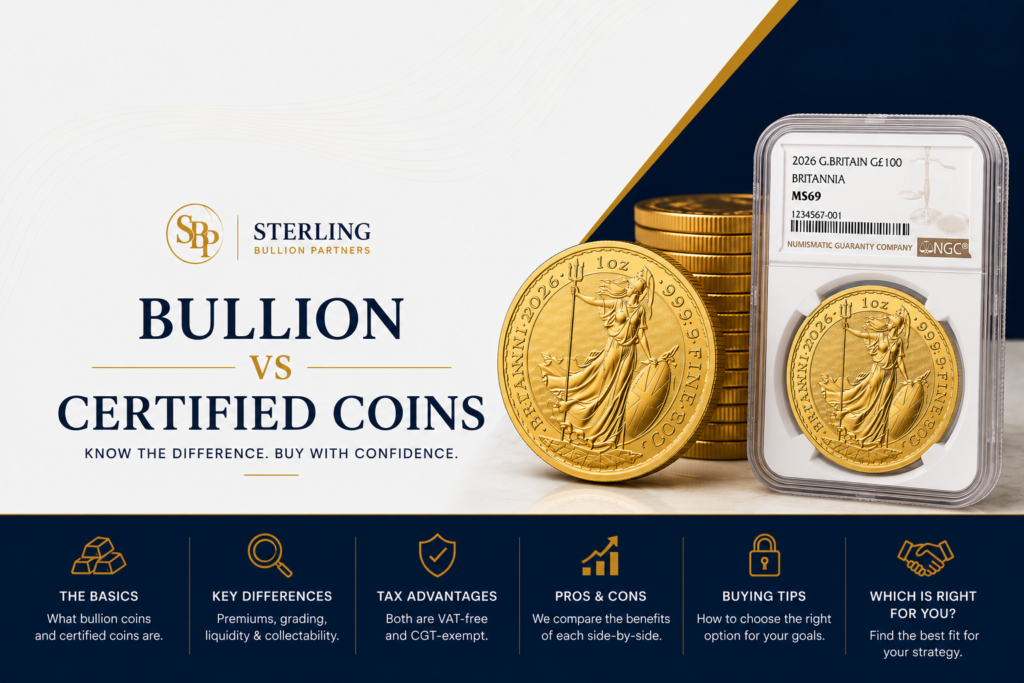
Bullion vs Certified Coins: Which Should You Buy?
Jul
Bullion vs Certified Coins: Which Should You Buy?
About this guide
Sterling Bullion Partners Knowledge Centre — Last reviewed: 9 July 2026
Educational disclaimer: This guide is for general education and does not constitute financial, tax or investment advice. Always seek independent advice and consider your personal circumstances and risk appetite before purchasing precious metals.
Introduction
When people first learn about buying physical gold, they quickly discover there are two broad categories of coins on the market:
- Bullion coins, which are mass‑produced by national mints and bought primarily for their metal content.
- Certified (or “graded”) coins, which have been assessed by an independent third‑party service, given a numerical grade and sealed in a tamper‑evident plastic “slab”. These can be proof coins, commemoratives or even ordinary bullion coins that have been graded.
This guide explains what both terms mean, how grading works, and how to decide whether bullion coins, certified coins or a combination of both suits your objectives. By the end you should understand the differences in premiums, liquidity, tax treatment, storage, collectability and resale value.
Quick Answer
Should I buy bullion or certified coins?
Bullion coins are ideal if you want to buy physical gold for its metal value at the lowest possible premium and maintain maximum liquidity. Certified coins appeal to collectors and investors willing to pay extra for independently verified authenticity and high grades. They can command higher premiums and may appreciate separately from the gold price, but they are less liquid and require specialist knowledge.
Did You Know?
A “certified coin” is simply a coin that has been authenticated and graded by a professional service . Certification doesn’t change the coin’s inherent metal content, but it does provide assurance of its authenticity and condition, which many collectors value.
Common Mistake
Many new buyers think certification automatically makes a coin more valuable. In reality, certification verifies a coin’s grade, but whether that translates into a higher price depends on rarity, demand and market conditions .
Key Takeaway
Bullion coins: Lower premiums, highly liquid, price closely tracks gold spot price, ideal for straightforward investing.
Certified coins: Higher premiums, appeal to collectors, price influenced by grade and demand, suitable for those who value numismatics or want to diversify into rare coins.
Table of contents
- What are bullion coins?
- What are certified coins?
- How coin grading works
- Bullion vs certified coins: side‑by‑side comparison
- Premiums and pricing
- Liquidity and resale
- Storage, security and insurance
- Collectability and numismatic appeal
- Tax considerations (VAT & Capital Gains Tax)
- Who should buy bullion coins?
- Who should buy certified coins?
- Buying tips and avoiding fakes
- Frequently asked questions
- Conclusion & next steps
What are bullion coins?
Bullion coins are government‑issued gold pieces minted primarily for investment. They contain a specific weight and purity of gold and are sold close to the current spot price. The Royal Mint’s Britannia and Sovereign are well‑known examples in the UK. Other notable bullion coins include the American Eagle, Canadian Maple Leaf and South African Krugerrand.
Characteristics of bullion coins
- Investment purpose: Bullion coins are designed for investors who want exposure to physical gold. They are not rare; national mints produce hundreds of thousands to millions of coins annually .
- Legal tender: In the UK, bullion coins like the 1‑oz Britannia and Sovereign are legal tender, which means they have face values (£100 and £1 respectively). Their legal tender status makes them exempt from Capital Gains Tax (CGT) when sold by UK residents, provided current legislation continues .
- Purity and weight: Bullion coins typically contain .999 or .9167 fine gold. They are produced to standard weights (1 oz, ½ oz, ¼ oz, 1/10 oz) and sometimes fractional sizes down to 1 g. The purity is stamped on the coin.
- Uncirculated finish: Bullion coins are struck once using standard minting techniques. They may have minor imperfections, edge nicks or scuffs from production. This is acceptable, as the focus is on metal content rather than flawless appearance .
- Low premium: Prices closely track the underlying gold price with a small premium covering minting and distribution. Larger coins typically have lower premiums per ounce than smaller denominations.
- High liquidity: Bullion coins are widely recognised and easy to buy and sell around the world. Dealers base their buy and sell prices on the gold spot price minus/plus a small margin.
Pros of bullion coins
- Lowest cost over spot: You pay the smallest premium relative to the gold price. Premiums decrease with larger coin sizes and when buying multiple coins.
- Ease of resale: Dealers and investors readily buy bullion coins because they recognise and trust the designs and mints.
- Tax advantages in the UK: UK legal tender coins (e.g., Britannias and Sovereigns) are exempt from CGT; both coins and bars that meet HMRC’s definition of investment gold are VAT‑free .
- Simplicity: Bullion coins require no specialist knowledge; you’re buying gold weight at a known purity.
Cons of bullion coins
- Little numismatic premium: Unless a particular year has a low mintage or special design, bullion coins’ value is largely tied to the spot price. There’s little opportunity for price appreciation beyond gold’s movements.
- Lesser aesthetics: Bullion coins have a standard finish with minor imperfections . They lack the mirror‑like surfaces and frosted details of proof coins.
- Counterfeiting risk: Because bullion coins are valuable and widely recognised, they are targeted by counterfeiters. Simple tests (weight, dimensions, magnetism) can help, but advanced fakes require professional verification.
What are certified coins?
A certified coin is any coin that has been authenticated and graded by a professional third‑party grading service. After examination, the coin is sealed in a tamper‑evident plastic holder with a label detailing its grade and a unique serial number. The slab provides confidence that the coin is genuine and the grade hasn’t been altered .
Key points about certified coins
- Definition: Certified coins are authenticated and graded by independent services such as the Professional Coin Grading Service (PCGS) and Numismatic Guaranty Corporation (NGC). A coin in a slab is referred to as “certified” or “graded” .
- Purpose: Certification provides impartial assurance of a coin’s authenticity and condition. Without a grade, buyers must rely on the seller’s description, which can be subjective and inaccurate .
- Grading scale: Most grading services use a 70‑point numerical scale where MS (Mint State) refers to uncirculated coins and PF (Proof) to proof issues. A grade of 70 represents a coin with no visible imperfections; a 60 is uncirculated but may have noticeable marks.
- Protective slab: Certified coins are encapsulated in clear, tamper‑resistant holders. The slab label lists the coin’s year, mint mark, denomination, grade, and sometimes additional designations (e.g., “First Strike” or “Early Releases”).
- Third‑party reputation: Different grading companies have different grading standards. The market generally pays higher premiums for coins graded by more stringent companies, such as PCGS and NGC .
Pros of certified coins
- Guaranteed authenticity: Certification removes doubts about whether a coin is genuine and not altered or cleaned. Major grading services use advanced imaging and metallurgical analysis to detect counterfeits and alterations.
- Consistent grading: Certified coins have a universally recognised grade. When you sell, potential buyers know exactly what grade they are purchasing; there’s no need to haggle over subjective descriptions .
- Protection: The plastic slab protects the coin from environmental damage, fingerprints and scratching.
- Potential for higher premiums: Rare or high‑grade coins can sell for significant premiums above melt value. Certified coins with top grades (e.g., MS70 or PF70) are especially prized by collectors and may appreciate independent of gold’s price .
- Numismatic appeal: Certified coins often include special issues (proofs, commemoratives, low mintage years) that have historical or artistic appeal.
Cons of certified coins
- Higher purchase price: Certification adds costs. You’re paying for grading, encapsulation and the premium associated with the coin’s grade and rarity.
- Reduced liquidity: While there is an active market for graded coins, it is smaller and less liquid than the bullion market. Not all dealers handle certified coins, and it may take longer to find a buyer willing to pay the desired premium.
- Subjectivity and grading inconsistencies: Different grading companies can assign different grades to the same coin, and even within a company, grading can vary . A coin remains certified regardless of who grades it, but the market may discount coins from less reputable services.
- Not always worth it for common coins: Certification may not add much value for common modern bullion coins. Many modern bullion coins graded MS69 sell only slightly above their raw counterparts. MS70 coins command a higher premium, but high MS70 populations mean they’re not rare .
- Larger storage footprint: Certified coins in slabs take up more space than raw bullion coins of the same weight.
How coin grading works
Coin grading involves assessing a coin’s condition on a numerical scale and verifying its authenticity. Here’s how the process typically works:
- Submission to a grading service: Owners send coins to a professional grading service such as PCGS, NGC, ANACS or ICG. The services charge a fee based on the coin’s value and turnaround time.
- Authentication: Experts verify that the coin is genuine and has not been altered or damaged. They use tools like microscopes, X‑ray fluorescence, weight and diameter measurements and reference databases.
- Grading: The coin is assigned a grade on a 70‑point scale. Uncirculated coins (Mint State, MS) are graded from MS60 to MS70; proof coins (PF or PR) are graded from PF60 to PF70. The grade reflects the number of imperfections and overall eye appeal.
- Encapsulation (“slabbing”): The graded coin is placed in a tamper‑evident holder with a label showing the grade, certification number and other descriptors. The slab is sealed to prevent tampering.
- Certification database: Each coin receives a unique serial number. Buyers can verify the coin’s details on the grading company’s database using this number.
Major grading companies
The two most widely recognised grading services globally are PCGS (Professional Coin Grading Service) and NGC (Numismatic Guaranty Corporation). They are widely respected; coins graded by these companies are unlikely to have their grades contested .
Other services include ANACS (American Numismatic Association Certification Service) and ICG (Independent Coin Grading Company). While their grades are considered legitimate, the market may value them differently due to perceived grading strictness .
Bullion vs certified coins: side‑by‑side comparison
The table below summarises the key differences between bullion and certified coins. Remember, some coins fall into both categories: a bullion coin can also be certified (for example, an MS70 Britannia). In such cases, the coin retains the attributes of both types.
|
Feature |
Bullion Coins |
Certified Coins |
|---|---|---|
|
Primary purpose |
Investment in metal content; price tracks spot |
Collectability and verified grade; value may include numismatic premium |
|
Minting |
Mass‑produced; single strike; standard finish |
High‑grade strikes or proofs; individually graded; often multiple strikes with polished dies for proof coins |
|
Premiums |
Low premiums; larger sizes have lower premiums |
Higher premiums reflecting grading fees and rarity; high‑grade coins can command significant premiums |
|
Pricing tied to spot |
Yes; closely follows gold price |
No; price influenced by grade, rarity and collector demand; may appreciate independently of spot |
|
Tax |
Legal tender bullion coins (e.g., Britannias, Sovereigns) are VAT‑free and CGT‑exempt in the UK |
Same tax treatment as bullion if legal tender; certification doesn’t affect tax status |
|
Liquidity |
High; widely traded; easy to sell |
Moderate; specialist market; may take longer to find buyer |
|
Storage |
Compact; easy to store in tubes or capsules |
Bulky slabs; require more space and careful storage |
|
Authentication |
Requires tests (weight, dimensions, magnetism) or trusted dealer |
Authentication guaranteed by third‑party grading service |
|
Counterfeiting risk |
Higher risk; must be vigilant |
Lower risk; slabs and certification deter counterfeiting |
|
Collectability |
Generally low; some years/designs become collectible |
High; includes proof coins, rare dates, special labels and designations |
|
Typical buyers |
Investors seeking cost‑effective gold exposure |
Collectors, investors interested in numismatics, those who value assurance of grade and authenticity |
Premiums and pricing
Bullion premiums
Bullion coins are priced close to the gold spot price. Premiums cover minting costs, distribution, insurance and dealer margins. Larger bullion coins usually have lower premiums per ounce than smaller coins. For example, a 1‑oz Britannia will have a lower percentage premium than a 1/10‑oz coin. When you buy multiple coins, you can often negotiate slightly lower premiums.
Certified coin premiums
Certified coins usually carry higher premiums than raw bullion. The extra cost includes:
- Grading fees: Professional grading services charge fees based on the coin’s value and desired turnaround time.
- Rarity and grade: Coins with high grades (MS70, PF70) or those from low‑mintage years command higher prices. Collectors pay premiums for coins with low population reports (few examples in that grade).
- Company reputation: Coins graded by stricter services may sell for more .
- Market demand: Certain series (e.g., early Sovereigns, commemorative proofs) attract strong collector interest, boosting premiums.
When certification adds value
Certification can add value when a coin’s grade is uncertain or when the population of high‑grade coins is low. Older proof coins and rare dates often benefit substantially from certification . For common modern bullion coins, certification may not justify the expense, because large numbers of coins achieve perfect grades and therefore aren’t scarce .
Liquidity and resale
Selling bullion coins
Bullion coins are the most liquid form of physical gold. You can sell them to high street dealers, specialist bullion retailers or online dealers. Prices are based on the current spot price minus a small dealer margin. Because bullion coins are widely recognised, dealers can easily test and purchase them. This makes them ideal for investors who want to move in and out of the market quickly.
Selling certified coins
Certified coins are less liquid and the market is more specialised. To achieve the best price, you may need to sell to numismatic dealers, attend coin shows or list coins on specialist auction sites. The selling process may take longer than bullion. However, if a coin is in high demand or has a low population in a top grade, you can achieve a significant premium over its gold content.
Be aware that not all dealers buy certified coins at the same level. Some dealers focus on bullion and may offer only melt value for certified coins. Others might value the slab and grade but will typically pay less than the retail price if you need a quick sale.
Pricing fluctuations
Bullion coin prices closely follow the gold spot price, rising and falling with the market. Certified coins can be less volatile because the numismatic premium may cushion price fluctuations. However, they can also be harder to sell quickly in a declining market .
Storage, security and insurance
Storing bullion coins
Bullion coins are relatively easy to store. You can keep them in their original plastic capsules or tubes. Most investors store bullion coins in a safe deposit box at a bank or in a home safe. If storing at home, consider spreading storage across multiple secure locations to reduce theft risk and ensure adequate insurance coverage.
Storing certified coins
Certified coins come in larger plastic slabs, so they take up more room. You can store them in dedicated slab boxes or coin cabinets. Because these coins often carry higher premiums, it’s important to store them securely and avoid scratches or damage to the slab. Insurance may need to reflect the numismatic value rather than just the metal content.
Security considerations
Both bullion and certified coins should be insured. When you insure bullion, you can usually declare the weight and value. For certified coins, you may need to list each coin’s certification number, grade and insured value. The slab label serves as documentation for the insurer.
Collectability and numismatic appeal
Bullion coins
Most bullion coins have little numismatic appeal because they are mass‑produced. However, some years or specific designs become sought after when mintages are low or design changes are introduced. For example, certain special‑edition Britannias or early Sovereigns may attract collector interest.
Proof and special‑issue coins
Proof coins are struck with polished dies and multiple strikes to achieve a mirror‑like finish . They are often produced for collectors and sold in presentation boxes with certificates of authenticity. When certified, proof coins can command higher premiums, particularly if the mintage is low or the coin achieves a top grade. Older proof coins (particularly pre‑1933 issues) can benefit substantially from certification .
Certified bullion coins
Bullion coins can be graded too. For instance, a modern Britannia graded MS70 might be sold at a premium because the grade indicates a flawless example. However, because minting technology is so consistent today, many bullion coins achieve perfect grades . High populations of MS70 coins limit scarcity and reduce the potential upside. MS69 graded coins often sell only slightly above raw bullion; the grading cost may exceed the premium achieved.
Population reports
Grading companies publish population reports showing how many coins exist in each grade. Before buying a certified coin for investment, check the population report to gauge rarity. A coin with only a handful of examples in MS70 may warrant a higher premium, whereas a coin with tens of thousands of MS70 examples might not.
Tax considerations (VAT & Capital Gains Tax)
The tax treatment of gold coins in the UK depends on whether the coin is legal tender and meets HMRC’s definition of investment gold.
VAT
HMRC classifies “investment gold” as gold bars or coins that are of a purity not less than 995/1000 and which are traded at a price that does not exceed 180 % of the gold value. Investment gold is exempt from Value Added Tax (VAT) . This means both bullion and certified coins meeting these criteria are VAT‑free.
Capital Gains Tax (CGT)
CGT applies when you sell an asset for more than you paid and realise a gain. In the UK, legal tender coins produced by the Royal Mint, such as Britannias and Sovereigns, are exempt from CGT for UK residents. This exemption applies whether or not the coin is certified because it is the legal tender status, not the grading, that determines the CGT treatment . Gold bars (even when stamped with weight and purity) and foreign legal tender coins (e.g., Krugerrands) are liable for CGT.
Personal circumstances
Tax laws can change, and individual circumstances vary. Always consult a professional tax adviser for advice tailored to your situation.
Who should buy bullion coins?
Bullion coins suit buyers who:
- Want to invest in physical gold at the lowest possible premium. You’re focused on metal content rather than collectability.
- Seek high liquidity. You intend to buy and sell with minimal friction; bullion coins have the broadest market.
- Prefer simplicity. You don’t want to learn about grading, population reports or numismatic trends.
- Value tax efficiency. Legal tender bullion coins are CGT‑exempt in the UK and VAT‑free as investment gold .
- Plan to store gold in bulk. Bullion coins are compact and efficient to store.
For these reasons, bullion coins are often recommended for first‑time gold buyers and those building a core position in physical gold.
Who should buy certified coins?
Certified coins suit buyers who:
- Enjoy collecting. You appreciate artistry, historic significance and low mintage coins. Certified coins allow you to diversify into different designs and eras.
- Value guaranteed authenticity and grade. Certification provides confidence when buying remotely or from less established sources .
- Seek potential numismatic appreciation. Some certified coins, particularly rare proof coins or low‑mintage bullion, can appreciate beyond gold’s price movements.
- Have a longer time horizon. Certified coins can take longer to sell and often perform best over years rather than months.
- Can evaluate population reports. You are willing to research how many coins exist in a given grade and compare grading company reputations to ensure you’re paying an appropriate premium.
Certified coins are less suitable if your primary goal is acquiring maximum gold weight per pound or if you need to liquidate quickly.
Buying tips and avoiding fakes
Whether you buy bullion or certified coins, follow these best practices:
- Use reputable dealers. Look for dealers with established reputations, memberships in professional associations (e.g., BNTA or LBMA) and positive customer reviews. Be wary of online marketplaces without clear provenance.
- Check authentication features. For bullion coins, verify weight, diameter and thickness. Look for advanced security features such as micro‑text, holographic images and radial lines on modern coins.
- Verify certification numbers. If buying certified coins, use the grading company’s online verification tool to confirm the coin’s serial number and grade.
- Understand premiums. Compare prices from several dealers. For bullion, premiums should be within a narrow range. For certified coins, check population reports and recent auction results to gauge fair value.
- Consider insurance and storage. Decide where you will store your coins and ensure they are insured for their full value.
- Keep documentation. Retain invoices, certificates and packaging. This helps when selling and can support insurance claims.
- Avoid “too good to be true” deals. Counterfeit coins and fake slabs exist. If a deal seems excessively cheap compared to market prices, proceed with caution and consult an expert.
Frequently asked questions
Are certified coins always a better investment than bullion?
No. Certified coins can be great investments when they are rare or have particularly high grades, but for common modern bullion coins, certification may not add much value . Bullion coins offer straightforward exposure to gold at the lowest possible premium.
Does grading a coin affect its tax treatment in the UK?
Certification does not affect VAT or CGT status. The tax treatment depends on whether the coin qualifies as investment gold and, for CGT, whether it is UK legal tender .
Should I grade my bullion coins?
For most modern bullion coins, the cost of grading often exceeds the premium you would receive for a certified coin . Grading may make sense for coins with potential numismatic value (e.g., proof coins or scarce dates) or if you suspect the coin is in exceptional condition.
What does MS69 or PF70 mean?
These are grades on the 70‑point scale. MS stands for “Mint State” (uncirculated), and PF/PR stands for “Proof”. A grade of 70 indicates a flawless coin with no post‑production imperfections; 69 indicates a coin with nearly imperceptible flaws.
What is a “First Strike” or “Early Release” designation?
Some grading companies label coins as “First Strike” or “Early Release” if they were shipped from the mint within a specified period after launch . These designations can enhance collectability but have no official legal definition.
Which grading company is best?
PCGS and NGC are the most widely recognised services . They command higher premiums because buyers trust their grading standards. ANACS and ICG are also respected but may attract lower premiums.
How do I verify a certified coin?
Use the certification number printed on the slab to look up the coin on the grading company’s website. You should see the coin’s details and an image. If the information doesn’t match, the slab may be counterfeit.
Conclusion & next steps
Bullion coins and certified coins both offer ways to own physical gold, but they serve different objectives. Bullion coins provide straightforward exposure to gold at low premiums and high liquidity—ideal for most first‑time buyers and investors focusing on the metal’s intrinsic value. Certified coins, on the other hand, appeal to collectors and those who value guaranteed authenticity and exceptional quality. They can offer significant upside when rarity and grade align, but they come with higher premiums and lower liquidity.
Choosing between bullion and certified coins isn’t an either‑or decision. Many experienced buyers hold both: bullion for their core gold holdings and certified coins for their numismatic interests. Whichever route you take, ensure you buy from reputable sources, understand premiums and storage requirements, and stay informed about market trends.
Suggested reading
Our knowledge centre contains in‑depth guides on related topics. For deeper insights, see:
- Gold Coins vs Gold Bars — A detailed comparison of bars and coins, including tax, liquidity, storage and premiums.
- Britannia vs Sovereign — Side‑by‑side comparison of the UK’s two flagship gold coins.
- Understanding Coin Grading — A future guide exploring grading scales, how to interpret population reports and how to submit coins for grading.
- MS69 vs MS70 — An upcoming article discussing grade differences and whether perfection is worth the premium.
- PCGS vs NGC — A comparative guide to the two major grading services.
