

Guides
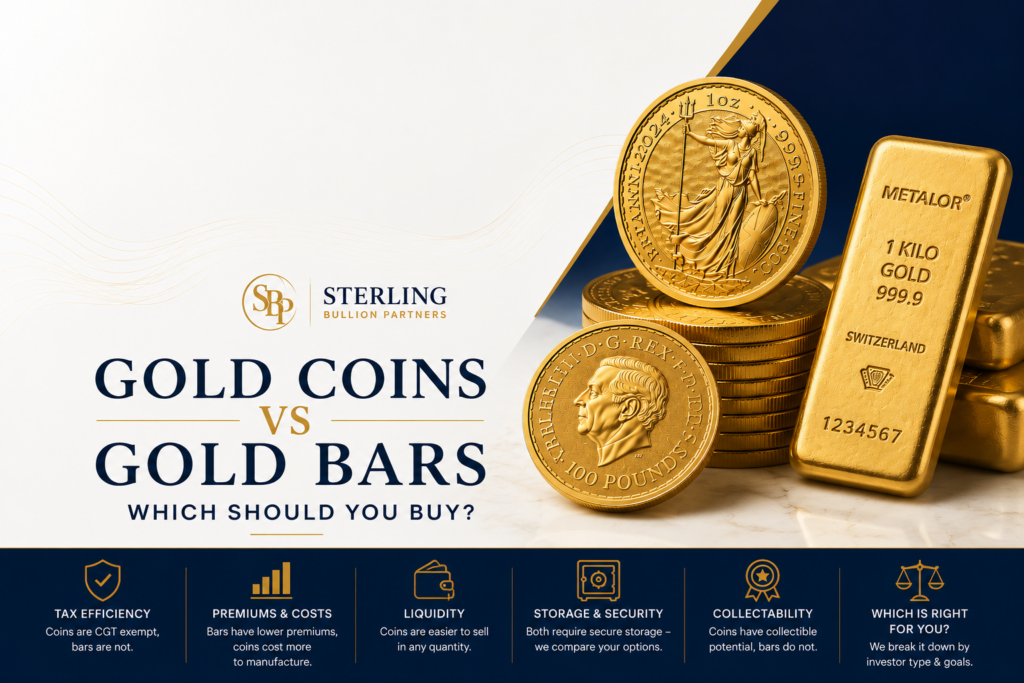
Gold Coins vs Gold Bars: Which Should You Buy?
Jul
Gold Coins vs Gold Bars: Which Should You Buy?
Buying physical gold is one of the most direct ways to gain exposure to the precious metals market. Once you decide to invest in gold, one of the first questions you may ask is whether to choose coins or bars. Both formats contain the same metal, yet they differ in important ways. The aim of this guide is to provide a thorough, legally safe and SEO‑optimised comparison of gold coins and gold bars for UK buyers in 2026. This guide is written for beginners and experienced buyers alike and forms part of a wider knowledge centre on physical gold.
About this guide
This guide explains the differences between gold coins and gold bars, focusing on tax, pricing, liquidity, storage, collectability and practical considerations. It is educational in nature and does not constitute financial or tax advice. Tax treatment depends on your personal circumstances and may change. Always consult a qualified professional if you are unsure.
Contents
- Is This Guide for You?
- Why Compare Gold Coins and Gold Bars?
- Understanding Gold Coins
- Understanding Gold Bars
- Comparing Coins and Bars
- Tax Differences
- Premiums and Pricing
- Liquidity and Flexibility
- Storage and Insurance
- Security and Authenticity
- Collectability and Rarity
- Which Format Is Right for You?
- Common Mistakes to Avoid
- Frequently Asked Questions
- Summary and Next Steps
Is This Guide for You?
This guide has been prepared for anyone who is considering investing in physical gold and wants to understand whether coins or bars would be more suitable. It will be especially useful if you:
- Are new to buying gold and want to understand the basics without marketing hype.
- Want to compare coins and bars in terms of tax, pricing, liquidity, storage, collectability and overall suitability for different investment strategies.
- Are a UK resident seeking information relevant to UK tax laws (VAT and Capital Gains Tax).
- Prefer clear, plain English explanations using British terminology and a professional tone.
If any of these apply to you, read on—this guide will help you make an informed decision.
Why Compare Gold Coins and Gold Bars?
At first glance, a troy ounce of gold is the same whether it is in coin form or bar form. In practice, however, these two formats serve different purposes and suit different buyers. Understanding their differences allows you to align your purchase with your goals and circumstances. The following are common reasons people compare coins and bars:
|
Motivation |
Reason to Compare |
|---|---|
|
Budget |
You may be deciding whether to buy several small coins or a single larger bar. |
|
Tax planning |
UK tax rules treat coins and bars differently for Capital Gains Tax (CGT). |
|
Liquidity |
You might need to sell part of your holding later and want to know which format is easier to liquidate. |
|
Collectability |
Some buyers enjoy collecting historic or limited‑edition coins, while others prefer a simple bullion product. |
|
Storage and insurance |
Bars and coins differ in size, weight and packaging, which affects how you store and insure them. |
|
Flexibility |
Being able to sell in small increments can be important when gold prices fluctuate. |
Throughout this guide, we will explore each of these considerations in detail.
Quick Answer
There is no single “best” choice between gold coins and gold bars. Coins generally offer greater flexibility and tax advantages for UK residents because many bullion coins are exempt from Capital Gains Tax , while bars typically carry lower premiums per gram, especially in larger sizes . Your decision should depend on your budget, tax planning, investment horizon, storage options and personal preferences.
Understanding Gold Coins
Gold coins are minted by government mints or authorised private mints and typically carry a face value, making them legal tender. They come in a variety of designs, sizes and metals. In the UK, the most recognised bullion coins are the Britannia and Sovereign, both produced by the Royal Mint. This section outlines what makes gold coins unique.
Characteristics of Gold Coins
- Legal tender – Most bullion coins have a nominal face value (e.g., £100 for a 1 oz Britannia), although their intrinsic gold value is far higher. Their legal tender status means that coins like the Britannia and Sovereign are considered UK currency, which confers a significant tax advantage: they are exempt from Capital Gains Tax for UK residents .
- Purity and alloy – Modern UK bullion coins are usually struck in 999.9 fine gold (24 carat), while historic coins such as the Sovereign are minted in 22 carat gold. The purity is stamped on the coin, and the fine gold content is guaranteed by the issuing mint.
- Sizes and denominations – Gold coins are available in a variety of sizes, from as little as 1/40 oz (fractional) up to 10 oz . Common sizes include 1/10 oz, 1/4 oz, 1/2 oz and 1 oz. Fractional sizes make it easier for buyers to start with a lower budget and gradually build a collection.
- Security features – Many modern bullion coins incorporate advanced security features to deter counterfeiting. For example, the latest Britannia incorporates a latent image, micro‑text and surface animation to ensure authenticity.
- Design and collectability – Gold coins often feature historic or symbolic designs (e.g., Britannia, St George and the Dragon). Limited mintage, special editions and proof strikes can make certain coins highly collectible. Collectors may pay premiums for coins with rarity or high grades.
- Packaging and grading – Bullion coins are typically supplied in plastic capsules or tubes. Collector coins may be encapsulated by third‑party grading services (PCGS or NGC), with tamper‑evident slabs that certify the coin’s authenticity and condition.
Benefits of Gold Coins
According to the Royal Mint’s official guidance on buying bullion, gold coins offer several advantages for UK buyers:
- Modest outlay – Coins are suitable for those making a smaller investment because fractional sizes allow you to buy less than one ounce .
- Capital Gains Tax exemption – Due to their legal tender status, bullion coins such as Britannias and Sovereigns are exempt from CGT for UK residents . This can be a substantial advantage over gold bars when selling your holdings.
- Iconic designs – Coins often feature popular designs like the Britannia and Sovereign. Collectors appreciate the artistry and historical significance .
- Collecting and gifting – Coins provide an opportunity to collect or gift numismatic pieces at a lower cost than proof coins .
- Ease of buying and selling – The small size of coins makes them easier to buy and sell compared to larger bars . They are widely recognised around the world.
- Multiple metals – While this guide focuses on gold, bullion coins are available in gold, silver and platinum .
- VAT‑free – All Royal Mint gold coins are exempt from VAT .
- Buy‑back and storage options – The Royal Mint offers a buy‑back scheme and secure storage for coins .
These features make coins particularly attractive to first‑time buyers, collectors and those seeking tax efficiency.
Drawbacks of Gold Coins
Despite their advantages, gold coins also have some downsides:
- Higher premiums per gram – Coins generally carry higher premiums than large bars because minting, design and distribution costs are proportionally higher . Premiums can vary depending on the coin type and size.
- Potential for scratches – While modern coins are durable, smaller 24‑carat coins can scratch more easily than 22‑carat coins (such as Sovereigns). Proper handling and storage are important.
- Collectability risk – The collectible value of certain coins may fluctuate based on market demand. Not all coins appreciate beyond their metal value.
- CGT exemption limited to UK coins – Only UK legal‑tender coins are CGT exempt. Foreign bullion coins (e.g., Krugerrands, Maple Leafs) are not legal tender in the UK and therefore are subject to CGT if your gains exceed the allowance .
Keeping these points in mind will help you decide whether coins align with your goals.
Understanding Gold Bars
Gold bars, sometimes called ingots, are rectangular pieces of refined gold produced by LBMA‑approved refiners and other accredited manufacturers. They come in a wide range of sizes and are generally intended for investors who want to own the metal itself rather than collect individual designs.
Characteristics of Gold Bars
- Purity – Gold bars are usually 999.9 fine (24 carat). The bar’s purity, weight and refiner’s mark are stamped directly onto the bar. Some bars also include a serial number.
- Sizes – Bars come in a variety of weights from as little as 1 gram up to 400 troy ounces (the standard “Good Delivery” bar used by central banks). Popular sizes for retail investors include 1 g, 5 g, 10 g, 20 g, 1 oz, 50 g, 100 g, 250 g, 500 g and 1 kg .
- Cast vs minted – Bars can be cast (poured into a mould and left to solidify) or minted (cut from a rolled gold sheet and struck like coins). Minted bars typically have sharper edges and a polished finish, while cast bars are more utilitarian.
- Packaging – Many smaller bars are sealed in tamper‑evident packaging with an assay card certifying weight and purity. Larger cast bars are often stored loose or in protective sleeves.
- Serial numbers and certificates – Some bars include serial numbers and may come with certificates of authenticity. Serial numbers help with security and record‑keeping.
Benefits of Gold Bars
The Royal Mint highlights several benefits of buying bullion bars :
- Efficient way to acquire larger quantities – Bars provide a straightforward means to invest in larger amounts of gold .
- Lower premium per gram – In general, the larger the bar, the lower the premium over the spot price . This can make bars more cost‑effective for investors focused on metal content rather than collectability.
- Wide selection of designs and sizes – Bars are available in numerous weights and finishes, including premium gift bars .
- Available in multiple precious metals – Bars can be purchased in gold, silver and platinum .
- VAT‑free – All Royal Mint gold bars are exempt from VAT .
- Physical asset – Like coins, bars are tangible assets you can hold.
- Buy‑back and storage options – Bars can be sold back to the Royal Mint, and there are secure storage options available .
Drawbacks of Gold Bars
Despite their appeal, bars have some limitations:
- Capital Gains Tax (CGT) – Unlike UK bullion coins, gold bars are not legal tender. They are treated as personal possessions for tax purposes and any gain above your annual CGT allowance is subject to CGT .
- Less flexible – Selling a portion of a bar is not possible; you must sell the entire bar or buy smaller bars for flexibility. This can make it harder to liquidate part of your investment in response to gold price movements.
- Lower liquidity for large bars – Very large bars (e.g., 400 oz “Good Delivery” bars or 1 kg bars) may have a smaller resale market and can be harder to sell quickly compared with widely recognised coins.
- Storage requirements – Large bars can be heavy and require secure vault storage. Storing high‑value bars at home involves significant security and insurance considerations (discussed further in Storage and Insurance
).
- Less collectable – Standard bullion bars have little numismatic appeal. Their value is tied primarily to the gold content, not design or rarity.
Understanding these pros and cons will help you decide whether bars fit your strategy.
Comparing Coins and Bars
In this section we compare coins and bars across several critical factors: tax, premiums, liquidity, storage, security and collectability. Each factor influences whether one format or the other suits your circumstances.
Tax Differences
Value‑Added Tax (VAT)
Under UK tax law, gold bullion coins and bars qualify as investment gold, meaning they are exempt from VAT . This makes gold unique among precious metals, as silver bullion remains subject to VAT . Whether you buy coins or bars, you will not pay VAT on the purchase.
Capital Gains Tax (CGT)
The major tax difference relates to CGT:
- Coins – UK legal‑tender bullion coins, such as the Britannia and Sovereign, are exempt from Capital Gains Tax for UK residents . This is because they are sterling currency; any gain you realise when selling them is not subject to CGT .
- Bars – Gold bars are personal possessions and do not have legal tender status. Any gain above your annual CGT allowance (currently £6,000 from 6 April 2026) is subject to CGT at the prevailing rate . If you sell several bars in a single tax year and your combined gains exceed the allowance, you may incur CGT .
Key Takeaway
If you are concerned about Capital Gains Tax, UK bullion coins (Britannias and Sovereigns) offer a significant advantage because they are CGT‑exempt . Gold bars do not share this exemption and may incur CGT on gains .
Premiums and Pricing
The premium is the amount charged above the metal’s spot price. It covers minting, distribution, insurance and dealer margins. The choice between coins and bars can affect the premium you pay.
- Bars – Bars generally have lower premiums per gram than coins because they are simpler to manufacture and package. The Royal Mint notes that “the larger the bar, the lower the premium over the value of the metal” . A 1 kg bar will usually have a lower percentage premium than a 1 oz coin.
- Coins – Coins typically carry a higher premium because they involve more intricate minting, design, marketing and distribution costs. However, the difference in premiums between small bars and coins diminishes when you buy multiple small bars. The Britannia Coin Company points out that as you purchase more small bars (1 g, 5 g, etc.), the incremental packing and processing costs increase and the premium gap narrows .
- Size matters – Premiums vary by size. A single 1 oz coin may have a similar premium to a 1 oz bar. Fractional coins (1/10 oz, 1/4 oz) often carry higher premiums due to higher manufacturing costs per gram, while large bars (100 g, 1 kg) usually offer lower premiums.
- Market conditions – During periods of high demand or limited supply (e.g., market volatility), premiums can rise for both coins and bars. Dealer premiums may vary depending on the brand and design. Always compare quotes from multiple reputable dealers.
Did You Know?
Premiums reflect more than just manufacturing costs. They can be influenced by collector demand, availability and brand reputation. For example, Royal Mint bars and coins may command slightly higher premiums than unbranded bars due to perceived trust and buy‑back guarantees.
Liquidity and Flexibility
Liquidity refers to how quickly and easily an asset can be sold at a fair market price. Flexibility relates to how easily you can sell part of your holding.
- Coins – Coins are generally more liquid than large bars. They have an established international market, and fractional sizes allow you to sell small portions of your holding. The Royal Mint emphasises that coins are easier to buy and sell due to their size and recognition . Many bullion dealers, coin shops and online platforms trade in popular coins like Britannias and Sovereigns.
- Bars – Bars remain liquid, but large bars can limit flexibility. If you own a 1 kg bar, you must sell the entire bar to realise any value. Smaller bars (e.g., 1 oz or 100 g) are more flexible but may have slightly higher premiums. Some dealers buy back bars at competitive rates, but the market for very large bars is more specialised.
- Market participants – The market for gold coins includes private collectors, investors and dealers, whereas large bars are mostly traded among bullion dealers, refineries and institutional investors. This can affect resale speed.
Common Mistake
First‑time buyers sometimes assume that all gold is equally liquid. In reality, the ability to sell quickly at a fair price depends on the form and size of your gold. Coins offer greater flexibility because they can be sold individually, whereas large bars require selling the whole bar.
Storage and Insurance
Proper storage is essential for preserving the value and security of your gold. Your choice of coins or bars will influence storage requirements.
Storage Options
- Professional vaults – Many investors use professional vault services (such as the Royal Mint’s Vault®) for secure storage. Vaults provide high security, insurance and professional handling. Both coins and bars can be stored in a vault, often for a fee. .
- Home storage – Storing gold at home is possible but requires robust security measures. The Britannia Coin Company notes that storing large bars at home can be difficult and may require a safe or creative hiding places . Smaller coins and bars are easier to conceal but may still be targets for theft. If you store gold at home, you should inform your insurer and consider additional cover .
- Bank safe‑deposit box – Some banks offer safe‑deposit boxes. These can be convenient, but the box contents may not be insured by the bank. You’ll need to arrange separate insurance.
Insurance Considerations
Insurance for gold depends on where you store it:
- Vault storage – Professional vault services generally include insurance to cover the full replacement value. Check the terms carefully and ensure the insurance is underwritten by a reputable provider.
- Home insurance – Standard home insurance policies often exclude high‑value items like gold or limit cover. You may need to add a specific rider or declare your holdings. Keep purchase receipts and photographic evidence to substantiate any claim. Splitting your holdings across multiple hiding places can reduce risk .
- Specialist insurers – Some insurers specialise in precious metals. If you hold a significant quantity of gold outside a vault, consider obtaining a specialist policy.
Packaging and handling
- Coins – Most bullion coins are supplied in capsules or tubes. Avoid touching coins with bare hands; use cotton gloves. Scratches and marks can reduce resale value, especially for collectible coins.
- Bars – Small bars often come sealed in tamper‑evident packaging with an assay card. Do not remove them from this packaging unless absolutely necessary. Larger cast bars may be stored in protective sleeves. Handle bars carefully to avoid damage.
Key Takeaway
Coins are easier to store discreetly at home and offer flexibility in selling small amounts. Large bars require more robust security measures and may be best stored in a professional vault. Always ensure your gold is adequately insured.
Security and Authenticity
Ensuring that your gold is genuine and secure is crucial. Counterfeiting remains a risk, though modern minting techniques make it harder to replicate genuine bullion.
- Coins – Modern bullion coins incorporate advanced security features. For example, the Britannia includes a latent image that switches between a trident and padlock when tilted, micro‑text and tincture lines . These features make it difficult to counterfeit coins and easy for buyers to verify authenticity. Third‑party grading services also enhance authenticity by encapsulating coins in tamper‑evident slabs.
- Bars – Bars rely on hallmarking and, in some cases, serial numbers and assay certificates. Buying bars from reputable dealers or directly from the Royal Mint ensures authenticity. Avoid purchasing gold bars from unknown sources. Many large bars include a certificate or a sealed plastic card with a matching serial number.
- Buy‑back schemes – Buying from established dealers who offer buy‑back schemes helps ensure authenticity and provides an exit route when selling. The Royal Mint allows you to sell back coins or bars purchased from them .
Testing and verification
If you purchase gold from a secondary market, consider testing methods such as:
- Measuring dimensions and weight.
- Using a magnet (gold is non‑magnetic).
- Conducting ultrasonic or XRF (X‑ray fluorescence) analysis through professional services.
- Checking serial numbers with the manufacturer if applicable.
Did You Know?
Some counterfeiters plate base metals with gold to imitate genuine bars or coins. Buying from reputable mints or dealers with transparent provenance and buy‑back guarantees greatly reduces this risk.
Collectability and Rarity
Collectability sets coins apart from bars. While bars are valued purely for their metal content, coins may carry additional value because of their design, mintage and condition.
- Limited mintages – Bullion coins are minted annually in varying quantities. Limited editions, special privy marks and proof issues can make certain coins rarer. The Britannia Coin Company notes that variations in design and mintage confer rarity and can increase value .
- Historical significance – Historic coins such as Sovereigns have been minted for over 200 years. Collectors appreciate coins from specific years or reigns, adding to their appeal.
- Grading and certification – Professional grading services (PCGS, NGC) evaluate a coin’s condition using the Sheldon scale (e.g., MS69, MS70). Higher grades indicate better preservation and can command premiums. Slabbed coins with high grades may be more valuable to collectors.
- Numismatic vs bullion – Not all coins are collectible. Standard bullion coins have high mintages and are intended for investment. Proof coins, commemoratives and certain historic issues may have numismatic value beyond their gold content.
- Bars – Bars rarely have numismatic value. Some premium bar series (e.g., limited edition designs or bars with art motifs) can be collectible, but this market is small compared with coins. For most bars, value depends solely on the metal content.
Common Mistake
Some buyers confuse collectable proof coins with standard bullion coins. Proof coins are struck multiple times with polished dies, resulting in a high‑quality finish and higher premiums. They are better suited to collectors than bullion investors. For investment purposes, stick with standard bullion coins unless you specifically want to collect limited editions.
Summary Comparison Table
The table below summarises the key differences between gold coins and gold bars. It is not exhaustive but highlights the factors most relevant to UK buyers.
|
Feature |
Gold Coins |
Gold Bars |
|---|---|---|
|
Legal tender |
Yes – UK coins like Britannias and Sovereigns are legal tender and CGT‑exempt |
No – bars are not legal tender; gains may be subject to CGT |
|
VAT |
Exempt |
Exempt |
|
Premium per gram |
Generally higher due to minting and design; fractional sizes carry higher premiums |
Generally lower, especially for larger bars |
|
Minimum investment |
Fractional sizes allow entry from about 1/10 oz; good for smaller budgets |
Bars start from 1 g; small bars still accessible but larger bars may require a bigger outlay |
|
Liquidity |
High – widely recognised and easy to sell; fractional sizes provide flexibility |
High to moderate – small bars sell easily; very large bars may take longer |
|
Flexibility |
High – you can sell individual coins |
Moderate – must sell the entire bar unless you own multiple small bars |
|
Collectability |
Potential numismatic value for limited editions and historic coins |
Minimal numismatic value; value tied to metal content |
|
Storage |
Easier to store discreetly; coins fit in small containers; can split across locations |
Large bars require more space and secure storage; vault recommended |
|
Security features |
Modern coins incorporate advanced security features |
Bars rely on hallmarks, serial numbers and packaging |
|
Buy‑back schemes |
Offered by the Royal Mint and many dealers |
Offered by the Royal Mint and some dealers |
|
CGT considerations |
CGT‑exempt for UK legal‑tender coins |
Subject to CGT above allowance |
Understanding these differences will help you choose the format that aligns with your objectives.
Which Format Is Right for You?
There is no one‑size‑fits‑all answer. Your personal circumstances, goals and preferences determine whether coins or bars are more suitable. Consider the following scenarios:
When Gold Coins Might Be Best
- You want tax efficiency – If avoiding Capital Gains Tax is important, UK legal‑tender coins like Britannias and Sovereigns are CGT‑exempt .
- You have a smaller budget – Fractional coins allow you to start with a modest outlay and build your holdings over time.
- You value flexibility – Coins can be sold individually, making it easier to release small amounts of capital when needed.
- You enjoy collecting – Coins offer artistic designs and the potential for numismatic appreciation .
- You intend to give gifts – Attractive designs and small sizes make coins suitable as gifts.
- You prefer a mix of bullion and collectability – Owning both bullion coins and limited‑edition coins can diversify your holdings.
When Gold Bars Might Be Best
- You want the lowest premium per gram – Larger bars (100 g, 1 kg) typically have lower premiums than coins .
- You are investing a significant sum – Bars allow you to acquire large amounts of gold efficiently.
- You are comfortable with storage – If you have access to a secure vault or are comfortable paying vault storage fees, bars may suit you.
- You don’t need to sell in small increments – If you plan to hold for the long term and sell in bulk, bars offer simplicity.
- You want minimal numismatic exposure – Bars are valued solely for their metal content, avoiding fluctuations in collector demand.
When to Consider Both
Many experienced investors hold both coins and bars. They may accumulate bars for core holdings and use coins for flexibility, gifts or tax efficiency. Diversifying between coins and bars can balance premium costs, liquidity and tax considerations.
Did You Know?
Some investors buy a large bar to secure a lower premium and then gradually trade portions of it for coins. This strategy allows them to benefit from both lower costs and greater flexibility over time.
Common Mistakes to Avoid
- Ignoring tax rules – Buying foreign coins or bars without considering UK Capital Gains Tax can result in unexpected tax bills. Ensure you understand which products are CGT‑exempt .
- Focusing solely on price – The lowest premium is not always the best choice. Consider liquidity, flexibility and your ability to store and insure your gold.
- Buying rare proof coins as investments – Proof coins can carry very high premiums. Unless you are a collector, focus on standard bullion coins.
- Neglecting storage and insurance – Gold must be protected. Do not store high‑value bars without proper security and insurance .
- Buying from unverified sellers – Counterfeit risk exists. Purchase from reputable dealers or directly from the Royal Mint.
- Selling at the wrong time – Gold prices fluctuate. Selling because of short‑term volatility can lock in losses. Have a clear strategy.
- Not diversifying – Holding only bars or only coins may not suit future needs. Diversify across formats and sizes.
Frequently Asked Questions
Below are answers to common questions about gold coins and bars. They provide quick reference for newcomers.
Are gold bars cheaper than gold coins?
As a general rule, yes—bars carry lower premiums per gram than coins, especially in larger sizes . However, the difference narrows for small bars, and market conditions can affect premiums. Coins may be more cost‑effective when you consider tax advantages.
Are gold coins VAT‑free?
Yes. Gold coins and bars that qualify as investment gold are exempt from VAT in the UK . This applies to gold coins such as Britannias and Sovereigns as well as bullion bars. Silver and other precious metals may still attract VAT .
Which is easier to sell, coins or bars?
Coins are generally easier to sell because they are widely recognised and can be sold individually. Large bars require you to sell the entire bar at once. Both coins and bars can be sold through reputable dealers, but coins provide greater flexibility and a broader resale market .
Do gold bars attract Capital Gains Tax?
Yes. Gold bars are not legal tender and are therefore subject to Capital Gains Tax on gains exceeding your annual allowance . UK bullion coins such as Britannias and Sovereigns are exempt from CGT .
What sizes do gold bars come in?
Bars range from 1 gram up to 400 troy ounces. Common retail sizes include 1 g, 5 g, 10 g, 20 g, 1 oz, 50 g, 100 g, 250 g, 500 g and 1 kg . Each size carries a different premium and may suit different budgets.
What sizes do gold coins come in?
Gold coins come in fractional sizes (e.g., 1/10 oz, 1/4 oz) up to large sizes like 1 oz and even 10 oz . Fractional coins allow you to buy small amounts of gold and are popular with first‑time buyers.
Can I buy both coins and bars?
Yes. Many investors hold both coins and bars to balance premiums, tax considerations and liquidity. Coins offer flexibility and CGT advantages, while bars offer lower premiums for larger purchases.
Should I store gold at home or in a vault?
The choice depends on your comfort with security and cost. Vault storage offers professional security and insurance but comes with fees . Home storage requires robust security measures and may necessitate additional insurance .
Are modern gold coins easy to counterfeit?
Modern coins incorporate advanced security features such as latent images, micro‑text and tactile surfaces . These features, along with third‑party grading and buy‑back guarantees, make counterfeiting more difficult. However, always buy from trusted sources.
What is DigiGold and how does it compare to physical bars and coins?
The Royal Mint offers a digital gold product called DigiGold, which allows you to purchase a fractional ownership of large bars. DigiGold is VAT‑free and provides flexibility to buy and sell at any time . However, it does not confer legal tender status and is not CGT‑exempt. This guide focuses on physical coins and bars, but you may consider DigiGold if you prefer a purely digital holding.
Summary and Next Steps
Gold coins and gold bars each have unique advantages and drawbacks. Coins are often chosen for their flexibility, ease of resale, legal tender status and CGT exemption . Bars appeal to investors looking for the lowest premium per gram and a straightforward way to accumulate larger quantities of gold . Both formats are VAT‑free and can be stored either at home or in professional vaults.
When deciding between coins and bars:
- Assess your budget – Determine how much you want to invest and whether fractional coins or larger bars make more sense.
- Consider tax – If you expect significant gains or plan to sell frequently, CGT‑exempt coins may be advantageous.
- Think about liquidity – Coins provide flexibility to sell small amounts, while bars may require selling the entire bar.
- Plan for storage – Ensure you have a secure storage solution and understand insurance requirements.
- Decide if collectability matters – If you enjoy collecting or want potential numismatic appreciation, coins offer more variety. If you prefer pure metal exposure, bars may be simpler.
Ultimately, many investors choose to hold both coins and bars, balancing the benefits of each. Whatever you decide, ensure you buy from reputable dealers, understand the associated costs and tax implications, and store your gold securely. Gold should be part of a well‑diversified portfolio rather than your sole investment. We hope this guide has provided clarity and confidence as you explore the world of physical gold.
For more information on related topics, explore our guides on Gold Coins vs Gold Bars, Understanding Coin Grading, Bullion vs Certified Coins and How to Store Gold Safely.
