

Guides
PCGS vs NGC Coin Grading
Jul
PCGS vs NGC: Quick Answer
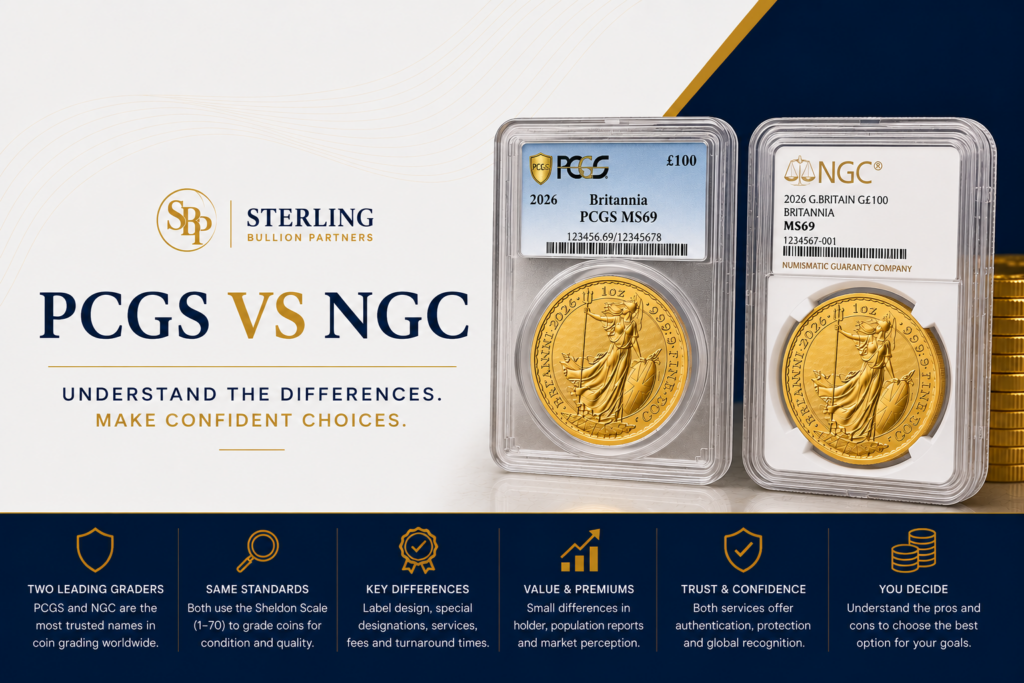
PCGS (Professional Coin Grading Service) and NGC (Numismatic Guaranty Company) are two of the world’s leading third-party coin grading services. Both authenticate, grade and encapsulate coins and use the internationally recognised 1–70 Sheldon grading scale.
For collectors, the most obvious difference is often terminology. NGC uses PF for Proof coins and Ultra Cameo for qualifying high-contrast Proofs, while PCGS uses PR for Proof coins and Deep Cameo (DCAM) for qualifying high-contrast examples.
Neither PCGS nor NGC is automatically better. The most appropriate grading service can depend on the coin, the market in which it is collected, the services required and collector preference.
For UK collectors buying certified British gold coins such as Sovereigns, Britannias and modern Royal Mint Proofs, both PCGS and NGC certification can provide independent authentication, grading and encapsulation.
PCGS vs NGC Comparison Chart
|
Feature |
PCGS |
NGC |
|---|---|---|
|
Full name |
Professional Coin Grading Service |
Numismatic Guaranty Company |
|
Founded |
1986 |
1987 |
|
Grading scale |
1–70 Sheldon scale |
1–70 Sheldon scale |
|
Mint State designation |
MS |
MS |
|
Proof designation |
PR |
PF |
|
High-contrast Proof designation |
Deep Cameo / DCAM |
Ultra Cameo |
|
Population database |
PCGS Population Report |
NGC Census |
|
Certification verification |
Available |
Available |
|
Encapsulation |
Tamper-evident holder |
Tamper-evident holder |
|
Registry programme |
PCGS Set Registry |
NGC Registry |
|
UK & world coins |
Graded |
Graded |
|
Overall winner |
Depends on the individual coin and collector |
Depends on the individual coin and collector |
Key takeaway: A grade of NGC PF70 and PCGS PR70 both represent the top numerical grade on their respective 1–70 grading scales. However, the grading company, designation, population, coin type and market demand can all influence how an individual certified coin is perceived and valued.
PCGS confirms that its standards are built on the Sheldon 1–70 scale, while NGC publishes its own 1–70 grading scale. NGC also explicitly defines Ultra Cameo for qualifying PF coins, while PCGS uses PR and Deep Cameo terminology.
About this guide
This guide compares the two most prominent third‑party coin grading services: Professional Coin Grading Service (PCGS) and Numismatic Guaranty Company (NGC). It aims to help UK collectors and investors understand the differences between these grading companies so they can make informed choices. It is intended as educational information only and does not constitute financial advice. The guide was last reviewed on 9 July 2026. Always check the latest information and consult professionals before submitting coins for grading.
Who is this guide for?
If you are considering submitting coins for grading, buying certified gold coins or simply want to understand why one holder might command a higher price than another, this guide is for you. It assumes basic familiarity with coin grading (see our Understanding Coin Grading guide for an introduction) and focuses on the differences between PCGS and NGC.
Table of contents
- Why compare PCGS and NGC?
- Background and history
- Shared standards
- Key difference
- Proof designations and labels
- Special labels and designations
- Services and fees
- Turnaround times
- Market premiums and resale values
- PCGS vs NGC Population Reports
- PCGS vs NGC for UK Gold Coins
- PCGS advantages vs NGC advantages
- Choosing the right service
- Frequently asked questions
- Conclusion
Why compare PCGS and NGC?
Quick answer. Both PCGS and NGC are reputable grading services that use the same 1–70 Sheldon scale. They authenticate, grade and encapsulate coins in tamper‑evident holders . While the numeric grades they assign (e.g., MS‑69, PF‑70) are directly comparable, differences in labels, services, fees and market perception can influence which service is better suited to a particular coin or collector.
Did you know?
PCGS and NGC emerged within a short period of one another during the 1980s — PCGS in 1986 and NGC in 1987 — and went on to become two of the best-known third-party coin grading services.
Common mistake. Some collectors assume that one grading company is inherently stricter than the other. Both PCGS and NGC use the 1–70 grading scale, but each company grades coins independently according to its own standards and procedures. Differences in market preference can also vary considerably according to coin type, series and market.
Key takeaway. There is no universal “best” grading service. The choice depends on the type of coin, your collecting goals, cost considerations and personal preferences. Understanding the nuances between PCGS and NGC will help you make decisions that align with your objectives.
Background and history
PCGS
PCGS was founded in 1986 and officially began operations on 3 February 1986 in Newport Beach, California . It is considered the first major third‑party grading service and is credited with pioneering the modern tamper‑evident coin slab and establishing comprehensive population reports . PCGS’s mission is to standardise coin grading using the Sheldon scale and provide market‑leading authentication services .
NGC
NGC (Numismatic Guaranty Company) was founded in 1987 in Sarasota, Florida . It focuses on providing impartial grading and authentication with particular emphasis on world coins and modern issues . NGC has developed innovative holder technology and variety attribution and has a strong international presence .
Healthy competition
The two companies emerged within a few years of each other during a time when collectors needed standardised grading. NGC was founded by former PCGS executives to address perceived shortcomings. Their competition has driven innovation, leading to improved services and consistency in the market.
Shared standards
Both PCGS and NGC use the 1–70 Sheldon grading scale. Their numerical grades therefore communicate broadly comparable levels of condition, although each company grades coins independently according to its own standards and procedures. Graders assess characteristics including strike, surface preservation, lustre, colour and eye appeal when determining a coin’s grade.
Each company guarantees the authenticity and accuracy of its grades, providing a safety net for buyers and sellers . The shared standards make it easier to compare coins across services.
Key differences
Although PCGS and NGC follow the same grading scale, there are practical differences that influence collector preferences.
Proof designations and labels
Both companies use MS (Mint State) for circulation‑strike coins, but they differ in how they designate Proof coins. NGC uses the prefix “PF” (e.g., PF‑70) for Proof coins, while PCGS uses “PR” (e.g., PR‑70). Despite the different abbreviations, a PF‑70 from NGC and a PR‑70 from PCGS denote identical quality .
Special labels and designations
PCGS and NGC offer special labels that can add collectible appeal:
- Cameo designations: Both services use terms to describe proof coins with frosted devices and mirrored fields. NGC’s Ultra Cameo corresponds to PCGS’s Deep Cameo .
- Release designations: NGC’s Early Releases and PCGS’s First Strike both indicate that a coin was graded within about 30 days of its release . NGC also offers Advance Releases, a designation for coins purchased by bulk dealers before the public sale date .
- Specialty labels: PCGS pioneered the Set Registry concept, encouraging collectors to assemble and compete for top registry sets . Both companies offer a variety of commemorative and signature labels (e.g., designer or anniversary labels).
- Star/plus designations: NGC awards Star designations for coins with exceptional eye appeal and Plus grades for coins at the high end of their numeric grade . These designations can enhance value on attractive coins.
Understanding these differences is important if you value certain labels or designations.
Services, Fees and Turnaround Times
Both PCGS and NGC offer multiple grading tiers and additional services. Fees can depend on factors including the coin’s declared value, type, service level and any additional designations or services requested.
Turnaround times also change according to submission volumes and the service selected. For this reason, collectors considering a submission should check the current fees and estimated turnaround times directly with PCGS or NGC, or with the authorised dealer handling their submission, rather than relying on historic figures.
Market Premiums and Resale Values
Both PCGS and NGC coins are widely traded in the certified coin market. In some coin series, collectors may show a preference for one grading service over the other, which can result in differences in realised prices.
However, there is no universal percentage premium that applies to all PCGS- or NGC-certified coins. Value can depend on the individual coin, its grade and designation, certified population, rarity, eye appeal, market demand and the buyers competing for it.
For modern British gold coins, it is therefore more useful to compare actual market evidence for the specific coin and grade than to assume that one grading company’s holder automatically makes a coin more valuable.
PCGS vs NGC Population Reports
Both grading companies maintain searchable population databases showing how many examples of particular coins they have certified at different grades.
PCGS calls its database the PCGS Population Report.
NGC calls its database the NGC Census.
For collectors of scarce certified coins, understanding a coin population report can provide useful context. For example, a coin may have a relatively low original mintage but a much smaller number certified at PF70 or PR70.
However, a grading population should not be treated as the number of coins that exist. It records coins certified by that grading company and may be affected by factors including resubmissions.
Population is therefore best considered alongside the coin’s original mintage, grade, condition, market availability and collector demand.
PCGS itself explicitly warns that its Population Report covers coins submitted and certified by PCGS and should not by itself be relied upon to determine market value. NGC describes its Census as its current population report and says it is updated each Monday.
PCGS vs NGC for UK Gold Coins
For UK collectors, the comparison between PCGS and NGC often involves modern Royal Mint and historic British coins rather than the US coin series discussed in many American grading guides.
Both services grade British coins, including Sovereigns, Britannias and modern Proof issues.
When comparing two certified British gold coins, collectors should consider more than the company named on the holder. Relevant factors can include:
- the numerical grade;
- Proof or Mint State designation;
- Cameo, Ultra Cameo or Deep Cameo designation where applicable;
- original mintage;
- certified population at that grade;
- special labels or release designations;
- the condition and eye appeal of the coin; and
- actual demand for that particular issue.
For example, an NGC PF70 Ultra Cameo and a PCGS PR70 Deep Cameo may both represent exceptionally high-grade Proof examples, despite the different terminology used by the two grading companies.
PCGS advantages vs NGC advantages
PCGS advantages
Established market recognition: PCGS is one of the longest-established major third-party coin grading services and has strong recognition among collectors and dealers.
PCGS Set Registry: Its Set Registry allows collectors to build and compare registered collections and can be particularly important within competitive collecting categories.
Strong presence in US numismatics: PCGS has a particularly established position within the US certified coin market.
Population and certification data: PCGS provides certification verification and its Population Report for researching certified coins.
NGC advantages
Strong international presence: NGC grades a substantial range of world coins and modern issues and is widely encountered by collectors of British and international coins.
NGC Census: Its population database provides certification population information across grades and coin types.
Labels and designations: NGC offers a wide range of labels and designations, including Ultra Cameo, Early Releases and First Releases where applicable.
Conservation services: NGC is affiliated with Numismatic Conservation Services (NCS), which provides professional coin conservation services.
Registry programme: NGC also operates its own Registry for certified collections.
Choosing the right service
When deciding whether to submit to PCGS or NGC (or buy a coin graded by either), consider the following:
-
Type of coin: Consider which grading service is most commonly encountered for the particular coin or series you collect. Market preferences can differ between US, British, world, historic and modern coins.
-
Fees and turnaround: Compare the current service levels, fees and estimated turnaround times offered by PCGS and NGC at the time you intend to submit. These can change.
-
Registry participation: If registry collecting matters to you, consider which company’s Registry best suits the collection you intend to build.
- Personal preference: Some collectors prefer the aesthetics of one holder over the other or value specific labels and designations. Decide what matters most to you.
- Cross grading: If you have a coin graded by one service and believe it might achieve a higher grade elsewhere, cross grading is possible. However, crossover fees apply and there is no guarantee the grade will improve.
Frequently asked questions
Are PCGS and NGC grades directly comparable?
Yes. Both services use the 1–70 grading scale, so their numerical grades are designed to communicate the same broad condition levels. However, each coin is graded independently and collectors should not assume that two coins carrying the same numerical grade are identical in appearance or market value.
Why do PCGS coins sometimes sell for more?
In some coin series, collector preference, registry competition and market convention can result in PCGS-certified examples achieving different prices from equivalent NGC-certified examples. However, there is no universal PCGS premium. The difference can vary according to the individual coin, grade, population, rarity, eye appeal and market demand.
Which service is better for world coins?
Both PCGS and NGC grade world coins. NGC has a substantial international presence and is commonly encountered across modern and historic world coin markets. The better choice will depend on the particular coin, available services and collector preference.
Which service is better for US coins?
Both PCGS and NGC are extensively used for US coins. PCGS has a particularly established position within US numismatics, but the appropriate service depends on the individual coin, series and collector’s objectives.
What is the difference between PF and PR grades?
Both PF and PR denote Proof coins. NGC uses PF, while PCGS uses PR. PF70 and PR70 both represent the highest numerical grade on the respective companies’ grading scales, although coins are graded independently and should not be assumed to be identical in appearance or market value.
Do special labels like Early Releases and First Strike matter?
Special labels can add collectible appeal. NGC’s Early Releases and PCGS’s First Strike both mark coins graded within about 30 days of release . Some collectors pay premiums for these designations, while others focus solely on the numeric grade.
Can I submit coins from the UK?
Yes. UK collectors can submit eligible coins to PCGS and NGC using the submission routes currently offered by each company, including through approved submission centres or authorised dealers where applicable. Check the current submission requirements, fees, insurance arrangements and shipping procedures before sending valuable coins.
Should I cross a coin from NGC to PCGS (or vice versa)?
Cross grading involves submitting a coin in one company’s holder to the other service for re‑evaluation. The grade may stay the same, improve or decrease. Cross grading can be worthwhile if a higher grade would significantly increase the coin’s value, but there is no guarantee. Always weigh the costs and potential benefits.
Does PCGS or NGC guarantee buyback prices?
Neither company guarantees buyback prices. They guarantee the authenticity and accuracy of the grade . Buyback prices depend on market demand and dealer policies.
Conclusion
PCGS and NGC are two of the world’s leading third-party coin grading services. Both authenticate, grade and encapsulate coins using the 1–70 grading scale, but they differ in terminology, labels, population databases, services and areas of market strength.
There is no universal winner between PCGS and NGC. For collectors of British gold coins, the grading company is only one part of the picture. The individual coin, numerical grade, designation, original mintage, certified population, condition, rarity and collector demand should all be considered.
For that reason, an NGC PF70 Ultra Cameo and a PCGS PR70 Deep Cameo should be assessed on the merits and market evidence of the individual coin rather than assuming that one holder is automatically superior to the other.
For more reading, see our guides on Bullion vs Certified Coins, Understanding Coin Grading and MS69 vs MS70.
