

Guides
What Is a Coin Population Report?
Aug
The Complete Guide to NGC & PCGS Population Reports
Coin Population Report: Quick Answer
A coin population report shows how many examples of a particular coin have been certified at each grade by a grading company. NGC publishes its population data through the NGC Census, while PCGS publishes the PCGS Population Report.
For example, if an NGC coin is described as “PF70 Population 29”, this means NGC had recorded 29 examples of that particular coin at that grade when the population data was checked. It does not mean that only 29 examples of the coin exist.
Population data can help collectors understand the certified availability of a coin at a particular grade, but it should be considered alongside original mintage, condition, market availability and collector demand.
If you’ve ever looked at a certified coin, you’ve probably seen terms such as “Population 11”, “Top Pop” or “Only 29 Graded PF70.” Understanding what these figures actually mean is an important part of researching certified coins.
A coin population report is a searchable database maintained by a professional third-party grading company that records how many examples of a particular coin it has certified at each numerical grade. It is one of the most valuable research tools available to collectors because it provides independently recorded certification data that can be used alongside other information when evaluating a coin.
Population reports are published by grading companies such as Numismatic Guaranty Company (NGC) and Professional Coin Grading Service (PCGS) and are widely used by collectors, dealers and auction houses throughout the world.
However, population reports are often misunderstood. They do not tell you how many coins were originally struck, how many still exist worldwide or whether a coin is guaranteed to be valuable. Instead, they provide one important piece of information that should be considered alongside mintage, condition, historical significance and collector demand.
In this guide, you’ll learn exactly what coin population reports are, how they work, how to interpret them correctly and why they have become an essential part of modern certified coin collecting.
What Is a Coin Population Report?
A coin population report is a searchable database published by a professional third-party grading company that records how many coins it has certified at each numerical grade.
Whenever a coin is authenticated, graded and encapsulated by a grading company, its certification is added to that company’s population database. As more examples are submitted, the database continues to grow, providing collectors with an up-to-date record of how many coins have achieved each grade.
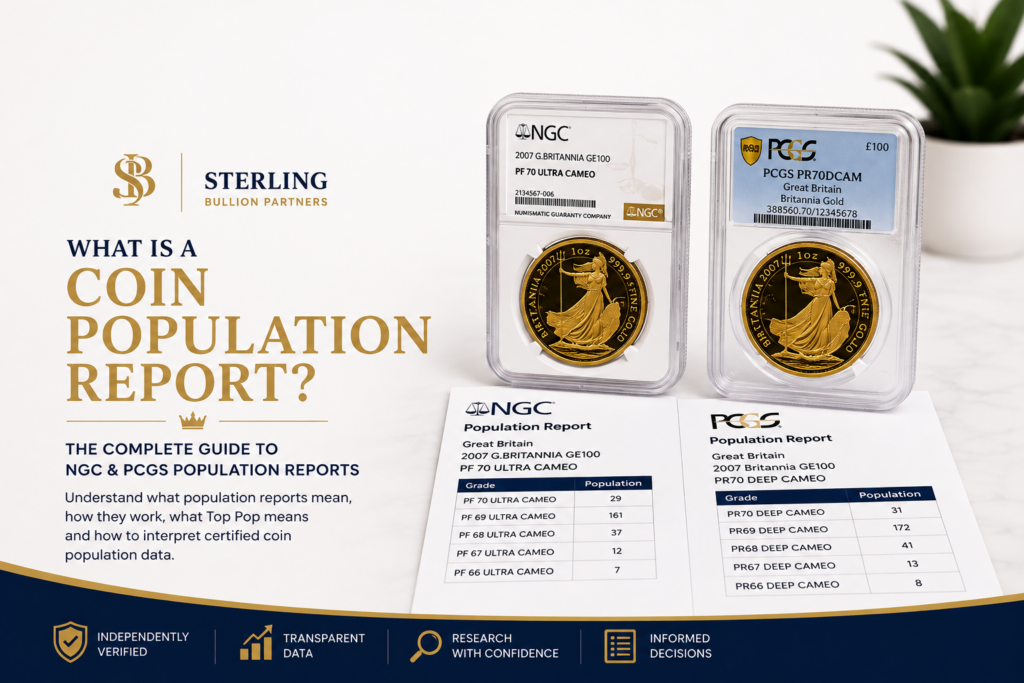
For example, a population report may display the following certification data:
|
Grade |
Population |
|---|---|
|
PF70 Ultra Cameo |
29 |
|
PF69 Ultra Cameo |
161 |
|
PF68 Ultra Cameo |
37 |
|
PF67 or Below |
12 |
This means that, at the time the report was viewed, the grading company had certified:
- 29 examples as PF70 Ultra Cameo
- 161 examples as PF69 Ultra Cameo
- 37 examples as PF68 Ultra Cameo
- 12 examples as PF67 or below
These figures relate only to that grading company’s certification records.
Each grading company maintains its own independent database. A coin certified by NGC will not automatically appear within the PCGS Population Report, and a coin certified by PCGS will not automatically appear within the NGC Population Report.
It is equally important to understand what a population report does not show.
A population report is not a record of every coin ever struck by a mint, nor is it a census of every surviving example. It records only the coins that have been certified by a particular grading company and the grades they received.
Understanding this distinction is fundamental to interpreting population reports correctly.
Who Produces Coin Population Reports?
The world’s two leading independent coin grading companies—Numismatic Guaranty Company (NGC) and Professional Coin Grading Service (PCGS)—each publish their own online population reports.
If you’re unfamiliar with the differences between the two grading companies, see our PCGS vs NGC coin grading guide for a side-by-side comparison.These searchable databases allow collectors to research the certification records for millions of coins graded by that company.
Although both organisations perform the same role, they maintain completely separate certification databases.
For example, if a coin has been certified by NGC, it will appear only within the NGC Population Report. Likewise, a coin certified by PCGS will appear only within the PCGS Population Report.
As a result, it is perfectly normal for the same coin to have different population figures at NGC and PCGS. This does not indicate an error. It simply reflects the number of examples certified by each organisation.
NGC Population Report (NGC Census)
Founded in 1987, Numismatic Guaranty Company (NGC) is one of the world’s leading third-party coin grading services.
NGC publishes its population data through the NGC Census, which allows collectors to research how many examples of particular coins NGC has certified at different grades.
Collectors can research NGC population data using information such as:
- Country
- Year
- Denomination
- Variety
- Grade
For each coin, the report shows how many examples NGC has certified at every numerical grade.
PCGS Population Report
Founded in 1986, Professional Coin Grading Service (PCGS) is another internationally recognised third-party grading company.
PCGS publishes the PCGS Population Report, which allows collectors to research how many examples of particular coins PCGS has certified at different grades.
Like the NGC Census, the PCGS Population Report provides certification data that collectors, dealers and researchers can use when researching certified coins.
Why Does NGC Use “PF” While PCGS Uses “PR”?
One difference that often confuses new collectors is the terminology used for proof coins.
NGC uses PF (Proof), while PCGS uses PR (Proof).
For example:
- NGC PF70 Ultra Cameo
- PCGS PR70 Deep Cameo
Although the abbreviations differ, both companies use the 1–70 grading scale. NGC PF70 and PCGS PR70 both represent the highest numerical grade on their respective grading scales, although each coin is graded independently and coins carrying the same numerical grade should not automatically be assumed to be identical in appearance or market value.
NGC uses the designation Ultra Cameo for qualifying Proof coins with deeply mirrored fields and heavily frosted devices, while PCGS uses Deep Cameo (DCAM) for qualifying Proof coins displaying strong contrast between the fields and devices. Although the terminology differs, both designations describe a high degree of cameo contrast on Proof coins.
How Do Coin Population Reports Work?
A coin only appears in a population report after it has been submitted to, authenticated and graded by a professional third-party grading company.
The process begins when a collector, dealer or authorised submitter sends a coin to a grading company such as NGC or PCGS for certification.
After confirming that the coin is genuine, professional graders assess its condition using the internationally recognised Sheldon 70-point grading scale.
Once grading has been completed, the coin is encapsulated in a tamper-evident holder—commonly known as a slab—which displays key information including its grade, certification number and identifying details.
The certification is then recorded within the grading company’s database, becoming part of that company’s population report.
As additional examples of the same coin are submitted, the population figures continue to develop. Population reports are therefore dynamic records that evolve over time as more coins complete the certification process.
Are Population Reports Updated?
Yes. Population reports are updated as grading companies process additional certifications and update their records.
This means the figures shown today may differ from those shown several months or years later.
For that reason, population data should always be viewed as a snapshot of a grading company’s certification records at the time it is consulted.
When dealers or auction houses reference population figures, good practice is to state when the data was checked, recognising that populations may change as additional coins are graded.
Why Do Population Reports Matter?
For collectors of certified coins, population reports provide valuable context that cannot be seen simply by looking at the coin itself.
Two coins may share the same design, year, denomination and precious metal content, yet have very different certified populations at the highest grades. Population reports help collectors understand how many examples of a particular coin have achieved each grade within a grading company’s certification records.
Collectors commonly use population reports to:
- Research certified coins before making a purchase.
- Compare the availability of different certified grades.
- Understand how frequently the highest grades have been awarded.
- Verify population figures referenced by dealers and auction houses.
- Build a broader understanding of the certified coin market.
Rather than relying on assumptions or marketing claims, collectors can refer to independently maintained certification data as part of their research.
Population reports should never be viewed in isolation. Instead, they form one part of a broader research process that also considers mintage, historical significance, collector demand, condition and market availability.
Population vs Mintage – What’s the Difference?
One of the most common misunderstandings among new collectors is confusing a coin’s population with its mintage.
Although the two terms are often mentioned together, they measure completely different aspects of a coin.
In simple terms:
- Mintage is the number of coins originally struck by the issuing mint.
- Population is the number of examples certified by a particular grading company at each numerical grade.
Neither figure is more important than the other—they simply answer different questions.
What Is Mintage?
A coin’s mintage is the total number of examples originally produced by the issuing mint.
For modern British coins, this information is typically published by The Royal Mint when a coin is released.
For example, a proof coin may have a Limited Edition Presentation of 550 pieces, while a bullion coin’s final mintage may depend on production demand.
Mintage tells collectors how many coins were originally produced. It does not indicate how many examples have survived, how many have been professionally graded or how many remain in private collections.
What Is Population?
A coin’s population records how many examples have been certified by a particular grading company at each numerical grade.
Unlike mintage, population figures are not fixed. They increase as additional coins are submitted for certification.
Because NGC and PCGS maintain separate certification databases, the same coin may also have different population figures depending on which grading company’s report is being viewed.
Why Are Population and Mintage Different?
In most cases, the certified population will be significantly lower than the original mintage.
This is entirely normal.
Many coins are never submitted for professional grading, while others may be certified by a different grading company. As a result, population figures often represent only a proportion of the total number originally struck.
For this reason, population and mintage should never be confused or used interchangeably.
Looking at the Bigger Picture
Experienced collectors rarely rely on a single statistic.
Instead, they consider population alongside:
- Original mintage
- Historical significance
- Collector demand
- Grade
- Availability on the secondary market
- Overall eye appeal
Looking at these factors together provides a much more balanced understanding than relying on either population or mintage alone.
Key Takeaway: Mintage tells you how many coins were originally struck. Population tells you how many examples have been certified by a particular grading company at each grade. Understanding both provides a clearer picture than relying on either figure in isolation.
What Population Reports Don’t Tell You
Population reports are one of the most valuable research tools available to collectors, but they do not tell the complete story of a coin.
Understanding their limitations is just as important as understanding the information they contain.
Population Does Not Measure Rarity
One of the biggest misconceptions is that a low population automatically means a coin is rare.
This is not necessarily true.
A population report records only how many examples have been certified by a particular grading company. It does not record every example that exists.
True rarity depends on a combination of factors, including original mintage, the estimated number of surviving examples, collector demand and market availability.
Population Does Not Determine Value
Population figures do not determine a coin’s market value.
Prices are influenced by many factors, including:
- Collector demand
- Historical importance
- Original mintage
- Grade
- Market availability
- Overall desirability
Two coins with similar population figures may achieve very different prices because the market values them differently.
Population Does Not Measure Demand
Population reports record certified coins.
They do not record how many collectors are actively trying to purchase them.
Some coins with relatively high populations remain extremely popular, while others with much lower populations attract comparatively little demand.
Demand and population are related, but they are not the same thing.
Population Does Not Predict Future Performance
Some collectors assume that a low population guarantees stronger future prices.
No population report can make that prediction.
Future market performance depends on many factors, including collector demand, availability, wider market conditions and the long-term popularity of a particular coin or series.
Population data provides useful context, but it should never be treated as a forecast.
Key Takeaway: Population reports tell you how many coins have been certified at each grade by a particular grading company. They do not tell you whether a coin is rare, valuable or likely to increase in value.
What Does “Top Pop” Mean?
If you’ve researched certified coins, you’ve almost certainly come across the term Top Pop.
Short for Top Population, it describes a coin that has achieved the highest grade awarded by a particular grading company for that specific issue.
In other words, it sits at the highest point of that grading company’s population report.
How Top Pop Works
If PF70 Ultra Cameo is the highest grade awarded to a proof coin, every example graded PF70 Ultra Cameo is considered Top Pop within that grading company’s records.
The same principle applies to Mint State coins. If MS70 is the highest grade recorded for a particular issue, every MS70 example is also considered Top Pop.
Does Top Pop Mean a Coin Is Rare?
Not necessarily.
Top Pop simply means a coin is among the highest-certified examples recorded by that grading company.
It does not tell you:
- How many coins were originally struck.
- How many examples still exist.
- How many have been certified by another grading company.
- Whether the coin is genuinely rare.
Top Pop should always be considered alongside population, mintage and the wider context of the coin.
Can There Be More Than One Top Pop Coin?
Yes.
Top Pop does not refer to a single coin.
If a grading company has certified 45 examples at PF70 and no higher grade exists, all 45 examples are considered Top Pop.
Can Top Pop Populations Change?
Yes.
As additional coins are certified and achieve the highest grade, the number of Top Pop examples can increase.
This is one reason reputable dealers often state that population figures were correct at the time of writing.
Key Takeaway: Top Pop identifies the highest-certified examples recorded by a particular grading company. It does not automatically indicate rarity or value.
Limitations of Coin Population Reports
Population reports are an outstanding research tool, but they are not a complete census of every certified coin.
Understanding how the data is collected helps collectors interpret it more accurately.
Population Figures Can Change
Unlike mintage figures, population figures are continually updated.
Every new certification has the potential to increase the population recorded at a particular grade.
For this reason, population reports should always be viewed as current certification records rather than permanent figures.
NGC and PCGS Maintain Separate Databases
NGC and PCGS operate independently.
Each company records only the coins it has certified.
This means the same coin can legitimately have different population figures depending on which grading company’s report is being viewed.
Coins Can Be Resubmitted
Collectors sometimes choose to submit a certified coin for grading again, either to the same grading company or to another.
For this reason, population reports should be viewed as certification records rather than an exact count of unique coins.
Population Reports Are One Part of the Research Process
Population reports become most valuable when considered alongside:
- Original mintage
- Historical significance
- Collector demand
- Market availability
- The condition and eye appeal of the individual coin
Looking at the complete picture leads to better-informed collecting decisions.
Key Takeaway: Population reports are an excellent source of certification data, but they should always be considered alongside other information when researching a certified coin.
How to Read a Coin Population Report
Whether you’re using an NGC or PCGS Population Report, the principles are the same.
A population report should be read as a whole rather than focusing on a single figure. Looking at the complete grade distribution provides far more insight than simply checking how many examples have achieved the highest grade.
Step 1: Confirm You Have the Correct Coin
Before reviewing the population figures, make sure you’ve selected the correct coin.
Check details such as:
- Country of issue
- Year
- Denomination
- Metal
- Variety or design, where applicable
Many coins share similar designs or denominations, so confirming these details ensures you’re viewing the correct certification record.
Step 2: Review the Grade Distribution
Rather than looking only at the highest grade, review the complete distribution.
Ask yourself:
- Are most examples concentrated within one or two grades?
- Is there a significant drop between the highest grade and the grades immediately below it?
- Does the distribution suggest the highest grade is relatively common or relatively uncommon within that grading company’s records?
Looking at the complete distribution provides far more context than focusing on a single number.
Step 3: Understand the Terminology
NGC and PCGS use slightly different terminology for proof coins.
|
NGC |
PCGS |
|---|---|
|
PF70 Ultra Cameo |
PR70 Deep Cameo |
|
PF69 Ultra Cameo |
PR69 Deep Cameo |
|
PF68 Ultra Cameo |
PR68 Deep Cameo |
Although the wording differs, the grading systems are directly comparable.
- PF (NGC) and PR (PCGS) both identify proof coins.
- Ultra Cameo (NGC) and Deep Cameo (PCGS) describe proof coins with strong contrast between frosted design elements and mirrored fields.
Step 4: Consider the Population in Context
Population figures become much more meaningful when considered alongside other information, including:
- Original mintage
- Historical significance
- Collector demand
- Availability on the secondary market
No single statistic should determine your opinion of a coin.
Step 5: Remember Population Figures Can Change
Population reports are continually updated as additional coins complete the certification process.
For that reason, figures published today may be different in the future.
If a dealer references a population figure, check whether it states that the information was correct at the time of writing.
Common Mistakes to Avoid
When using a population report, avoid these common assumptions:
- Assuming the population equals the coin’s mintage.
- Assuming a low population automatically means a coin is rare.
- Comparing NGC and PCGS population figures directly without recognising they maintain separate certification databases.
- Looking only at the highest grade instead of considering the entire grade distribution.
Key Takeaway: A population report is most useful when considered alongside other information rather than used as the sole basis for evaluating a certified coin.
Frequently Asked Questions
What is a coin population report?
A coin population report is a searchable database published by a professional grading company that records how many coins it has certified at each numerical grade.
What does “Population 11” mean?
It means the grading company had certified 11 examples of that particular coin at the specified grade when the report was viewed. It does not mean only 11 coins exist worldwide.
What is the difference between mintage and population?
Mintage is the total number of coins originally struck by the issuing mint.
Population is the number of examples certified by a particular grading company at each numerical grade.
Why do NGC and PCGS show different population figures?
Because they maintain completely separate certification databases.
Each company records only the coins it has certified.
Does a low population mean a coin is rare?
Not necessarily.
A low population means relatively few examples have been certified by a particular grading company. Genuine rarity depends on original mintage, surviving examples, collector demand and market availability.
Can population reports change?
Yes.
Population reports are updated whenever additional coins complete the certification process, meaning the figures can increase over time.
What does Top Pop mean?
Top Pop describes a coin that has achieved the highest grade awarded by a particular grading company for that specific issue.
Which is better, NGC or PCGS?
Both are internationally recognised third-party grading companies with long-established reputations for authentication and grading.
Neither population report is inherently “better”; each reflects that company’s own certification records.
Why do some proof coins use PF while others use PR?
NGC uses PF (Proof), while PCGS uses PR (Proof).
Although the terminology differs, both use the same 70-point Sheldon grading scale.
Should I buy a coin based only on its population?
No.
Population should always be considered alongside mintage, historical significance, collector demand, condition and market availability.
Final Thoughts
Coin population reports have become one of the most valuable research tools available to collectors of certified coins.
By recording how many examples have been certified at each grade, they provide reliable certification data that helps collectors better understand the certified market. However, they were never designed to answer every question about a coin.
Population figures do not tell you how many coins were originally struck, how many survive today or whether a coin is rare or valuable. Those questions require a broader assessment that includes mintage, historical significance, collector demand, condition and market availability.
Whether you’re researching your first certified coin or adding to an established collection, understanding how population reports work will help you interpret certification data more accurately and make better-informed collecting decisions.
At Sterling Bullion Partners, we believe informed collectors make better decisions. That’s why we carefully research and reference verified NGC and PCGS population data, alongside original mintage figures and historical context where appropriate. By providing accurate information alongside our certified gold coins, we aim to help collectors understand the coins they are considering more clearly.
Continue Learning
If you’d like to learn more about certified coins and gold coin collecting, these guides may also be helpful:
- Understanding Coin Grading
- PCGS vs NGC: What’s the Difference?
- MS69 vs MS70: What’s the Difference?
- Coin Population vs Mintage
- Bullion vs Certified Coins
- How to Buy Gold Coins in the UK
- Gold Coins vs Gold Bars
- Britannia vs Sovereign
- Complete Guide to the Britannia Gold Coin
- How to Store Gold Coins
- Bitcoin vs Gold
