

Guides
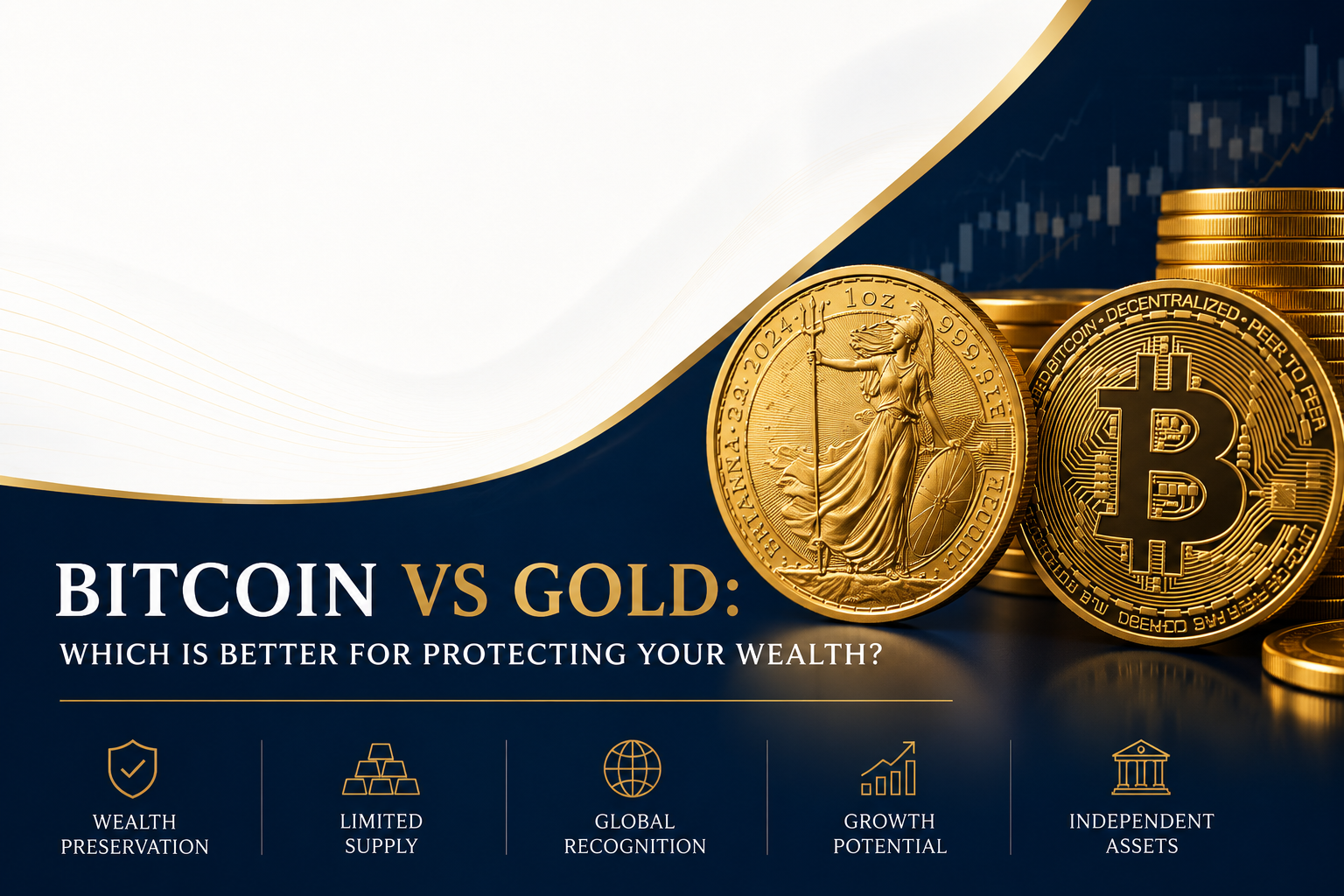
Bitcoin vs Gold: Which Is Better for Protecting Your Wealth?
Jul
Bitcoin vs Gold: Which Is Better for Protecting Your Wealth?
For decades, gold has been regarded as one of the world’s most trusted stores of wealth. More recently, Bitcoin has emerged as a digital alternative, with supporters arguing that it could play a similar role in the modern financial system.
Both assets have attracted significant attention from investors, institutions and governments. Both have limited supply, both operate independently of traditional currencies and both are often discussed during periods of inflation or economic uncertainty.
However, despite these similarities, Bitcoin and gold are fundamentally different assets.
Gold has been used as a form of money and a store of value for thousands of years. It is a tangible physical asset held by central banks, governments and private investors around the world. Bitcoin, by comparison, was created in 2009 and exists entirely in digital form, relying on blockchain technology to record ownership and transactions.
So, which is the better choice?
The answer depends on your financial objectives, your tolerance for risk and how you intend to preserve or grow your wealth.
In this guide, we’ll compare Bitcoin and gold across the factors that matter most, including history, scarcity, volatility, security, taxation, accessibility and long-term performance, helping you understand the strengths and weaknesses of each asset.
Key Takeaway
Gold and Bitcoin are both scarce assets that many people use to preserve wealth, but they serve different purposes. Gold has over 5,000 years of history, lower volatility and widespread acceptance by central banks. Bitcoin offers fixed supply, digital ownership and significant growth potential, but with considerably greater price volatility. Many investors choose to own both assets as part of a diversified portfolio.
Contents
- What Is Gold?
- What Is Bitcoin?
- Why Are Bitcoin and Gold Compared?
- Bitcoin vs Gold at a Glance
- Gold’s Greatest Advantage: History
- Scarcity: Natural vs Digital
What Is Gold?
Gold is a naturally occurring precious metal that has been valued for more than 5,000 years.
Throughout history it has been used as currency, jewellery, a symbol of wealth and, more recently, as an investment and reserve asset. Even today, central banks continue to hold thousands of tonnes of gold as part of their official reserves, reinforcing its role as one of the world’s most trusted stores of value.
Unlike paper money, gold cannot be created by governments or central banks. Every ounce must first be discovered, mined, refined and transported before it reaches the market.
This limited natural supply is one of the reasons gold has maintained its value over long periods.
Today, investors can own gold in several forms, including:
- Gold bullion coins
- Gold bars
- Certified (graded) gold coins
- Gold Exchange Traded Funds (ETFs)
- Shares in gold mining companies
Many investors choose physical gold because they own the asset outright, without relying on a financial institution or digital platform.
In the UK, many investment-grade gold products also benefit from favourable tax treatment. Qualifying investment gold is exempt from VAT in the UK, while UK legal tender gold coins such as Sovereigns and Britannias are also exempt from Capital Gains Tax (CGT) for UK taxpayers.
These tax advantages make certain UK gold coins particularly attractive for long-term wealth preservation.
What Is Bitcoin?
Bitcoin is the world’s first decentralised cryptocurrency.
Created in 2009 by the anonymous developer (or group) known as Satoshi Nakamoto, Bitcoin was designed as a peer-to-peer electronic payment system that does not depend on a central authority to validate transactions.
Rather than existing physically, Bitcoin exists entirely on a decentralised blockchain—a digital ledger that records every transaction ever made.
One of Bitcoin’s defining characteristics is its fixed supply.
Only 21 million Bitcoins will ever exist.
Unlike traditional currencies, governments cannot create additional Bitcoin or increase its supply during periods of economic uncertainty.
This scarcity has led many supporters to refer to Bitcoin as “digital gold.”
Bitcoin can be bought through cryptocurrency exchanges and stored in digital wallets, allowing owners to transfer value almost instantly anywhere in the world.
While adoption has increased significantly since its launch, Bitcoin remains considerably younger and substantially more volatile than gold.
Why Are Bitcoin and Gold Compared?
At first glance, Bitcoin and gold appear to have very little in common.
One is a physical precious metal that has been valued for thousands of years.
The other is a digital asset created less than two decades ago.
Yet they are frequently compared because they share several important characteristics.
Limited Supply
Neither asset can be produced without restriction.
Gold is naturally scarce because new deposits are increasingly difficult and expensive to discover and mine.
Bitcoin’s scarcity is programmed directly into its software, limiting total supply to exactly 21 million coins.
Independence from Governments
Neither gold nor Bitcoin can be printed or created at the discretion of a central bank.
This makes both attractive to people concerned about inflation, currency devaluation or excessive government borrowing.
Global Recognition
Gold is recognised and traded in virtually every country.
Bitcoin can also be bought, sold and transferred internationally, although regulation varies between jurisdictions.
Alternative Stores of Wealth
Many investors view both assets as alternatives to traditional investments such as cash or shares.
During periods of economic uncertainty, discussions surrounding both gold and Bitcoin often increase as people look for ways to preserve purchasing power.
However, despite these similarities, the differences between the two assets are arguably far more significant.
Bitcoin vs Gold at a Glance
|
Feature |
Gold |
Bitcoin |
|---|---|---|
|
History |
Over 5,000 years |
Since 2009 |
|
Physical Asset |
✔ Yes |
✘ No |
|
Supply |
Naturally limited |
Fixed at 21 million |
|
Central Banks Hold It |
✔ Yes |
Very limited |
|
Volatility |
Lower |
Higher |
|
Tangible |
✔ Yes |
✘ No |
|
Requires Internet |
✘ No |
✔ Yes |
|
Used in Industry |
✔ Yes |
✘ No |
|
Income Produced |
✘ No |
✘ No |
|
Counterparty Risk |
None when held physically |
Depends on storage method |
|
Market Maturity |
Highly established |
Still developing |
|
UK Tax Advantages |
Investment gold VAT exempt and eligible UK legal tender coins CGT exempt |
No equivalent tax advantages |
|
Typical Investor Objective |
Wealth preservation |
Growth potential |
This comparison highlights why many investors view the two assets differently.
Gold is generally associated with stability, wealth preservation and lower volatility, whereas Bitcoin is often viewed as a higher-risk asset with greater potential for long-term capital growth.
Gold’s Greatest Advantage: History
If there is one area where gold has a clear advantage over Bitcoin, it is history.
Gold has survived the rise and fall of empires, wars, financial crises and countless changes to the global monetary system.
Ancient Egyptians valued gold more than 5,000 years ago.
The Roman Empire used gold coins throughout its expansion.
The British Sovereign became one of the world’s most recognised gold coins during the nineteenth century.
Even after countries moved away from the Gold Standard, central banks continued holding significant gold reserves.
Today, gold remains one of the largest reserve assets held by central banks around the world.
This long history gives many investors confidence that gold is likely to remain valuable regardless of political or economic changes.
Bitcoin simply has not existed long enough to establish a comparable track record.
Although Bitcoin has experienced remarkable growth since 2009 and has gained increasing institutional acceptance, it has yet to experience the centuries of economic cycles that have shaped gold’s reputation.
For many investors, that distinction remains one of the biggest differences between the two assets.
Scarcity: Natural vs Digital
Scarcity is one of the strongest arguments in favour of both gold and Bitcoin.
However, the reason each asset is scarce is fundamentally different.
Gold’s Scarcity
Gold is scarce because nature limits its supply.
Mining companies invest billions of pounds each year exploring for new deposits, yet major discoveries have become increasingly rare.
Developing a new gold mine can take well over a decade, requiring exploration, environmental approvals, financing and construction before production begins.
Even when gold prices rise significantly, supply cannot be increased quickly.
This natural limitation is one reason gold has retained its value over centuries.
Bitcoin’s Scarcity
Bitcoin’s scarcity is mathematical rather than physical.
Its software ensures that no more than 21 million Bitcoins will ever exist.
New Bitcoins are introduced through a process known as mining, but the rate at which new coins are created decreases approximately every four years during an event known as the Bitcoin halving.
This predictable supply schedule is one of Bitcoin’s defining characteristics and a major reason why supporters compare it to gold.
Unlike gold, whose future supply depends on geological discoveries and mining investment, Bitcoin’s maximum supply is fixed by its underlying code.
Volatility: Stability vs Growth Potential
One of the biggest differences between gold and Bitcoin is volatility—the degree to which an asset’s price rises and falls over time.
While both assets have experienced significant price appreciation over the long term, the journey has been very different.
Gold has historically been viewed as a relatively stable asset. Although its price does fluctuate, movements are generally less dramatic than those seen in cryptocurrencies. Investors often turn to gold during periods of economic uncertainty because it has historically helped preserve purchasing power over the long term.
Bitcoin, on the other hand, is known for its substantial price swings.
It is not unusual for Bitcoin to rise or fall by more than 10% in a single day, while periods of gains exceeding 100% have often been followed by significant corrections.
For some investors, this volatility represents opportunity. For others, it introduces a level of risk they are uncomfortable accepting.
Neither approach is inherently right or wrong.
The key is understanding your own investment objectives and risk tolerance.
If preserving wealth with lower volatility is your priority, gold may be more suitable.
If you’re comfortable accepting greater risk in pursuit of potentially higher returns, Bitcoin may appeal more.
Inflation Protection
One of the main reasons investors buy both gold and Bitcoin is to protect themselves against inflation.
Inflation reduces the purchasing power of money over time. As the cost of goods and services rises, cash held in a bank account may buy less in the future than it does today.
Gold has historically been viewed as a hedge against inflation.
Although its price does not move in line with inflation every year, many investors see physical gold as a long-term store of value that has maintained purchasing power across generations.
Bitcoin supporters make a similar argument.
Because its supply is permanently capped at 21 million coins, they believe Bitcoin cannot be devalued through money printing in the same way as traditional currencies.
However, Bitcoin’s history is still relatively short compared with gold.
While it has performed strongly during certain periods, it has also experienced significant declines that make its long-term behaviour during different economic cycles more difficult to assess.
Gold’s reputation as an inflation hedge has been established over centuries.
Bitcoin’s role continues to evolve as adoption grows.
Why Do Central Banks Hold Gold Instead of Bitcoin?
Perhaps the biggest difference between the two assets can be seen in the decisions made by central banks.
Central banks collectively hold tens of thousands of tonnes of gold as part of their official reserves.
These reserves help diversify national assets, strengthen confidence in financial systems and provide liquidity during periods of economic stress.
Gold’s long history, global acceptance and deep liquidity make it well suited for this role.
By comparison, central bank ownership of Bitcoin remains extremely limited.
Although some governments have explored or accumulated Bitcoin in various ways, it has not yet become a widely adopted reserve asset.
There are several reasons for this:
- Bitcoin’s price remains considerably more volatile than gold.
- Regulatory approaches continue to evolve.
- Gold has an established global market with centuries of trust behind it.
- Central banks generally prioritise stability over growth.
This does not mean Bitcoin lacks value.
Rather, it illustrates that the two assets currently fulfil different roles within the global financial system.
Security: Physical Ownership vs Digital Ownership
Both gold and Bitcoin require secure storage, but the risks are different.
When purchasing physical gold, investors need to consider secure storage and insurance.
Many choose to store gold at home in a safe, while others prefer professional vault storage.
Provided it is stored securely, physical gold cannot be hacked, deleted or lost due to software failure.
Bitcoin security is different.
Ownership is controlled through cryptographic private keys.
If those keys are lost or stolen, access to the Bitcoin may be permanently lost.
Similarly, investors using cryptocurrency exchanges must consider cybersecurity risks and ensure they use reputable providers.
Neither asset is inherently more secure than the other.
Instead, each requires different security measures and different responsibilities from the owner.
Accessibility and Ease of Ownership
Buying both gold and Bitcoin has become significantly easier in recent years.
Physical gold can be purchased from reputable bullion dealers in the form of coins or bars.
In the UK, popular choices include Sovereigns, Britannias and investment-grade gold bars.
Ownership is straightforward, and many dealers offer fully insured delivery directly to your home.
Bitcoin can be purchased through cryptocurrency exchanges and stored in digital wallets.
Transactions can often be completed within minutes, allowing investors to transfer funds almost anywhere in the world.
However, this convenience also requires investors to understand wallet security, private keys and digital storage.
For many first-time investors, buying physical gold is often perceived as simpler because ownership closely resembles buying any other valuable physical asset.
Regulation and Government Oversight
Gold benefits from a long-established regulatory framework.
Bullion dealers, refiners and financial institutions operate within mature markets that have developed over many decades.
Pricing is transparent, global liquidity is strong and ownership is widely recognised.
Bitcoin regulation continues to evolve. In the UK, cryptoasset promotions and anti-money laundering requirements are already subject to regulatory controls, while a wider FCA authorisation regime is expected to take effect in October 2027. Regulation also differs significantly between jurisdictions, so investors should stay informed about changes that could affect taxation, reporting requirements and market access.
Gold’s regulatory environment is generally more stable, reflecting its long history within the global financial system.
UK Tax Treatment
Tax can be an important consideration when comparing Bitcoin and physical gold.
One of the advantages of buying physical gold in the UK is that qualifying investment gold is exempt from VAT.
In addition, certain UK legal tender gold coins—including Sovereigns and Britannias—are exempt from Capital Gains Tax (CGT) for UK taxpayers because they are recognised as legal tender.
This can provide a significant advantage for investors who realise gains over time.
Bitcoin is treated differently.
Profits made when selling or disposing of Bitcoin may be subject to Capital Gains Tax, depending on your individual circumstances and current UK tax rules.
As tax legislation can change, investors should always seek professional advice based on their own situation.
Understanding the tax treatment of each asset is an important part of making an informed decision, particularly for long-term investors.
Historical Performance
Comparing the historical performance of gold and Bitcoin is not straightforward because they have existed for very different lengths of time.
Gold has been used as a store of value for thousands of years and has experienced periods of both rising and falling prices. Over the long term, it has helped preserve purchasing power and has often performed well during times of economic uncertainty, high inflation and financial market volatility.
Bitcoin has delivered extraordinary returns since its launch in 2009, becoming one of the best-performing assets of the modern era. However, those returns have been accompanied by significant price volatility, with multiple periods where its value has fallen by more than 50% before recovering.
This highlights an important distinction.
Gold has a long-established history of preserving wealth.
Bitcoin has demonstrated exceptional growth potential but has also experienced much larger price fluctuations.
Past performance does not guarantee future returns, and both assets can rise or fall in value. Investors should ensure any investment decision reflects their own objectives, financial circumstances and tolerance for risk.
Can You Own Both?
Choosing between Bitcoin and gold does not necessarily have to be an either-or decision.
Many investors own both assets because they serve different purposes within a diversified portfolio.
Gold is often held as a long-term store of wealth and as a way of reducing overall portfolio volatility. It has historically been viewed as a defensive asset during periods of economic uncertainty.
Bitcoin is frequently viewed as a higher-risk, higher-growth asset. Investors who believe in the long-term potential of blockchain technology and digital assets may allocate a portion of their portfolio to Bitcoin while accepting that its price is likely to fluctuate significantly.
Holding both assets allows some investors to benefit from the different characteristics each offers, balancing stability with growth potential.
Who Might Choose Gold?
Physical gold may appeal to investors who:
- Want to preserve wealth over the long term.
- Prefer tangible assets they can own outright.
- Are looking for lower volatility than cryptocurrencies.
- Value thousands of years of historical acceptance.
- Appreciate the tax advantages available on eligible UK legal tender gold coins.
- Wish to diversify away from traditional financial markets.
Gold is often viewed as a long-term asset rather than a short-term speculation.
Who Might Choose Bitcoin?
Bitcoin may appeal to investors who:
- Are comfortable accepting higher levels of risk.
- Believe digital assets will play a greater role in the future financial system.
- Want exposure to an asset with significant long-term growth potential.
- Value rapid international transfers and digital ownership.
- Understand cryptocurrency wallets and private key security.
Bitcoin has attracted increasing institutional interest in recent years, but it remains a relatively young asset compared with gold.
Gold vs Bitcoin: Advantages and Disadvantages
Gold
Advantages
- More than 5,000 years of history as a store of wealth.
- Physical asset that can be owned outright.
- Generally lower volatility than Bitcoin.
- Held by central banks around the world.
- Investment-grade gold is VAT exempt in the UK.
- Eligible UK legal tender coins are exempt from Capital Gains Tax.
Disadvantages
- Requires secure storage.
- Does not generate income.
- Physical delivery takes time.
- Can experience periods of underperformance compared with higher-risk assets.
Bitcoin
Advantages
- Fixed maximum supply of 21 million coins.
- Can be transferred globally within minutes.
- Significant long-term growth potential.
- Increasing institutional and retail adoption.
- Easy to buy through cryptocurrency exchanges.
Disadvantages
- Highly volatile.
- Requires understanding of digital wallets and private keys.
- Subject to evolving regulation.
- No physical ownership.
- Capital Gains Tax may apply when profits are realised.
The UK’s Financial Conduct Authority (FCA) classifies cryptoassets as high-risk investments and warns that investors should be prepared to lose all the money they invest.
Frequently Asked Questions
Below are answers to some of the most common questions people ask when comparing Bitcoin and physical gold.
Is Bitcoin replacing gold?
No.
Although Bitcoin is often described as “digital gold”, the two assets currently serve different purposes. Gold remains widely held by central banks and has thousands of years of history as a store of value, while Bitcoin is a newer digital asset with a shorter track record.
Is gold safer than Bitcoin?
Historically, gold has experienced lower price volatility than Bitcoin and has been used as a store of wealth for centuries.
Bitcoin has the potential for higher returns but also carries significantly greater price risk.
Is Bitcoin more volatile than gold?
Yes.
Bitcoin has historically experienced much larger price swings than gold. While this has created opportunities for substantial returns, it has also resulted in periods of significant losses. Gold has generally demonstrated lower volatility and is often chosen by investors seeking greater stability.
Why do central banks buy gold instead of Bitcoin?
Central banks prioritise stability, liquidity and long-term confidence.
Gold has an established global market and forms part of many countries’ official reserves.
Bitcoin is not yet widely held by central banks due to its relatively short history and higher volatility.
Can I own both gold and Bitcoin?
Yes.
Many investors choose to own both assets as part of a diversified portfolio.
Gold may help provide stability, while Bitcoin offers exposure to the digital asset market and greater growth potential.
Which asset performs better during inflation?
Gold has a much longer history of helping preserve purchasing power during periods of inflation.
Bitcoin’s fixed supply has led many supporters to describe it as an inflation hedge, but its relatively short history means there is less long-term evidence available.
Which is easier to buy?
Both assets are now relatively easy to purchase.
Physical gold can be bought from reputable bullion dealers in the form of coins and bars, while Bitcoin is available through regulated cryptocurrency exchanges.
The right choice depends on your investment objectives and personal preferences.
At a Glance: Which Asset Might Suit You?
Gold may be more suitable if you:
- ✔ Want to preserve wealth over the long term.
- ✔ Prefer lower price volatility.
- ✔ Like owning a physical, tangible asset.
- ✔ Value more than 5,000 years of proven history.
- ✔ Want to benefit from the UK tax advantages available on eligible legal tender gold coins.
- ✔ Are looking to diversify away from traditional financial markets.
Bitcoin may be more suitable if you:
- ✔ Are comfortable with higher levels of risk.
- ✔ Want exposure to the cryptocurrency market.
- ✔ Believe in the long-term potential of blockchain technology.
- ✔ Value fast, global digital transactions.
- ✔ Are seeking greater long-term growth potential.
- ✔ Understand digital wallets and private key security.
Many investors choose both
Rather than viewing gold and Bitcoin as direct competitors, many investors hold both assets within a diversified portfolio.
Gold is often used to provide stability and preserve wealth, while Bitcoin offers exposure to a newer asset class with greater growth potential but higher volatility.
The right choice depends on your financial objectives, investment horizon and tolerance for risk.
Verdict: Gold or Bitcoin?
There is no universal answer.
If your priority is preserving wealth, reducing volatility and owning a tangible asset with thousands of years of history, gold is likely to be the more suitable choice.
If you’re seeking higher growth potential and are comfortable accepting significantly greater price volatility, Bitcoin may appeal more.
Many experienced investors choose not to see the two assets as competitors. Instead, they use each for a different purpose within a diversified portfolio.
The right choice ultimately depends on your financial goals, investment horizon and appetite for risk.
Final Thoughts
Gold and Bitcoin are often compared because both offer an alternative to traditional fiat currencies and both have limited supply.
However, they are fundamentally different assets.
Gold has more than 5,000 years of history, is held by central banks around the world and has earned a reputation as a long-term store of wealth.
Bitcoin represents a newer form of digital ownership with a fixed supply and significant growth potential, although it remains considerably more volatile and has a much shorter track record than gold.
Rather than asking whether one asset is objectively “better” than the other, a more useful question is which asset best aligns with your financial goals, investment horizon and tolerance for risk.
For some investors, physical gold provides reassurance through stability and tangible ownership.
For others, Bitcoin offers exposure to a rapidly evolving digital asset market.
Many investors choose to hold both, recognising that each can play a different role within a diversified portfolio.
The most important step is to understand the characteristics, risks and potential benefits of each asset before making any investment decision.
Learn More About Physical Gold
If you’re considering buying physical gold, these guides may also be helpful:
- How to Buy Gold Coins in the UK
- Bullion vs Certified Gold Coins
- Britannia Gold Coin Guide
- Understanding Gold Coin Grading
- How to Store Gold Coins Securely
Explore our Knowledge Centre for more educational guides covering physical gold, gold coins, bullion investing and the precious metals market.
Sources
This guide has been researched using information from recognised organisations and publicly available resources, including:
- World Gold Council
- Bank of England
- HM Revenue & Customs (HMRC)
- Financial Conduct Authority (FCA)
- Bitcoin White Paper by Satoshi Nakamoto
Information is believed to be accurate at the time of publication.
Disclaimer
This guide is provided for general information only and should not be considered financial, investment or tax advice. The value of investments can rise as well as fall, and past performance is not a guarantee of future results. You should seek independent professional advice before making any investment decisions.
