

Guides
PF69 vs PF70: What’s the Difference and Is PF70 Worth It?
Sep
PF69 and PF70 are two of the highest grades awarded to Proof coins by professional grading companies such as NGC.
On paper, there is only one grading point between them. In practice, that single point can sometimes result in a significant difference in certified population, collector demand and market price.
A PF70 represents the highest numerical Proof grade. A PF69 is a fully struck Proof coin with only nearly imperceptible imperfections.
For collectors of modern British gold coins, the important question is therefore not simply whether PF70 is better than PF69. It is whether the additional grade, scarcity and market demand justify the premium being asked for a particular coin.
NGC uses PF to identify Proof coins, while PCGS uses PR. This means the equivalent PCGS grades are PR69 and PR70. For more on the differences between the two grading companies, see our PCGS vs NGC guide.
For Mint State rather than Proof coins, see our MS69 vs MS70 guide.
⸻
At a Glance
PF70: The highest numerical Proof grade on the 70-point grading scale.
PF69: A near-perfect Proof coin with only nearly imperceptible imperfections.
Is PF70 better than PF69? Yes, technically. PF70 is the higher numerical grade.
Can you see the difference? Often not with the naked eye. The difference can be extremely small.
Is PF70 always rarer? No. The population figures for the individual coin need to be checked.
Is PF70 worth more? It can be, particularly when significantly fewer examples achieve PF70 and collector demand is strong.
Is PF70 always worth paying more for? No. The size of the premium needs to be considered alongside mintage, population, availability and demand.
⸻
What Does PF69 Mean?
PF is the designation NGC uses for Proof coins.
Proof coins are specially produced collector coins, typically manufactured using processes designed to create highly detailed designs and distinctive finishes.
NGC grades coins using the internationally recognised 1 to 70 numerical grading scale.
According to NGC’s official grading scale, PF69 describes a fully struck coin with nearly imperceptible imperfections.
A PF69 is therefore an exceptionally high-grade Proof coin.
The imperfection separating a PF69 from PF70 can be extremely small and may be difficult to identify without magnification and appropriate lighting.
This is one reason PF69 coins can sometimes offer collectors an opportunity to acquire an example that appears virtually perfect to the naked eye without paying the premium associated with PF70.
⸻
What Does PF70 Mean?
PF70 is the highest numerical grade available for a Proof coin.
Under NGC’s grading standard, a grade of 70 means there are no post-production imperfections visible at 5x magnification.
There is no PF71.
A PF70 coin therefore sits at the top of the numerical Proof grading scale.
However, this does not mean every PF70 coin is automatically rare or valuable.
Modern manufacturing standards can result in significant numbers of some coins achieving PF70. The importance of the grade therefore depends on the individual coin, how many examples have been certified and how much collector demand exists for perfect-grade examples.
This distinction between grade and scarcity is important throughout certified coin collecting.
⸻
PF69 vs PF70: What Is the Actual Difference?
The technical difference is one grading point.
|
Feature |
PF69 |
PF70 |
|---|---|---|
|
Proof coin |
Yes |
Yes |
|
Exceptionally high grade |
Yes |
Yes |
|
Highest numerical Proof grade |
No |
Yes |
|
Imperfections |
Nearly imperceptible |
No post-production imperfections visible at 5x magnification |
|
Can receive Ultra Cameo |
Yes |
Yes |
|
Automatically rare |
No |
No |
|
Automatically worth a large premium |
No |
No |
Although the numerical difference is small, the difference in certified population can sometimes be much larger.
Imagine 1,000 examples of a particular Proof coin have been graded:
750 achieve PF69
150 achieve PF70
In that hypothetical example, PF70 represents a much smaller proportion of the certified population.
Now consider another coin where:
400 achieve PF69
550 achieve PF70
PF70 remains technically the superior grade, but PF70 examples are not scarcer within that certified population.
That is why the number 70 by itself does not tell you enough.
⸻
Can You See the Difference Between PF69 and PF70?
Sometimes, but often the difference is extremely difficult to see with the naked eye.
PF69 is already an exceptionally high grade.
NGC defines PF69 as a fully struck coin with nearly imperceptible imperfections while PF70 requires no post-production imperfections to be visible at 5x magnification.
The physical distinction can therefore be minute.
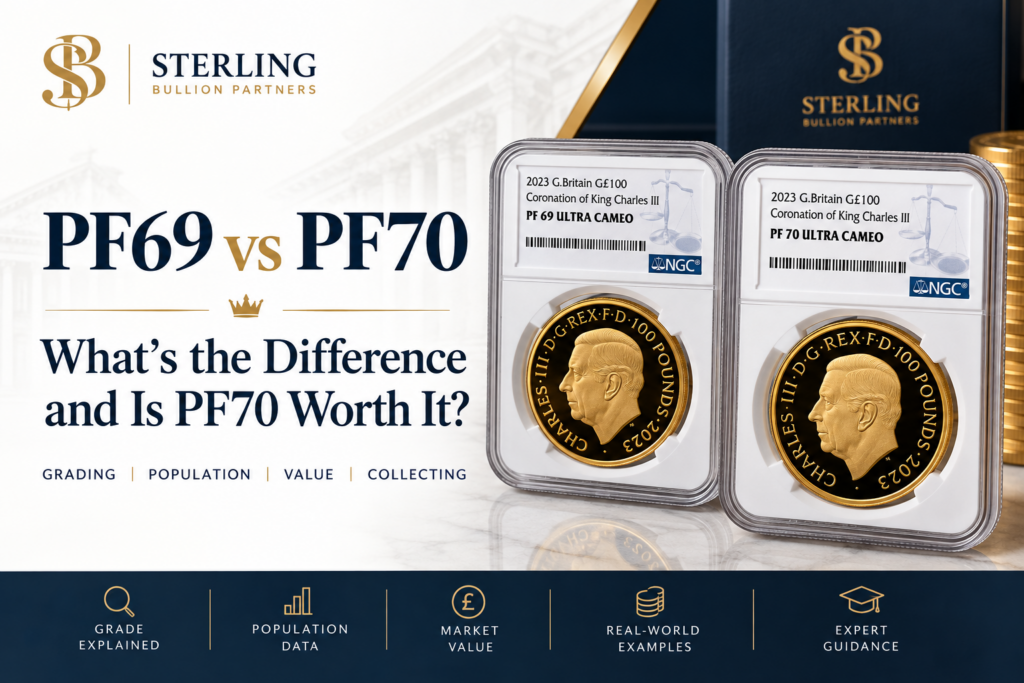
Once both coins are encapsulated in grading holders, many collectors may find it difficult to identify which is PF69 and which is PF70 purely from normal viewing.
This creates an important distinction between visual appearance and certified grade.
A PF69 may appear virtually perfect to the unaided eye, while professional grading has identified a small enough difference to prevent it achieving PF70.
⸻
Is PF70 Better Than PF69?
Technically, yes.
PF70 is one point higher and represents the highest numerical Proof grade.
But when deciding which coin to buy, higher grade does not automatically mean better value.
Consider two hypothetical examples of the same coin:
PF69: £2,000
PF70: £2,100
If the PF70 population is substantially smaller and there is strong demand for perfect-grade examples, the additional £100 may be attractive to a collector.
Now consider:
PF69: £2,000
PF70: £3,500
The PF70 is still technically the higher grade, but the buying decision is very different.
The collector now needs to establish what justifies the additional £1,500.
That is why a graded coin should never be assessed solely from the number on its holder.
⸻
Is PF70 Worth More Than PF69?
PF70 will often command a premium over PF69 for the same coin, but there is no universal PF70 premium.
The difference in market value can depend on:
- original mintage
- PF69 population
- PF70 population
- proportion of certified examples achieving PF70
- collector demand
- availability
- historical significance
- First Releases or other designations
- certification label
- comparable market sales
For some coins, the difference between PF69 and PF70 may be relatively modest.
For others, particularly where PF70 examples are considerably more difficult to obtain, the difference can be significant.
This is why checking the actual population data is important.
Our guide What Is a Coin Population Report? explains how NGC and PCGS population figures work, what they can tell collectors and their limitations.
⸻
Does a Low PF70 Population Make a Coin Rare?
It can indicate scarcity within that particular certification grade, but it does not automatically make the underlying coin rare.
Suppose a gold Proof coin has:
Original mintage: 5,000
NGC PF69 population: 400
NGC PF70 population: 40
There may be only 40 examples recorded by NGC at PF70, but that does not mean only 40 examples of the coin exist.
The original mintage remains 5,000.
What the population figure tells us is how many examples are recorded by NGC within that particular grade and category at the time the Census is checked.
A low PF70 population can therefore reveal a different form of scarcity:
condition rarity.
This is distinct from the original scarcity created by the coin’s mintage.
Our Coin Population vs Mintage guide explains why these two measurements should never be treated as the same thing.
⸻
What Does PF70 Ultra Cameo Mean?
Many modern NGC-certified Proof gold coins are labelled:
PF70 ULTRA CAMEO
This combines two different aspects of the certification.
PF70
PF70 is the numerical grade.
It represents the highest grade on NGC’s numerical Proof scale.
Ultra Cameo
Ultra Cameo is a separate designation relating to the appearance of a Proof coin.
NGC describes qualifying Ultra Cameo Proofs as having deeply mirrored fields and heavily frosted devices that create bold contrast on both sides of the coin.
NGC explains this distinction in its official guidance on Cameo and Ultra Cameo designations.
A coin can therefore be:
PF69 Ultra Cameo
or
PF70 Ultra Cameo
Both can exhibit the Ultra Cameo characteristics. The difference between them is the numerical grade.
⸻
PF69 Ultra Cameo vs PF70 Ultra Cameo
When comparing these two certifications, Ultra Cameo is not the differentiating factor.
Both coins have received the same Ultra Cameo designation.
The difference is:
PF69 Ultra Cameo = near-perfect numerical grade + Ultra Cameo designation
PF70 Ultra Cameo = highest numerical grade + Ultra Cameo designation
Collectors should therefore avoid assuming that the words Ultra Cameo automatically mean a coin has received PF70.
Ultra Cameo and PF70 describe separate characteristics.
⸻
Why Can PF70 Cost So Much More Than PF69?
The answer is usually scarcity combined with collector demand, rather than the visible difference alone.
If a particular coin is difficult to obtain in PF70, collectors seeking the highest numerical grade may be competing for a relatively small number of certified examples.
This can create a price premium that appears disproportionate to the tiny physical difference between PF69 and PF70.
Consider a hypothetical population:
PF69: 500
PF70: 25
A collector looking specifically for PF70 is competing within a much smaller certified pool.
If demand for that particular coin is strong, the premium can become significant.
But reverse the figures:
PF69: 100
PF70: 600
and the argument for paying a very large premium simply because the holder says PF70 becomes considerably weaker.
This is why the population report should be checked before assuming PF70 scarcity.
⸻
PF69 vs PF70 for British Gold Coins
The PF69 versus PF70 distinction is particularly relevant to modern British gold coins.
NGC and PCGS certify numerous Royal Mint Proof issues, including:
- Proof Sovereigns
- Five Sovereign gold coins
- Britannia gold Proofs
- commemorative £5 gold coins
- Royal Mint series and special issues
Many of these coins were originally produced in relatively limited numbers.
Third-party grading can then reveal a second form of scarcity: condition rarity.
Only a proportion of the original mintage may have been submitted for grading and only a proportion of those submitted examples may have achieved PF70.
For example, a coin could have an original mintage of several hundred examples but only a relatively small recorded PF70 population.
That combination may be more meaningful to collectors than either figure viewed independently.
This is why original Royal Mint issue figures and third-party grading populations should be treated as separate measurements rather than presented as the same measure of rarity.
⸻
PF69 vs PF70 Sovereigns
Proof Sovereigns provide a particularly useful example because collectors can encounter both PF69 and PF70 examples of the same year and design.
When comparing them, consider several factors.
Original mintage
How many examples were originally produced?
PF70 population
How many examples have achieved the highest numerical grade?
PF69 population
How does PF70 availability compare with the grade immediately below it?
Market premium
How much more does the PF70 actually cost?
Collector demand
Is there evidence that collectors particularly seek the issue in perfect grade?
Historical significance
Is the Sovereign an important date, portrait, design or commemorative issue?
The fact that one holder says PF70 and another says PF69 is therefore the beginning of the comparison rather than the end of it.
⸻
Is PF69 Better Value Than PF70?
Sometimes.
PF69 can be particularly attractive when:
- the visual difference is negligible
- PF70 is relatively common
- the PF70 premium is disproportionately large
- the collector prioritises the underlying coin over having the highest possible grade
A collector could potentially obtain a near-perfect PF69 example and use the price difference elsewhere within a collection.
PF70 can be more attractive when:
- the PF70 population is genuinely low
- PF70 represents a small proportion of certified examples
- collector demand for the highest grade is strong
- the premium over PF69 is reasonable
- the buyer specifically wants the highest numerical grade
Neither answer is universally correct.
The numbers need to make sense for the individual coin.
⸻
PF69 vs PF70: Which Should You Buy?
A useful way to compare them is:
Coin → Mintage → Grade → Population → Demand → Price
rather than simply:
70 → therefore buy it
For a collector focused on obtaining the highest numerical grade, PF70 is clearly the target.
For someone primarily interested in owning the underlying coin at an attractive price, PF69 may sometimes offer better value.
For someone building a collection or portfolio around low-mintage, high-grade British gold coins, the more important question may be whether the PF70 population and price create a compelling combination of original scarcity and condition rarity.
The right decision therefore depends on the individual coin rather than a blanket rule that PF70 should always be bought instead of PF69.
⸻
Frequently Asked Questions
What is the difference between PF69 and PF70?
PF70 is the highest numerical Proof grade. PF69 is one grade below and describes a fully struck Proof coin with nearly imperceptible imperfections.
Is PF70 better than PF69?
Technically, yes. PF70 is the higher numerical grade. Whether it represents better value depends on population, scarcity, demand and price.
Can you see the difference between PF69 and PF70?
Often the difference is extremely difficult to see with the naked eye. The imperfection preventing a PF69 from achieving PF70 can be minute.
Is PF70 perfect?
Under NGC’s grading standard, PF70 means there are no post-production imperfections visible at 5x magnification.
Is PF69 still a good grade?
Yes. PF69 is an exceptionally high Proof grade and is only one numerical point below PF70.
Is PF70 worth more than PF69?
PF70 can command a premium, but the size of that premium varies significantly between coins.
Is PF70 always rarer than PF69?
No. Some modern issues have substantial PF70 populations. The population report for the individual coin should be checked.
What does PF70 Ultra Cameo mean?
PF70 is the highest numerical Proof grade. Ultra Cameo is a separate designation describing strong contrast between deeply mirrored fields and heavily frosted devices.
Can a PF69 coin be Ultra Cameo?
Yes. PF69 and PF70 Proof coins can both receive the Ultra Cameo designation when they meet NGC’s requirements.
Does a low PF70 population mean the coin has a low mintage?
No. Mintage and certified population measure different things. A coin can have a larger original mintage but a relatively small PF70 population.
Is PF69 better value than PF70?
It can be. If the visual difference is negligible and the PF70 premium is large relative to its scarcity, PF69 may offer an attractive alternative.
Should I always buy PF70?
No. PF70 is the highest numerical grade, but the underlying coin, mintage, population, collector demand and price should all be considered.
Is PF70 the same as PR70?
The grades are equivalent in numerical position, but the terminology differs between grading companies. NGC uses PF for Proof coins while PCGS uses PR, meaning an NGC PF70 and PCGS PR70 both represent the highest numerical Proof grade used by their respective services.
⸻
Final Thoughts
PF69 and PF70 are separated by only one point on the grading scale, but that one point can have very different implications depending on the coin.
PF70 represents the highest numerical Proof grade, while PF69 represents an exceptionally high-grade Proof coin with only nearly imperceptible imperfections.
For many modern Proof coins, the visual difference can be extremely difficult to detect without close examination.
The potentially significant difference is often found elsewhere: in the population report and the market price.
If relatively few examples achieve PF70 and collectors actively seek the coin in perfect grade, a PF70 premium may be justified.
If PF70 examples are plentiful or the premium is disproportionately large, a PF69 may provide a different value proposition.
For collectors of certified British gold coins, the most useful approach is therefore to consider mintage, grade, population, demand and price together.
The grade matters.
But the number on the holder should never be considered in isolation.
