

Guides
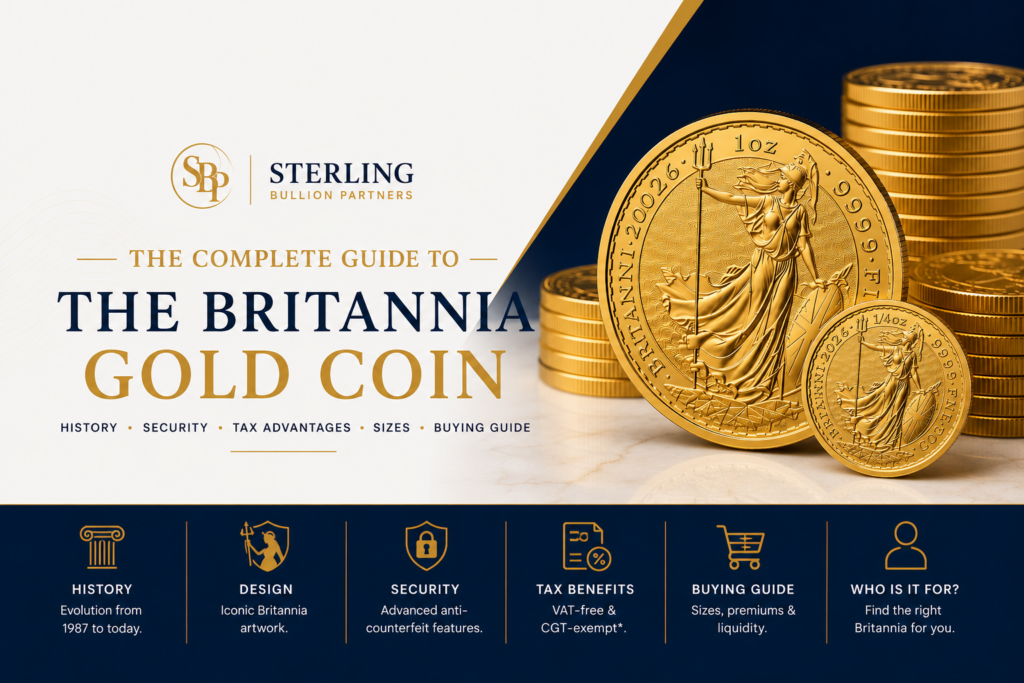
The Complete Guide to the Britannia Gold Coin
Jul
The Complete Guide to the Britannia Gold Coin
About this guide
Review date: 9 July 2026 (Europe/London).
Purpose: This guide explains everything a first‑time buyer needs to know about the Royal Mint’s flagship bullion coin, the Gold Britannia. It is an educational resource and not financial advice. Laws and market conditions change; always confirm current tax rules and consult a professional adviser where appropriate.
Educational disclaimer: Investing in precious metals involves risk. None of the information in this guide constitutes personal financial advice. The Royal Mint highlights that bullion prices can be volatile and that investors should consider their personal circumstances before buying .
Who should read this guide?
- People thinking about buying their first gold Britannia.
- Investors comparing Britannias with other bullion coins or bars.
- Collectors interested in proof Britannias and special issues.
- Anyone who wants to understand why Britannias are VAT‑free and CGT‑exempt in the UK.
Contents
- Introduction
- History of the Britannia coin
- Specifications and sizes
- Design and symbolism
- Security features
- Tax advantages
- Bullion vs proof Britannias
- Buying Britannias safely
- Storing and insuring your coins
- Selling Britannias
- Frequently asked questions
- Conclusion and related guides
Introduction
Quick answer: The Britannia is the Royal Mint’s flagship bullion coin. Introduced in 1987, it combines a long‑standing British symbol with modern security features and favourable UK tax treatment . Investors value Britannias for their reliability, beauty and liquidity.
The Gold Britannia sits alongside other iconic coins such as the Sovereign, Maple Leaf and American Eagle. Unlike many foreign coins, Britannias are legal tender in the UK, which gives them unique tax advantages. This guide explains the coin’s history, specifications, security features and how to buy, store and sell Britannias confidently.
History of the Britannia coin
Origins of the Britannia motif
Britannia is the personification of Britain. The figure first appeared on Roman coins around AD 119 during the reign of Emperor Hadrian and symbolised the province of Britannia . After disappearing for more than a millennium, she was revived on English coins in 1672 under King Charles II. During the age of sail, Britannia held a spear and olive branch, conveying British naval power and peace . She reappeared on the famous 1797 cartwheel pennies, depicted with a trident, rocks, sea and ship to emphasise maritime strength .
Britannia continued to adorn various bronze and copper coins until decimalisation in 1971 and even appeared on 50‑pence coins until 2008 . In 2015 she returned on the definitive £2 coin.
Launch of the Gold Britannia (1987)
By the mid‑1980s, demand for bullion coins surged worldwide as investors sought alternatives to the South African Krugerrand. In response, the Royal Mint introduced the Gold Britannia in 1987. The coin features Philip Nathan’s striking design of Britannia standing by the sea, holding a trident, shield and olive branch . The obverse bears the portrait of the reigning monarch; early issues show Queen Elizabeth II, while coins from 2023 onwards feature King Charles III.
The first Gold Britannia coins were struck in 22‑carat (0.917 fine) gold, containing exactly one troy ounce (31.10 g) of pure gold . Until 1989, the alloying metal was copper; from 1990 it switched to silver .
Purity change to 24 carat (2013)
In 2013, the Royal Mint increased the purity of Gold Britannia coins from 22 carats to 24 carats (0.9999 fine) . This change aligned Britannias with other high‑purity bullion coins such as the Canadian Maple Leaf and Austrian Philharmonic. The dimensions were slightly altered to reflect the new composition , though the coins still contain exactly one troy ounce of gold. The obverse design also transitioned: King Charles III first appeared on Britannias in 2024.
Expansion into silver and platinum
Following the success of the gold coin, the Royal Mint introduced Silver Britannias in 1997 and Platinum Britannias in 2018 . While this guide focuses on gold, many of the design and security features apply across the metals.
Why Britannia coins were created
Britannias were designed to give investors a British alternative to popular bullion coins such as the Krugerrand, Maple Leaf and American Eagle . They offer global recognition, exceptional purity and the reassurance of the Royal Mint’s quality standards. Their legal tender status also gives UK investors unique tax advantages, discussed later.
Specifications and sizes
Gold Britannias are available in several weights, making them accessible to a wide range of budgets. The table below summarises the current specifications for coins minted from 2013 onwards. Each coin contains pure gold and carries a nominal face value in pounds sterling, though the bullion value far exceeds the face value.
|
Weight (oz) |
Diameter (mm) |
Weight (g) |
Face value |
Notes |
|---|---|---|---|---|
|
1/20 |
12.0 |
1.58 |
£5 |
Fractional coin introduced in 2013 |
|
1/10 |
16.5 |
3.13 |
£10 |
Common entry‑level option |
|
1/4 |
22.0 |
7.86 |
£25 |
Quarter‑ounce coin |
|
1/2 |
27.0 |
15.60 |
£50 |
Half‑ounce coin |
|
1 |
32.69 |
31.10 |
£100 |
Flagship one‑ounce coin |
|
5 |
65.0 |
156.295 |
£500 |
Five‑ounce coin |
Key points:
- Purity: Coins minted from 2013 onwards are 24‑carat (0.9999 fine) gold . Pre‑2013 coins are 22‑carat with copper (until 1989) or silver (from 1990) as the alloy .
- Weight: Each denomination contains the stated amount of pure gold. For example, the one‑ounce coin weighs 31.10 g of gold and 31.10 g total (the alloy in pre‑2013 coins adds extra weight).
- Face value: As legal tender, Britannia coins have nominal face values (£5 to £500). In practice, their value is based on gold content.
Older specifications (1987–2012)
For collectors, pre‑2013 Britannias have different dimensions. The one‑ounce coin has a diameter of 32.69 mm and total weight of 34.05 g due to the 22‑carat alloy . Half‑, quarter‑ and tenth‑ounce coins follow similar patterns .
Design and symbolism
Philip Nathan’s iconic design
Sculptor Philip Nathan created the original Britannia design in 1987. His depiction shows Britannia standing by the sea with a shield (representing protection), an olive branch (peace) and a trident (naval strength) . The motif blends classical and modern elements, making it instantly recognisable worldwide. The Royal Mint continues to use Nathan’s design for the bullion version, with slight refreshes to incorporate security features.
Changing obverse portraits
The obverse of each Britannia gold coin features the reigning monarch. Early coins show Queen Elizabeth II; her portrait was updated in 1998 by Ian Rank‑Broadley. A new effigy of King Charles III first appeared on Britannia coins in 2024. Collectors sometimes value coins from key transition years.
Reverse design variations
Although the bullion coin retains Nathan’s standing Britannia, proof editions and special releases feature alternate depictions – seated Britannia, Britannia in a chariot, helmeted Britannia or incorporating the Union Flag . These artistic variations add collector appeal but do not affect gold content.
Security features
In 2021 the Royal Mint introduced four innovative security elements to make Britannia coins the world’s most visually secure bullion coins. These features enable investors to verify authenticity by simply tilting the coin in the light:
- Latent image: A tiny hologram that switches between a padlock and a trident when viewed from different angles .
- Micro‑text: The inscription “DECUS ET TUTAMEN” (Latin for “an ornament and a safeguard”) surrounds Britannia and is engraved using specialist lasers .
- Tincture lines: Fine engraving lines depict colours and patterns, reviving a traditional heraldic technique that is extremely hard to replicate .
- Surface animation: Micro details create the illusion of waves rolling behind Britannia when the coin is rotated .
These security elements are produced using advanced picosecond laser technology, which allows the Royal Mint to create features 200 times narrower than a human hair . The combination of design and technology makes Britannia coins extremely difficult to counterfeit, enhancing trust and liquidity .
Trial of the Pyx
Each year the Trial of the Pyx – a 700‑year‑old ceremony held at Goldsmiths’ Hall in London – verifies the weight and quality of Britannia coins and other UK coins. Independent judges test a random sample of coins to confirm they meet the specifications set by law. This tradition reinforces confidence in the coin’s purity and weight .
Tax advantages
Capital Gains Tax (CGT)
The UK charges Capital Gains Tax on profits from selling assets such as property, shares or bullion. However, all bullion coins produced by The Royal Mint – including Britannias – are exempt from CGT because they are legal British currency . This exemption means investors can realise unlimited tax‑free gains when selling Britannias, irrespective of the sale amount . In contrast, bullion bars and foreign coins (e.g. Krugerrands, Maple Leafs) are subject to CGT .
Key takeaway: Because Britannias are UK legal tender, profits from selling them are not subject to Capital Gains Tax . This advantage can make Britannias more attractive than other forms of gold for long‑term UK investors.
VAT
Investment gold is exempt from Value Added Tax (VAT) in the UK and EU. HMRC defines an investment gold coin as a gold coin minted after 1800 that:
- Has a purity of at least 900 thousandths (i.e. 90% pure).
- Is, or has been, legal tender in its country of origin.
- Is normally sold at a price not exceeding 180% of its gold content .
Gold Britannia coins meet all three criteria. Consequently, when you buy Britannias in the UK, the price you pay already includes the metal value and dealer premium; no VAT is added. Investors buying silver coins should note that silver Britannias are subject to VAT because investment silver is taxed differently.
Bullion vs proof Britannias
Britannia coins are issued in two main finishes:
Bullion coins
- Purpose: Designed for investment; their value tracks the gold spot price plus a small premium.
- Finish: Standard minting; small imperfections may occur.
- Mintage: Unlimited; produced according to demand.
- Suitability: Ideal for investors looking for low premiums, easy resale and tax advantages.
Proof coins
- Purpose: Created for collectors; minted with highly polished dies and multiple strikes to achieve a mirror‑like finish.
- Finish: Frosted design on a mirror background; packaged in presentation boxes with certificates.
- Mintage: Limited; often part of annual sets or special editions.
- Suitability: Appeals to collectors who value artistry, rarity and potential numismatic premiums. Proof coins carry higher premiums and may not track spot prices closely.
Buying Britannias safely
Common mistake: Many beginners focus solely on the spot price and ignore dealer reputation or authenticity. Always purchase Britannias from reputable sources. The Royal Mint advises investors to authenticate coins by checking security features and to choose dealers with good reviews and industry accreditations.
When evaluating a dealer, consider:
- Reputation: Look for membership of recognised organisations (e.g. LBMA, BNTA) and independent customer reviews.
- Pricing: Compare premiums above spot and be wary of offers that seem too good to be true.
- Authentication: Examine the security features (latent image, micro‑text, etc.) and request certificates for proof coins.
- Buy‑back policy: Understand how easily you can sell the coin back to the dealer.
Did you know? The Royal Mint’s own bullion website offers direct purchase and buy‑back services. Many private dealers also offer storage solutions and insured delivery.
Storing and insuring your coins
Gold coins are durable but still need proper storage:
- Home storage: A home safe provides convenient access but may require specialist insurance. Split storage (e.g. separate locations) can reduce the risk of total loss.
- Professional vaults: Many dealers and specialist vault providers offer insured storage. Fees vary but can be worth it for high‑value holdings.
- Capsules and cases: Keep bullion coins in protective capsules to prevent scratches. Proof coins usually come in capsules and presentation boxes.
Check with your insurer whether your home policy covers bullion. In many cases, you need to declare valuables separately.
Selling Britannias
One reason Britannias remain popular is their liquidity. Because they are legal tender and have advanced security features, they are widely recognised by dealers and collectors worldwide. When selling:
- Get multiple quotes: Compare buy‑back prices from different dealers to ensure a fair offer.
- Present proof coins with certificates: This helps achieve the best price for limited‑edition issues.
- Consider timing: Gold prices fluctuate; selling during a price surge can maximise returns.
- Keep records: Document purchase prices and dates for your own records.
Frequently asked questions
Are Gold Britannia coins pure gold?
Coins minted from 2013 onwards are 0.9999 fine (24 carat) . Pre‑2013 coins are 0.917 fine (22 carat) .
Are Britannia coins legal tender?
Yes. Each coin carries a face value (£5 to £500) and is legal tender in the UK . Their bullion value far exceeds the face value.
Do I pay VAT when buying Britannia coins?
No. Gold Britannias meet HMRC’s definition of investment gold coins , so they are VAT‑free in the UK.
Are Britannia coins exempt from Capital Gains Tax?
Yes. Bullion coins produced by the Royal Mint, including Britannias, are CGT‑exempt for UK residents .
How do I verify a Britannia coin is genuine?
Check the four security features (latent image, micro‑text, tincture lines and surface animation) . Buying from reputable dealers and using certified storage reduces the risk of counterfeits.
Are proof Britannias a good investment?
Proof coins can carry numismatic premiums and limited mintages. However, they are more expensive and may not track spot gold closely. Collectors often buy them for artistry rather than pure investment.
What sizes of Britannia are available?
Gold Britannias are minted in fractional sizes from 1/20 oz to 5 oz . The one‑ounce coin remains the most popular.
Do Britannias come in silver or platinum?
Yes. Silver Britannias were introduced in 1997 and platinum Britannias in 2018 . These coins have different specifications and tax treatment; silver Britannias are subject to VAT.
Conclusion and related guides
The Britannia gold coin combines historic symbolism, modern security and favourable UK tax rules. It offers investors a globally recognised way to own physical gold while benefiting from VAT and Capital Gains Tax exemptions. Whether you buy a single coin or build a long‑term holding, understanding the history, specifications and security features of Britannias will help you make an informed decision.
For more detailed comparisons and related topics, explore our other guides:
- Britannia vs Sovereign – compare the two most popular UK gold coins.
- Gold Coins vs Gold Bars – understand the pros and cons of coins versus bars.
- Bullion vs Certified Coins – learn the difference between standard bullion and graded coins.
- Understanding Coin Grading – a primer on grading scales and why they matter.
Key takeaway: Britannia coins offer a balanced combination of purity, recognition, security, and tax efficiency. For UK investors seeking a reliable and liquid way to own gold, Britannias remain a top choice.
