

Guides
How to Buy Gold Coins in the UK | Complete Beginner’s Guide
Jul
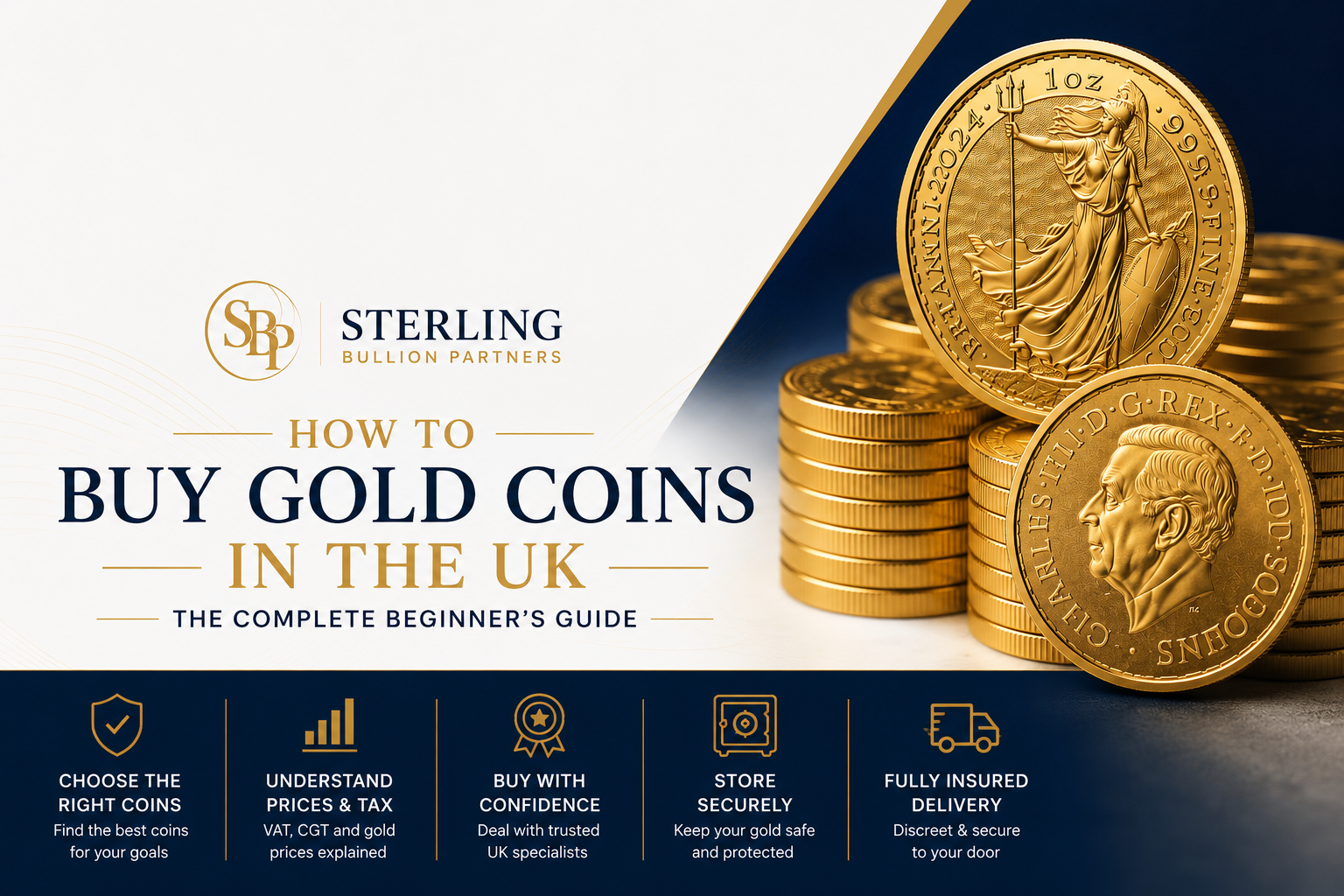
How to Buy Gold Coins in the UK: The Complete Beginner’s Guide
Buying physical gold for the first time can be intimidating. With dozens of different coins, numerous dealers and mountains of online opinions, newcomers often feel overwhelmed. You might be comparing Britannias, Sovereigns and gold bars, following the live gold price or simply trying to understand why gold has remained popular for centuries. Whatever brings you here, you are not alone. This guide has been created to answer the most common questions in plain English and to provide the knowledge needed to make informed decisions.
About this guide
This document is part of a series of educational resources and is designed to be the definitive starting point for anyone considering buying gold coins in 2026. It is not a sales brochure. Our goal is to help you understand how the market works so you can decide what’s right for you. Nothing in this guide constitutes financial, investment or tax advice, and tax treatment depends on your personal circumstances and may change. Always consult an independent professional if you are unsure about your own situation.
Is This Guide for You?
This guide is written for anyone who wants to understand physical gold before making a purchase. It will be particularly useful if you:
- Are buying gold for the first time. Maybe you’ve heard friends talk about owning gold or you’ve read about gold in the news and want to know where to start.
- Want to understand the differences between Britannias and Sovereigns. These are the UK’s two flagship bullion coins, but they serve different purposes and it helps to know why.
- Are comparing bullion and certified coins. Not all gold coins are created equal; some are designed as investment pieces, others are produced for collectors.
- Want to understand VAT and Capital Gains Tax. Tax is one of the main reasons people choose particular coins. Knowing the rules can make a big difference.
- Are looking for a reputable UK dealer. The gold industry is unregulated. Choosing the right dealer is essential for receiving genuine products at fair prices.
- Prefer to research before making an important purchase. This guide provides the depth needed for thorough research without hidden agendas or marketing hype.
If any of the above sounds like you, then you’re in the right place. Keep reading to learn everything you need to know about buying gold coins in the UK.
Before You Choose a Coin, Ask Yourself Why
Before comparing coins, it helps to understand why you want to own physical gold. People buy gold for many different reasons. Some want a tangible asset they can hold and pass down to future generations. Others appreciate British coinage and enjoy collecting Royal Mint releases. Many investors simply want to diversify their portfolios. Clarifying your objective makes selecting the right coin much easier.
For example:
- A modern bullion buyer may be naturally drawn to the Britannia because it provides the lowest premium per ounce and the most up‑to‑date security features.
- Someone who appreciates British history may prefer the Sovereign, which has been produced for over 200 years and carries a rich heritage.
- A collector might place greater value on independently certified coins with exceptional grades and limited mintages.
There isn’t a universally “best” gold coin. The right choice depends on your priorities, budget and interests. This guide will help you explore those options step by step.
What You’ll Learn
By the end of this guide you will understand:
✓ Why people buy physical gold and how to clarify your own reasons.
✓ The pros and cons of gold coins versus gold bars.
✓ Which Royal Mint coins are most popular and why.
✓ The differences between Britannia and Sovereign coins and how to decide which suits you.
✓ The distinction between bullion coins and certified coins (also called proof coins) and why it matters.
✓ How professional coin grading works and what terms like MS69 and MS70 mean.
✓ Gold purity terms such as carat, fineness and fine gold content, plus why a 22‑carat coin can be just as valuable as a 24‑carat coin.
✓ How gold prices are determined, what a spot price is and why retail prices include premiums.
✓ VAT and Capital Gains Tax rules for gold in the UK, including which coins are exempt and why .
✓ How to buy safely, find a reputable dealer and avoid scams .
✓ What happens after you purchase: delivery options, storage solutions, insurance considerations and how to sell your coins when the time comes.
✓ Answers to frequently asked questions from first‑time buyers.
Throughout the guide you’ll also see call‑out boxes with quick answers, interesting facts and common mistakes to watch out for. These are designed to help you digest key points quickly.
Why People Buy Physical Gold
People buy physical gold for many different reasons. While every situation is unique, gold has remained one of the world’s most recognised stores of value for centuries. Understanding the motives behind gold ownership will help you decide whether it’s right for you.
A Tangible Asset
Unlike shares, funds or money held electronically, physical gold is an asset you own directly. It isn’t dependent on the performance of a company or investment fund, and many buyers value the reassurance of holding something they can physically store and pass on to future generations.
Long‑Term Wealth Preservation
Gold has been used as a store of value for thousands of years. Many buyers view physical gold as a way of preserving wealth over the long term, although it’s important to remember that the price of gold can rise as well as fall. Past performance does not guarantee future results, and gold should be considered as part of a diversified portfolio.
Quick Answer
Many people buy gold because they believe it can help preserve purchasing power over the long term. However, gold prices fluctuate and there are no guarantees.
Diversification
Some investors include physical gold as part of a broader portfolio. Diversification means spreading exposure across different asset types rather than relying on one. While diversification may help reduce overall risk, it does not eliminate risk and should not be viewed as a guarantee against losses. Gold is simply one of many assets that some people choose to hold alongside others.
Direct Ownership
Many modern financial assets exist only as electronic records. Physical gold is different: once you purchase it, you own a tangible asset directly. For some buyers, this simplicity and independence from the financial system is a key attraction.
Collecting
Not everyone buys gold purely for its metal content. Many collectors are interested in:
- Royal Mint commemorative releases
- Historic Sovereign coins
- Limited edition collections
- Professionally certified coins
- Rare dates and low mintages
- Exceptional grades such as MS69 and MS70
For collectors, factors such as rarity, condition and historical significance can be just as important as the amount of gold a coin contains.
Passing Wealth to Future Generations
Gold has often been passed between generations as a long‑term family asset. Its durability, worldwide recognition and compact nature make it relatively easy to store and transfer. Many buyers view physical gold as something to be passed on rather than sold quickly.
Different Objectives, Different Coins
The reason you’re buying gold will often influence the type of coin that’s most suitable. For example:
|
If your priority is… |
You may wish to consider… |
|---|---|
|
A widely recognised bullion coin |
Britannia |
|
British history and heritage |
Sovereign |
|
Lower entry price |
Fractional gold coins |
|
Rarity and collectability |
Certified coins |
|
Building a long‑term collection |
A combination of bullion and certified coins |
There isn’t one gold coin that’s right for everyone. Choosing the right coin begins with understanding your own objectives.
Did You Know?
Two people can buy exactly the same amount of gold for completely different reasons. One may simply want to own physical bullion, while another may be building a collection of rare certified Royal Mint coins.
In Summary
People buy physical gold for many different reasons, including:
- Owning a tangible asset.
- Preserving wealth over the long term.
- Diversifying their assets.
- Collecting beautifully designed coins.
- Passing assets to future generations.
There isn’t a single reason to buy gold, and there isn’t a single coin that’s right for everyone. Understanding why you’re buying physical gold is the first step towards deciding what to buy.
Gold Coins vs Gold Bars
Once you’ve decided that you’d like to buy physical gold, the next question is often whether to choose coins or bars. Both options have their merits, but they serve different purposes. This section compares the two so you can decide which suits you.
What Is a Gold Coin?
Gold coins are produced by government mints and often carry a face value, even though their metal content is worth much more. Coins such as the Britannia and the Sovereign are legal tender in the UK, which gives them special tax benefits.
What Is a Gold Bar?
Gold bars (also called ingots) are rectangular blocks of refined gold. They range in weight from just 1 gram to several kilograms and are usually stamped with the refiner’s mark, purity and serial number. Bars are not legal tender and therefore do not enjoy the Capital Gains Tax exemption that some coins do.
Comparing Coins and Bars
|
Factor |
Gold Coins |
Gold Bars |
|---|---|---|
|
Sizes available |
Coins come in a variety of sizes—from 1/40th of an ounce (fractional coins) up to multiple ounces. This makes it easy to buy in smaller increments and to sell part of your holdings later. |
Bars are available in a wide range of weights, but they do not have as many “fractional” options as coins. Selling a bar means selling the entire bar. |
|
Legal tender status |
Many coins are legal tender, giving them Capital Gains Tax advantages . |
Bars are not legal tender and therefore gains are subject to CGT above the annual allowance. |
|
Premium over spot |
Coins typically have higher premiums than large bars because of higher minting costs, but premiums vary by coin and size. Popular bullion coins like Britannias and Sovereigns have competitive premiums. |
Bars often have the lowest premiums per gram because they are simpler to manufacture. Larger bars (e.g., 1 kg) usually have the lowest premiums per unit weight. |
|
Liquidity |
Coins are highly liquid because they are widely recognised. Fractional sizes make them easy to sell in small quantities. |
Bars are also liquid, but large bars may be harder to divide or sell quickly. |
|
Tax considerations |
VAT is generally not payable on investment gold coins , and many Royal Mint coins are exempt from Capital Gains Tax . |
Bars are VAT‑exempt if they meet the criteria for investment gold, but they do not benefit from CGT exemption. |
|
Collectability |
Some coins have collector value because of historic significance, limited mintages or proof quality. |
Bars are purely bullion and do not have numismatic appeal. |
Quick Answer
Choose coins if you want flexibility, potential tax advantages and the option to collect historic or proof issues. Choose bars if your priority is obtaining the lowest possible premium per gram and you don’t mind selling larger units.
Which Is Right for You?
- Coins suit buyers who value flexibility and tax efficiency. They are ideal for first‑time buyers, collectors and those who might sell in small amounts later.
- Bars suit buyers looking for the lowest cost per gram and who are comfortable selling an entire bar at once. Bars are popular for high‑value investments when CGT is not a primary concern.
Common Misconception
“A 24‑carat coin is always better than a 22‑carat coin.” This is not necessarily true. Both 24‑carat (99.99 % pure) and 22‑carat (91.67 % pure) coins have their place. Purity affects durability and design, not necessarily the overall value (see the Understanding Gold Purity section).
Key Takeaway
There is no single best format for everyone. Understanding the differences between coins and bars helps you choose the format that aligns with your budget, tax planning and storage preferences.
Which Gold Coin Should You Buy?
After deciding to buy a coin rather than a bar, many first‑time buyers ask: Which gold coin is right for me? There are four main types of gold coin typically purchased by UK buyers: Britannias, Sovereigns, fractional coins, and certified coins. Each type offers its own benefits.
Britannia Gold Coins
The Britannia is the Royal Mint’s flagship bullion coin and one of the world’s most recognisable gold coins. First introduced in 1987, modern Britannias are struck in 999.9 fine gold (24 carat) and include advanced security features to help protect against counterfeiting. Key points include:
- Produced by the Royal Mint.
- Struck in 999.9 fine gold (24 carat).
- Available in a range of sizes (1 oz, 1/2 oz, 1/4 oz, 1/10 oz and more).
- Recognised worldwide.
- Legal tender in the UK.
- Eligible for favourable Capital Gains Tax treatment for UK residents under current legislation .
Best suited to: first‑time buyers, investors looking for a modern bullion coin and those wanting a widely recognised investment‑grade coin.
Sovereign Gold Coins
The Sovereign is Britain’s most famous gold coin. First introduced in its modern form in 1817, it has been produced for more than two centuries and is one of the most recognisable coins ever minted by the Royal Mint. Unlike the Britannia, the Sovereign is struck in 22‑carat gold (916.7 fineness). Key points include:
- More than 200 years of British history. Collectors value the iconic St George and the Dragon reverse design that appears on most issues.
- Durable 22‑carat alloy. The alloy makes the coin more resistant to scratches and wear.
- Available in multiple sizes. Quarter Sovereign, Half Sovereign, Full Sovereign, Double Sovereign and Quintuple Sovereign.
- Legal tender in the UK.
- Eligible for favourable CGT treatment for UK residents under current legislation .
Best suited to: buyers interested in British history, collectors and those looking for a smaller starting budget.
Fractional Gold Coins
Buying physical gold does not mean you must purchase a full one‑ounce coin. Fractional coins contain less gold, providing a more affordable entry point. Popular examples include 1/10 oz and 1/4 oz Britannias as well as Quarter and Half Sovereigns. Many people begin with a fractional coin and gradually add to their collection over time.
Best suited to: smaller budgets, first‑time buyers and regular buyers building a collection gradually.
Certified Gold Coins
Certified coins have been independently authenticated, graded and encapsulated by professional grading companies such as PCGS (Professional Coin Grading Service) and NGC (Numismatic Guaranty Company). Certified coins may derive value from more than their gold content alone. Factors such as rarity, grade, collector demand and population reports can influence desirability.
Key reasons to consider certified coins:
- Independent authentication. The coin’s authenticity is verified by a third party.
- Graded condition. The numerical grade provides an internationally recognised assessment of the coin’s condition.
- Tamper‑evident holder. Certified coins are sealed in a protective slab with a unique certification number.
- Collector appeal. Some certified coins have strong demand among numismatists.
We will explain certified coins and professional grading in more detail in the Understanding Coin Grading section.
Best suited to: collectors, buyers interested in premium‑quality examples and those who want independently graded coins.
Comparing the Choices
|
If you’re looking for… |
Consider… |
|---|---|
|
A modern bullion coin |
Britannia |
|
British heritage and tradition |
Sovereign |
|
A lower‑cost starting point |
Fractional gold coins |
|
Rarity and collectability |
Certified gold coins |
Did You Know?
Many experienced buyers own more than one type of gold coin. For example, they may hold Britannias as bullion while collecting certified Sovereigns or limited edition Royal Mint releases.
Common Mistake
Many first‑time buyers spend too much time searching for the “perfect” coin. In reality, there are several excellent options. Rather than trying to find one perfect choice, focus on understanding the differences between each type of coin and selecting the one that matches your objectives and budget.
Key Takeaway
There isn’t a universally best gold coin. Britannias are ideal for buyers seeking a modern bullion coin; Sovereigns combine gold ownership with over 200 years of British history; fractional coins provide a lower‑cost entry point; and certified coins appeal to buyers who value rarity, condition and collectability. The right choice depends on what matters most to you.
Tax treatment is based on current UK legislation and depends on individual circumstances. Tax rules may change in the future.
Britannia vs Sovereign: Which Gold Coin Should You Choose?
If you’re buying physical gold for the first time, there’s a good chance you’ll find yourself comparing two of the Royal Mint’s most popular coins: the Britannia and the Sovereign. Both are recognised worldwide, both are UK legal tender and both are trusted by buyers across the UK. However, they were created for different purposes and each offers its own advantages. Rather than asking “Which coin is better?”, it’s more helpful to ask: Which coin is better for me?
The Britannia
Introduced in 1987, the Britannia has become the Royal Mint’s flagship bullion coin and one of the world’s most recognised gold bullion products. Modern Britannias are struck in 999.9 fine gold (24 carat) and feature advanced security features such as a latent image that changes from a trident to a padlock when tilted, surface animation within the waves, micro‑text and tincture lines . These features make the coin difficult to counterfeit and easy to authenticate.
Why buyers choose the Britannia:
- Struck in 999.9 fine gold (24 carat).
- Produced by the Royal Mint.
- Advanced security features to prevent counterfeiting .
- Available in a range of sizes (1 oz, 1/2 oz, 1/4 oz, 1/10 oz and more).
- Recognised worldwide and easy to sell.
- UK legal tender and eligible for favourable Capital Gains Tax treatment under current legislation .
Best suited to: first‑time buyers, investors looking for a modern bullion coin and those wanting an internationally recognised investment.
The Sovereign
The Sovereign is one of Britain’s most historic gold coins. First introduced in its modern form in 1817, it has remained in production for more than 200 years and is regarded as one of the world’s most iconic gold coins. Unlike the Britannia, the Sovereign is struck in 22‑carat gold (916.7 fineness). The small proportion of alloy metals makes it more resistant to everyday handling while still containing its specified amount of fine gold.
Why buyers choose the Sovereign:
- Over 200 years of British history.
- The iconic St George and the Dragon design that appears on most issues.
- Durable 22‑carat alloy that resists scratches and wear.
- Available in multiple sizes (Quarter Sovereign, Half Sovereign, Full Sovereign, Double Sovereign and Quintuple Sovereign).
- Popular with collectors.
- UK legal tender and eligible for favourable Capital Gains Tax treatment under current legislation .
Best suited to: buyers interested in British history, collectors and those wanting a smaller entry price.
Comparing Britannia and Sovereign
|
Feature |
Britannia |
Sovereign |
|---|---|---|
|
First issued |
1987 |
1817 (modern form) |
|
Gold purity |
999.9 fine (24 carat) |
916.7 fine (22 carat) |
|
Fine gold content |
1 troy ounce (standard bullion) |
7.32 g (full Sovereign) |
|
Security features |
Advanced security features (latent image, surface animation, micro‑text, tincture lines) |
No security features on standard bullion issues |
|
Legal tender |
Yes |
Yes |
|
Available in fractional sizes |
Yes (1/2 oz, 1/4 oz, 1/10 oz, etc.) |
Yes (Quarter, Half, Double, etc.) |
|
Popular with |
Bullion investors |
Buyers and collectors |
Quick Answer
If you’re looking for a modern bullion coin with advanced security features, the Britannia is often the preferred choice. If you value British history, traditional designs and collectability, the Sovereign is an excellent option.
Is 24‑Carat Better Than 22‑Carat?
One of the most common misconceptions among first‑time buyers is that a 24‑carat coin is automatically superior to a 22‑carat coin. In reality, both types have their place. The Britannia is struck in 999.9 fine gold, making it one of the purest bullion coins available, whereas the Sovereign contains 22‑carat gold with a small percentage of alloy metals added to improve durability. Neither coin is “better” because of its purity alone; they were designed with different purposes in mind. In fact, the Sovereign still contains 7.32 grams of pure gold despite being 22 carat.
Did You Know?
Although the Sovereign is struck in 22‑carat gold, it still contains 7.32 grams of pure gold. The additional metals simply make the coin more resistant to scratches and wear.
Which Coin Is Better for a Beginner?
There isn’t a single right answer. Many first‑time buyers choose a Britannia because it is easy to understand, widely recognised and available in various sizes. Others prefer the Sovereign because of its rich history, traditional appearance and lower purchase price for smaller denominations. Both are excellent starting points.
Can You Own Both?
Absolutely. In fact, many experienced buyers do. Some build their bullion holdings with Britannias while also collecting Sovereigns for their historical significance and iconic designs. The two coins complement each other well, and there’s no need to limit yourself to just one.
Common Misconception
“The Britannia has replaced the Sovereign.” It hasn’t. Both coins continue to be produced by the Royal Mint and both remain among the most popular gold coins purchased in the UK.
In Summary
Both the Britannia and the Sovereign are excellent choices. Choose a Britannia if you:
- Prefer a modern bullion coin.
- Want 999.9 fine gold.
- Value advanced security features.
- Want one of the world’s most recognisable bullion coins.
Choose a Sovereign if you:
- Appreciate British history.
- Like traditional coin designs.
- Want a durable 22‑carat coin.
- Enjoy collecting Royal Mint classics.
Ultimately, the best choice depends on your personal preferences, objectives and budget—not on one coin being objectively better than the other.
Tax treatment is based on current UK legislation at the time of writing and depends on individual circumstances. Tax rules may change in the future.
Bullion vs Certified Coins
One of the biggest decisions you’ll face when buying gold coins is whether to choose bullion coins or certified coins. Although both are genuine gold coins, they are purchased for different reasons and valued in different ways. Understanding this distinction will help you choose the type of coin that best matches your objectives.
What Is a Bullion Coin?
A bullion coin is primarily purchased for its precious metal content. Its value is closely linked to the current gold price and the amount of gold it contains. Bullion coins are produced in larger quantities than many collector coins and are designed for people who want to own physical gold. Some of the UK’s most popular bullion coins include Britannias, Sovereigns and other Royal Mint bullion series. Although condition is still important, bullion coins are not normally independently graded.
What Is a Certified Coin?
A certified coin is a genuine coin that has been independently authenticated and graded by a professional grading company such as PCGS or NGC. Before receiving a grade, the coin is examined to confirm its authenticity and assessed for its condition. Once graded, it is sealed inside a tamper‑evident holder with a unique certification number and a label displaying the grade and coin details. Certified coins may derive value from more than their gold content alone; factors such as rarity, grade, population reports and collector demand all influence desirability.
How Are They Valued?
This is where the biggest difference lies.
Bullion Coins
- Valued mainly according to the gold content, current gold price and dealer premium.
- Price follows movements in the gold market fairly closely. When the gold price rises or falls, bullion coin prices tend to move in the same direction.
- Supply and demand can influence premiums; during periods of high demand, premiums may rise.
Certified Coins
- Valued according to multiple factors, including gold content, grade, rarity, population reports, collector demand, historical significance and overall eye appeal.
- The highest grades (e.g., MS70) are often much scarcer than lower grades, which can significantly influence value.
- Certified coins may maintain or even increase in value independently of fluctuations in the gold price.
Bullion vs Certified Coins at a Glance
|
Characteristic |
Bullion Coins |
Certified Coins |
|---|---|---|
|
Purpose |
Purchased mainly for gold content and exposure to the metal price. |
Purchased for gold content and collectability. |
|
Grading |
Not independently graded. |
Professionally authenticated and graded. |
|
Packaging |
Usually supplied in capsules or tubes. |
Sealed in tamper‑evident holders with certification labels. |
|
Price relationship |
Closely follows the gold market. |
May also reflect rarity, grade and collector demand. |
|
Audience |
Popular with bullion investors. |
Popular with collectors and those who value condition. |
Quick Answer
If your priority is simply owning physical gold, a bullion coin is often the most straightforward choice. If you value rarity, condition and independent grading, a certified coin may be more suitable.
Why Can Certified Coins Cost More?
Many first‑time buyers assume they’re simply paying extra for the plastic holder. In reality, the holder is only a small part of the process. Professional grading provides an independent assessment of a coin’s authenticity and condition using internationally recognised standards. A higher grade can also be significantly scarcer than a lower one. For example, there may be hundreds of coins graded MS69 but only a handful achieving the perfect MS70 grade. That scarcity can influence collector demand and market value.
Did You Know?
A certified coin isn’t automatically worth more just because it’s graded. The grade, rarity, collector demand and population report all contribute to its value.
Which Is Right for You?
Ask yourself one simple question: What am I hoping to achieve?
- If your main objective is owning physical gold and tracking the gold price, bullion coins are often the logical starting point.
- If you’re interested in exceptional condition, rarity and long‑term collectability, certified coins may be worth considering.
Many experienced buyers eventually own both. They may hold bullion coins for metal exposure while collecting certified coins for their artistic and historic appeal.
Common Mistake
A common misconception is that certified coins are simply “expensive bullion.” They aren’t. Bullion and certified coins appeal to different types of buyers and are valued using different criteria. Understanding that difference is one of the biggest steps towards becoming a more informed buyer.
Key Takeaway
Both bullion and certified coins contain genuine precious metals, but they serve different purposes. Choose bullion coins if you want straightforward exposure to the gold price. Choose certified coins if you value independent grading, rarity and collectability. Neither is inherently better—the right choice depends on your objectives.
Understanding Coin Grading
If you’ve ever looked at a certified gold coin, you’ve probably seen terms like MS68, MS69 or MS70. For someone buying certified coins for the first time, these grades can seem confusing. In reality, the grading system is designed to provide an independent assessment of a coin’s authenticity and condition. Understanding how coin grading works will help you compare certified coins with greater confidence.
What Is Coin Grading?
Coin grading is the process of assessing a coin’s condition after it has been struck by the mint. Independent grading companies examine each coin using internationally recognised standards before assigning it a numerical grade. Specialists consider factors such as surface preservation, strike quality, lustre, contact marks, hairlines and overall eye appeal. Once the assessment is complete, the coin is sealed inside a tamper‑evident holder displaying its grade and certification details. This provides buyers with an independent opinion of the coin’s condition.
Who Grades Gold Coins?
The two best‑known grading companies are Professional Coin Grading Service (PCGS) and Numismatic Guaranty Company (NGC). Both were founded in the late 1980s and are internationally recognised. They use similar standards and provide tamper‑evident holders with unique certification numbers. PCGS and NGC certify millions of coins every year, making their holders trusted worldwide.
The Sheldon Grading Scale
Certified coins are graded using the Sheldon Grading Scale, which ranges from 1 to 70. For modern bullion coins, the grades you’ll encounter most often are:
|
Grade |
What It Means |
|---|---|
|
MS68 |
Exceptional condition with only tiny imperfections visible under magnification. |
|
MS69 |
Near‑perfect condition with only minute imperfections. |
|
MS70 |
A perfect coin with no post‑production imperfections visible under 5× magnification. |
MS stands for Mint State, meaning the coin has never entered circulation.
Why Does One Grade Make Such a Difference?
Two coins may appear identical to the naked eye. They may be the same year, have the same design, contain exactly the same amount of gold and have been struck by the same mint. Yet one may sell for considerably more than the other. The reason is scarcity. The highest grades (especially MS70) are often much harder to achieve. If only a small number of coins receive an MS70 grade, collectors may place a premium on those examples because they are more difficult to obtain.
Did You Know?
A difference of just one grading point can sometimes make a significant difference to collector demand, particularly for modern limited‑issue coins.
What Is a Population Report?
Both PCGS and NGC publish population reports. These reports show how many examples of a particular coin have been certified at each grade. For example:
|
Grade |
Population |
|---|---|
|
MS68 |
142 |
|
MS69 |
511 |
|
MS70 |
38 |
Population reports help collectors understand how common—or how scarce—a particular grade is. However, the numbers can change over time as additional coins are submitted for grading.
Does a Higher Grade Always Mean Better Value?
Not necessarily. Although higher grades are often more desirable, experienced collectors usually consider several factors together, including grade, rarity, population reports, collector demand, asking price and overall eye appeal. Looking at the complete picture is generally more useful than focusing on the grade alone.
Why Buy Certified Coins?
Professional grading offers several advantages. Many buyers appreciate:
- Independent authentication. The coin’s authenticity is confirmed by a trusted third party.
- A recognised international grading standard. Grades are consistent across markets, making comparison easier.
- Tamper‑evident protection. The slab protects the coin and provides assurance that it hasn’t been altered.
- Greater confidence when buying and selling. Certified coins are easier to value because their condition is objectively graded.
- Easier comparison between coins. The grade provides a standard benchmark for comparing similar coins.
Common Mistake
Many first‑time buyers assume that MS70 automatically represents the best purchase. In reality, the best value depends on several factors, including rarity, market demand and price. An MS69 coin may represent better value than an MS70 depending on the individual coin and the premium being charged.
In Summary
Professional coin grading provides an independent assessment of a coin’s authenticity and condition using internationally recognised standards. When comparing certified coins, consider more than just the grade. Look at rarity, population reports, collector demand, overall eye appeal and the asking price. The more information you consider, the easier it becomes to compare certified coins with confidence.
Understanding Gold Purity
If you’re buying gold for the first time, you’ll quickly encounter terms such as 24 carat, 22 carat, 999.9 fine gold and 916.7 fineness. At first glance these numbers can be confusing, but they’re simply different ways of describing the purity of the gold used to produce a coin. Once you understand the difference between carat, fineness and fine gold content, comparing gold coins becomes much easier.
What Does “Carat” Mean?
Carat (sometimes written as ct or karat) is a measure of gold purity. Pure gold is classified as 24 carat. As small amounts of other metals are added to improve strength and durability, the carat rating decreases. For example:
|
Carat |
Gold purity |
|---|---|
|
24 Carat |
99.99 % gold |
|
22 Carat |
91.67 % gold |
|
18 Carat |
75.00 % gold |
|
14 Carat |
58.50 % gold |
Most investment‑grade gold coins are either 24 carat (e.g., Britannia) or 22 carat (e.g., Sovereign).
Quick Answer
24‑carat gold is almost pure gold. 22‑carat gold contains a small proportion of alloy metals, making it harder and more resistant to everyday handling. Both purities are used for investment‑grade coins.
What Does 999.9 Fine Gold Mean?
Modern bullion coins often describe purity using fineness instead of carats. Fineness measures how much of the metal is pure gold. For example:
|
Fineness |
Gold purity |
|---|---|
|
999.9 |
99.99 % |
|
999.0 |
99.90 % |
|
916.7 |
91.67 % |
So a Britannia described as 999.9 fine gold simply means it contains 99.99 % pure gold.
Why Isn’t Every Gold Coin 24 Carat?
This is one of the most common questions first‑time buyers ask. The answer is simple: pure gold is naturally quite soft. Historically, many gold coins were designed to circulate in everyday commerce, so small amounts of copper and other metals were added to improve durability. That’s why coins such as the Sovereign are struck in 22‑carat gold, while modern bullion coins like the Britannia are struck in 24‑carat gold. Both are genuine investment‑grade gold coins produced to different specifications.
Did You Know?
The Sovereign has remained 22 carat for more than 200 years. Its alloy helps protect the coin from everyday knocks and scratches without changing its specified amount of fine gold.
Does 22 Carat Mean Less Gold?
Not necessarily. It’s important to distinguish between total weight and fine gold content. For example:
|
Coin |
Total weight |
Fine gold |
|---|---|---|
|
Full Sovereign |
7.98 g |
7.32 g |
|
Britannia (1 oz) |
31.103 g |
31.103 g |
Although the Sovereign is 22 carat, it still contains exactly 7.32 grams of pure gold. The remaining weight comes from alloy metals that improve durability.
What Is a Troy Ounce?
Gold is traded internationally using the troy ounce, not the standard avoirdupois ounce used for everyday goods. One troy ounce equals 31.1035 grams. Many of the world’s best‑known bullion coins contain exactly one troy ounce of fine gold, including the Britannia, Canadian Maple Leaf, American Gold Buffalo, Austrian Philharmonic and Australian Kangaroo.
Understanding this standard makes it much easier to compare bullion coins from different countries.
Gold Purity Comparison
|
Coin |
Purity |
Fine gold content |
|---|---|---|
|
Britannia 1 oz |
999.9 (24 carat) |
31.103 g |
|
Full Sovereign |
916.7 (22 carat) |
7.32 g |
|
Half Sovereign |
916.7 (22 carat) |
3.66 g |
|
Quarter Sovereign |
916.7 (22 carat) |
1.83 g |
Does Higher Purity Mean a Better Coin?
No. Higher purity doesn’t automatically make one coin superior to another. For example, the Britannia offers exceptional purity together with advanced security features, while the Sovereign offers over 200 years of British history, outstanding durability and worldwide recognition. Both are highly respected Royal Mint gold coins. The right choice depends on what matters most to you.
Common Misconception
“A 24‑carat coin is always worth more than a 22‑carat coin.” This isn’t necessarily true. The value of a gold coin depends on several factors, including fine gold content, rarity, condition, collector demand, certification and current gold price. Purity is just one part of the overall picture.
In Summary
Understanding gold purity is much simpler than it first appears. Remember these three key points:
- 24 carat means almost pure gold (999.9 fineness).
- 22 carat means pure gold has been alloyed to improve durability.
- Fine gold content is often the best way to compare different gold coins. Whether you choose a Britannia, Sovereign or another Royal Mint coin, understanding these terms will help you compare products with confidence and make more informed buying decisions.
How Gold Prices Work
One of the first things you’ll notice when buying gold is that prices change regularly. You may check the price of a Britannia in the morning and find it’s different later that afternoon. This is completely normal and reflects movements in the global gold market. Understanding why prices change will help you compare products more confidently and make better‑informed buying decisions.
What Is the Gold Spot Price?
The spot price is the current market price of gold for immediate settlement on international markets. It represents what buyers and sellers are willing to pay for gold at a particular moment in time and is updated continuously while global markets are open. The international spot price is quoted in US dollars per troy ounce. In the UK, dealers convert this price into pounds sterling using the current exchange rate before calculating retail prices. Because both the gold price and the exchange rate fluctuate, the price of gold coins can change throughout the day.
Quick Answer
The spot price is the current global market price of gold. It forms the foundation of the price you pay for most bullion products.
Why Doesn’t a Gold Coin Cost the Spot Price?
When you buy a physical gold coin, you’re purchasing much more than the raw gold itself. The retail price also includes costs such as manufacturing, refining, distribution, secure transport, insurance, packaging and dealer operating costs. The difference between the spot price and the retail price is known as the premium.
What Is a Premium?
A premium is the amount added to the value of the gold to cover the costs of producing and supplying a physical product. Premiums vary between products and are influenced by factors including coin or bar type, manufacturing costs, supply and demand, market availability, dealer costs and whether the product is bullion or certified. Premiums are a normal part of buying physical precious metals.
Why Do Some Gold Coins Cost More Than Others?
Two coins can contain exactly the same amount of gold yet have very different prices. That’s because a coin’s value isn’t always determined by its gold content alone. Other factors include:
- Rarity: limited‑edition releases and low‑mintage coins often attract greater collector interest.
- Certification: professionally graded coins may command higher prices because their authenticity and condition have been independently verified.
- Condition: higher‑grade coins are generally scarcer and may be more desirable to collectors.
- Collector demand: some Royal Mint releases remain particularly popular long after they have sold out, increasing demand in the secondary market.
- Availability: if supply becomes limited, prices may increase until more examples become available.
Did You Know?
Two coins containing exactly one troy ounce of gold can have very different market values if one is a scarce certified coin and the other is a standard bullion issue.
Does the Gold Price Affect Every Coin Equally?
Not always. For bullion coins, the gold price is usually the biggest influence on value. For certified coins, gold content is only one part of the picture. Their value may also be affected by grade, population reports, collector demand, rarity and historical significance. As a result, certified coin prices don’t always move in line with the spot price.
Should You Wait for Gold Prices to Fall?
Many first‑time buyers worry about purchasing at exactly the right time. The reality is that predicting short‑term movements in the gold price is extremely difficult. Some people prefer to make one purchase, while others choose to buy gradually over time (a strategy known as pound‑cost averaging). Neither approach is inherently better. The most appropriate strategy depends on your personal objectives, budget and circumstances.
Why Do Prices Differ Between Dealers?
It’s common to see the same coin advertised at different prices. Several factors can influence this, including supplier costs, stock availability, business overheads, dealer premiums and market demand. While price is important, it shouldn’t be the only consideration. Also look at reputation, customer reviews, delivery arrangements, insurance, product availability and after‑sales support. A slightly lower price isn’t always better value if it comes with poorer service or longer delivery times.
Common Misconception
“If the gold price rises by 5 %, every gold coin rises by exactly 5 %.” Not necessarily. Bullion coins usually follow movements in the gold market more closely, while certified and collectible coins may also be influenced by rarity, collector demand and availability.
In Summary
Gold coin prices are influenced by much more than the spot price alone. When comparing products, consider the current gold price, dealer premiums, whether the coin is bullion or certified, rarity and collectability, condition and grading, and overall value rather than price alone. Understanding how these factors work together will help you compare products more confidently and avoid common misunderstandings surrounding gold pricing.
VAT & Capital Gains Tax Explained
One of the most common questions we hear from first‑time buyers is: “Are gold coins tax free?” The short answer is that it depends on the type of tax and the type of gold you’re buying. In the UK, many Royal Mint gold coins benefit from favourable tax treatment, which is one of the reasons they are so popular. However, it’s important to understand the difference between Value Added Tax (VAT) and Capital Gains Tax (CGT), as they are two separate taxes with different rules.
VAT on Gold Coins
Many investment‑grade gold coins qualify as Investment Gold under UK legislation. At the time of writing (July 2026), qualifying investment gold is exempt from VAT in the UK. This means that when you purchase eligible investment‑grade gold coins or bars, you do not pay VAT on the purchase price. The HMRC guidance on investment gold coins explains that a gold coin minted after 1800 that is at least 90 % pure, is or has been legal tender in its country of origin and is normally sold at a price not exceeding 180 % of the gold value is treated as investment gold and is exempt from VAT . HMRC maintains a list of coins that qualify under these rules and updates it periodically . The latest list was updated on 3 July 2026.
An article by a UK bullion specialist summarises that investment gold is exempt from VAT and notes that this exemption covers gold bars and gold bullion coins sold at a premium of less than 180 % over their intrinsic metal value . Silver bullion, by contrast, is subject to VAT .
Quick Answer
Qualifying investment‑grade gold coins and bars are exempt from VAT in the UK. Silver bullion and many other gold products (such as jewellery) are not exempt and are subject to VAT .
What Counts as Investment Gold?
Under the UK definition:
- Gold bars meeting minimum purity requirements (usually at least 99.5 % for bars).
- Gold coins minted after 1800 with a purity of at least 90 %, which are or have been legal tender in their country of origin and are normally sold at a price not exceeding 180 % of the value of their gold content .
- Coins listed in HMRC’s official schedule of investment gold coins .
If a product doesn’t meet these criteria, VAT is normally charged at the standard rate.
Capital Gains Tax (CGT)
Capital Gains Tax is a tax on the profit you make when you sell an asset for more than you paid for it. Whether CGT applies depends on the type of asset, your total gains and your personal tax position. For the 2025/26 tax year, the CGT allowance is £3,000 . Gains above this threshold may be taxed at a rate between 18 % and 24 % depending on your overall income .
Which Coins Are CGT‑Exempt?
Britannias and Sovereigns are produced by the Royal Mint and are UK legal tender. Under current UK legislation, gains made on the disposal of eligible UK legal‑tender gold coins are generally exempt from Capital Gains Tax for UK residents . This favourable tax treatment is one of the reasons Britannias and Sovereigns remain among the UK’s most popular gold coins. The MyCoinage guide updated on 9 July 2026 confirms that CGT does not apply to gains from selling UK legal‑tender coins. The exemption covers gold Sovereigns (1817 onward), all sizes of gold Britannias (1987 onward), Royal Mint commemorative coins, the Lunar series and other qualifying UK issues . Foreign coins such as Krugerrands, Maple Leafs and American Eagles are not CGT‑exempt .
What About Gold Bars?
Gold bars are different. Although many bars qualify as investment gold and are therefore VAT‑exempt, they are not legal tender and do not benefit from CGT exemption. Gains above the annual allowance are subject to CGT at the applicable rate. This doesn’t make bars better or worse than coins; it’s simply a difference buyers should understand.
Did You Know?
Many buyers choose Royal Mint gold coins instead of bars because qualifying legal‑tender coins can offer favourable Capital Gains Tax treatment under current UK legislation .
Does This Mean You’ll Never Pay Tax?
Not necessarily. Tax depends on your own circumstances and the legislation in force at the time of sale. Changes to tax law, residency status or your personal financial position could affect how the rules apply. If tax is an important part of your decision, seek advice from a qualified accountant or tax adviser.
VAT & CGT at a Glance
|
Question |
General position* |
|---|---|
|
Is qualifying investment gold subject to VAT? |
No |
|
Are Britannias UK legal tender? |
Yes |
|
Are Sovereigns UK legal tender? |
Yes |
|
Are eligible UK legal‑tender gold coins generally exempt from CGT for UK residents? |
Yes |
|
Are gold bars generally exempt from CGT? |
No |
*Based on UK legislation at the time of writing. Individual circumstances and future legislative changes may affect tax treatment.
Common Misconceptions
- “All gold is VAT‑free.” No. Only products that qualify as investment gold are exempt from VAT. Gold jewellery and many other gold products do not qualify .
- “All gold is Capital Gains Tax‑free.” No. The CGT treatment depends on the type of gold you own. Many Royal Mint legal‑tender coins benefit from favourable treatment, whereas gold bars and foreign coins generally do not .
- “Tax should be the only reason to choose a coin.” No. Tax is just one factor. When choosing a gold coin, also consider your budget, gold purity, whether the coin is bullion or certified, collectability and your long‑term objectives.
In Summary
One of the key advantages of many Royal Mint gold coins is their favourable UK tax treatment. At the time of writing:
- Qualifying investment gold is exempt from VAT.
- Eligible Royal Mint legal‑tender gold coins are generally exempt from Capital Gains Tax for UK residents .
- Gold bars may be VAT‑exempt but do not generally benefit from the same CGT treatment.
Understanding these differences can help you compare products more effectively, but tax should always be considered alongside your own objectives and circumstances. Always seek professional advice if tax is a key consideration for you.
Buying Gold Safely
Buying physical gold should be a straightforward and transparent process. Whether you’re purchasing your first Sovereign or adding another coin to an existing collection, choosing the right dealer is just as important as choosing the right product. A reputable dealer should provide genuine products, clear pricing, secure delivery and knowledgeable customer support. Here are the key things to consider before placing an order.
Choose an Established Dealer
One of the easiest ways to buy with confidence is to purchase from an established precious metals dealer. Before placing an order, spend a few minutes researching the business. Look for:
- Independent customer reviews. Read feedback on Trustpilot, Google Reviews or other review platforms.
- Clear contact details. Legitimate dealers provide physical addresses and telephone numbers.
- Transparent pricing. Prices should be clearly explained, including any premiums or fees.
- Professional website. The site should look professional and provide comprehensive product descriptions.
- Clear delivery and returns policies.
- Industry accreditations. Membership of the British Numismatic Trade Association (BNTA) or the London Bullion Market Association (LBMA) indicates commitment to ethical standards .
Quick Answer
Buying from an established dealer can reduce many of the risks associated with purchasing physical gold online .
Know Exactly What You’re Buying
Gold coins can vary significantly, even when they look similar. Before placing an order, check:
- The name of the coin and year of issue.
- Gold purity, weight and fine gold content.
- Whether the coin is bullion or certified.
- Whether the images show the actual coin or a stock image.
Taking a few moments to understand the product description can help avoid misunderstandings later.
Check That the Gold Is Genuine
Established dealers source their products from recognised mints and refiners. Examples include the Royal Mint, PAMP Suisse, Metalor, Umicore and other LBMA‑accredited refiners. If you’re purchasing a certified coin, you should also be able to verify its certification number using the grading company’s online verification service.
Did You Know?
Both PCGS and NGC allow you to verify a certified coin online using its unique certification number.
Compare More Than Just Price
It’s natural to compare prices, but the cheapest option isn’t always the best value. When comparing dealers, also consider:
- Reputation and reviews.
- Product availability. Is the coin in stock?
- Delivery arrangements.
- Insurance coverage during transit.
- After‑sales support.
Paying slightly more to buy from a trusted dealer may provide greater peace of mind.
Understand the Delivery Process
Before placing an order, check which delivery service will be used, whether the parcel is fully insured, whether tracking information will be provided and whether a signature is required upon delivery. Knowing what to expect before you buy helps make the process smoother.
Beware of Prices That Seem Too Good to Be True
If a coin is advertised significantly below the typical market price, it’s sensible to investigate further. Ask yourself:
- Is the dealer well established?
- Is the product actually in stock?
- Does the description match the photographs?
- Are there any hidden charges?
- Is the price realistic?
A genuine bargain is possible, but unusually low prices should always be approached with caution. Counterfeit coins and scams do exist, and deals that seem too good to be true often are.
Keep Your Documentation
After making a purchase, keep copies of your order confirmation, invoice or receipt, dispatch confirmation, tracking details and certification information (if applicable). These documents may be useful for insurance purposes or if you decide to sell your coins in the future.
Questions Worth Asking Before You Buy
If you’re unsure about anything, ask. Some useful questions include:
- Is this the exact coin I will receive?
- Is the item currently in stock?
- When will it be dispatched?
- Is delivery fully insured?
- Is this a bullion or certified coin?
- If certified, which grading company certified it?
A reputable dealer should answer these questions clearly and without hesitation.
Common Mistakes to Avoid
Many first‑time buyers make the same avoidable mistakes, such as:
- Choosing a dealer based on price alone.
- Not reading the product description.
- Confusing bullion and certified coins.
- Not checking stock availability.
- Failing to understand the delivery process.
A little research before buying can help you avoid unnecessary problems.
In Summary
Buying physical gold doesn’t need to be complicated. Choosing an established dealer, understanding exactly what you’re buying and knowing how your order will be delivered will help you buy with confidence. Before placing an order, remember to research the dealer, read the product description carefully, confirm delivery arrangements, keep your purchase documentation and ask questions if you’re unsure. Taking these simple steps will help make your first gold purchase straightforward and enjoyable.
Delivery, Storage & Insurance
Once you’ve chosen your gold coin and placed your order, the next question is usually: “What happens next?” From secure delivery to safe storage, understanding what to expect after your purchase is just as important as choosing the right coin.
How Are Gold Coins Delivered?
Most established UK precious metal dealers use fully insured, tracked delivery services for physical gold. Although delivery methods vary, your order should normally be securely packaged, discreetly presented, fully insured while in transit and sent using a tracked service. Once your order has been dispatched, you should receive tracking information to monitor its progress.
Quick Answer
Physical gold is normally delivered using a fully insured, tracked service with a signature required on delivery.
How Long Does Delivery Take?
Delivery times depend on several factors, including product availability, the dealer’s dispatch schedule and the delivery service used. Items held in stock are often dispatched within a few working days, while limited edition or certified coins may require additional sourcing or processing. If delivery time is important, ask the dealer for an estimated dispatch date before placing your order.
Is My Gold Insured During Delivery?
Most reputable dealers insure your order while it is being transported. Before purchasing, confirm that the parcel is fully insured, that tracking is included and that a signature will be required on delivery. Insurance usually remains valid until the parcel has been successfully delivered. Knowing these details in advance can provide additional peace of mind.
How Should Gold Coins Be Stored?
Once your order arrives, storing it correctly helps protect its condition. Many buyers choose one of three options:
- Home safe. A quality home safe allows you to keep your gold close at hand while providing additional security. If you choose this option, make sure the safe is installed according to the manufacturer’s recommendations and is properly insured.
- Safety deposit box. Some buyers prefer to store valuable items in a bank safety deposit box or another secure storage facility. Availability and costs vary, so it’s worth checking what’s available in your area.
- Professional vault storage. Specialist vault providers offer secure facilities specifically designed for precious metals. This option may appeal to buyers who do not wish to store higher‑value collections at home.
Did You Know?
Gold doesn’t rust or corrode, but poor handling can still affect the appearance of a coin. Proper storage helps preserve its condition over time.
Looking After Your Coins
Whether you own bullion or certified coins, careful handling is important. Good practice includes:
- Holding coins by their edges to avoid fingerprints on the surfaces.
- Avoiding contact with the coin’s surfaces whenever possible.
- Leaving certified coins in their original holders. Removing them can void the certification and reduce value.
- Keeping bullion coins in protective capsules.
- Storing coins in a cool, dry environment away from direct sunlight.
Certified coins should never be removed from their tamper‑evident holders unless there is a specific reason to do so. Removing a coin from its holder also removes its independent certification.
Keep Your Documentation
It’s worth keeping all paperwork relating to your purchase. This may include order confirmation, invoice or receipt, dispatch confirmation, tracking information and certification details (where applicable). These documents can be useful for insurance purposes and may also assist if you decide to sell your coins in the future.
Should You Insure Your Collection?
As your collection grows, you may wish to consider whether additional insurance is appropriate. Some home insurance policies provide cover for valuables, while others require higher‑value items or collections to be declared separately. If you’re unsure, speak to your insurer to understand what cover is available under your policy and whether a specialist policy is needed.
Common Mistake
Some buyers assume that once their order has been delivered, no further thought needs to be given to storage. In reality, storing your coins correctly and retaining your purchase documentation can help preserve both their condition and their long‑term value.
In Summary
Receiving your gold should be the beginning of ownership, not the end of the buying process. Once your order arrives, check your delivery carefully, store your coins securely, handle them correctly, keep all purchase documentation and review whether additional insurance is appropriate. Taking these simple steps will help protect your coins and give you confidence in your purchase for years to come.
Selling Your Gold
One of the advantages of owning physical gold is that it is recognised and traded around the world. Whether you decide to sell in a few years or hold your coins for decades, understanding how the selling process works is just as important as understanding how to buy. Selling gold is usually straightforward when you’ve purchased genuine products from a reputable dealer and looked after them properly.
Can You Sell Gold Coins?
Yes. Investment‑grade gold coins are widely bought and sold throughout the UK. Depending on the type of coin you own, you may choose to sell through precious metal dealers, coin dealers, auction houses or private sales. Many people choose to sell through an established dealer because the process is often quicker, more straightforward and more secure than arranging a private sale.
Quick Answer
Yes. Genuine investment‑grade gold coins are widely recognised and can usually be sold through precious metal dealers, specialist coin dealers and auction houses.
What Determines the Value of a Gold Coin?
The amount you receive depends on several factors, not just the current gold price. Consider:
- Gold price: for bullion coins, the international gold price is usually the biggest influence on value.
- Type of coin: some coins are more widely recognised than others. Popular Royal Mint coins such as Britannias and Sovereigns are regularly traded within the UK precious metals market.
- Condition: the condition of a coin can influence its value. Bullion coins that have been carefully stored may be more desirable than those showing signs of heavy handling. For certified coins, the independently assigned grade forms an important part of their market value.
- Rarity: low‑mintage issues, historic coins and limited edition releases may attract additional collector interest. Where collector demand exists, rarity may influence value alongside the underlying gold content.
- Certification: professionally graded coins are valued using more than their precious metal content. Grade, population reports, collector demand and historical significance may all influence the price a buyer is willing to pay.
Did You Know?
Two coins containing exactly the same amount of gold can have very different values if one is a scarce certified coin and the other is a standard bullion issue.
Will You Receive the Same Price You Paid?
Not necessarily. Like any asset, the value of gold can rise or fall over time. The amount offered when selling will depend on market conditions at the time, together with the type of coin, its condition and current demand. For certified coins, rarity and collector interest may also influence the price achieved.
Should You Clean Gold Coins Before Selling?
In most cases, no. Cleaning can alter the surface of a coin and may reduce its desirability, particularly if it is a collectible or certified coin. Certified coins should remain sealed in their original tamper‑evident holders. If you’re unsure, it’s generally best to leave the coin exactly as it is.
Preparing Your Coins for Sale
If you decide to sell, it helps to have:
- Your original receipt or invoice.
- Certification details (if applicable).
- Protective capsules or original packaging.
- A list of the coins you wish to sell.
Having this information available can make the selling process quicker and more straightforward.
Choosing a Buyer
When comparing potential buyers, don’t focus solely on the headline price. Also consider reputation, experience, transparency, payment methods, customer service and timescales. Obtaining more than one quotation can help you understand the current market before making a decision.
Common Mistakes to Avoid
Many sellers can avoid unnecessary problems by remembering a few simple points. Avoid:
- Cleaning your coins.
- Throwing away original packaging.
- Losing invoices or certification details.
- Accepting the first offer without understanding current market prices.
- Selling to buyers you haven’t researched.
A little preparation can make the selling process much smoother.
In Summary
Selling physical gold is generally a straightforward process when you’ve purchased genuine products from a reputable dealer. Before selling, remember that gold prices change over time, that condition matters, that certified coins may be valued differently from bullion coins and that keeping your documentation and original packaging is important. Compare buyers as well as prices and take the time to understand how gold is valued before making a decision.
Frequently Asked Questions
Below are answers to some of the questions we’re asked most often by people buying physical gold for the first time.
Is Buying Gold Legal in the UK?
Yes. Buying, owning and selling physical gold is legal in the UK. Gold can be purchased from precious metal dealers, coin dealers and other reputable suppliers. There is no restriction on ownership, although money laundering regulations may require identity checks for high‑value transactions.
Do I Receive the Gold?
Yes. Unless you specifically arrange third‑party vault storage, your gold will be delivered to you. Most reputable UK dealers use fully insured, tracked delivery services and provide tracking details once your order has been dispatched.
What’s the Best Gold Coin for a Beginner?
There isn’t a single “best” gold coin. Many first‑time buyers choose a Britannia because it is widely recognised, produced by the Royal Mint and available in a range of sizes. Others prefer the Sovereign because of its history, traditional design and lower entry price. The right choice depends on your budget, objectives and personal preferences.
Should I Buy a Gold Coin or a Gold Bar?
Both are popular ways of owning physical gold. Gold coins may appeal to buyers who value collectability, British history or UK legal‑tender status. Gold bars are often chosen by buyers looking for a straightforward way to own investment‑grade gold with the lowest premium per gram. Neither option is inherently better; the best choice depends on your objectives.
What’s the Difference Between Bullion and Certified Coins?
Bullion coins are primarily valued for their precious metal content. Certified coins have been independently authenticated and graded by organisations such as PCGS and NGC. In addition to their gold content, certified coins may derive value from their condition, rarity and collector demand.
Are Britannias Better Than Sovereigns?
Not necessarily. The Britannia is a modern 24‑carat bullion coin, while the Sovereign is a traditional 22‑carat British gold coin. Both are produced by the Royal Mint, are recognised internationally and remain among the UK’s most popular gold coins. The right choice depends on your objectives.
Why Are Some Gold Coins More Expensive Than Others?
Although two coins may contain exactly the same amount of gold, their prices can differ because of factors such as rarity, condition, certification, collector demand, original mintage and current market availability. Certified coins may also command premiums because their authenticity and condition have been independently verified.
Do Gold Coin Prices Change Every Day?
Yes. Bullion coin prices are influenced by the international gold price, which changes throughout the trading day. Exchange rates, supply and demand and dealer premiums can also affect retail prices.
Are Gold Coins VAT‑Free?
At the time of writing, qualifying investment gold is exempt from VAT in the UK . Not all gold products qualify, so always check the product details before purchasing.
Do I Pay Capital Gains Tax When I Sell Gold Coins?
Many Royal Mint gold coins that are UK legal tender are generally exempt from Capital Gains Tax for UK residents under current legislation . This depends on individual circumstances, and tax rules may change, so seek professional advice if you’re unsure.
Can I Sell My Gold Later?
Yes. Physical gold is recognised and traded worldwide. Many dealers purchase gold coins and bars, while others choose to sell through auction houses or private sales. The value you receive will depend on market conditions together with the type and condition of the item you’re selling.
Should I Clean My Gold Coins?
No. Cleaning may reduce a coin’s desirability, particularly if it is a collectible or certified coin. Certified coins should always remain sealed in their original tamper‑evident holders.
How Should I Store My Gold?
Gold should be stored securely in a cool, dry environment. Many buyers choose a quality home safe, a safety deposit box or professional vault storage. Certified coins should remain in their original holders, while bullion coins should be kept in their protective capsules wherever possible.
How Can I Tell if a Dealer Is Reputable?
Before buying, look for independent customer reviews, transparent pricing, clear contact information, secure payment methods, fully insured delivery and knowledgeable customer support . A reputable dealer should be happy to answer your questions before you make a purchase.
Final Thoughts
Buying your first gold coin may seem daunting at first, but once you understand the basics, the process becomes much clearer. Throughout this guide, we’ve explored why people choose to own physical gold, the differences between gold coins and gold bars, how Britannias compare with Sovereigns, the distinction between bullion and certified coins, how professional grading works, gold purity and pricing, VAT and Capital Gains Tax, buying, storing and selling physical gold safely and the answers to frequently asked questions.
The most important thing to remember is that there isn’t a universally “best” gold coin. The right choice is the one that best suits your objectives, budget and personal preferences. Taking the time to understand your options before making a purchase will help you buy with confidence and enjoy the process. We hope this guide has given you the knowledge and assurance you need to begin your journey into gold ownership.
Continue Learning
This guide is the pillar page of our educational resource. If you’d like to explore these topics in more detail, our related guides cover subjects including:
- Gold Coins vs Gold Bars (a deeper dive into the pros and cons of each format)
- Britannia vs Sovereign (side‑by‑side comparisons)
- Bullion vs Certified Coins
- Understanding Coin Grading
- PCGS vs NGC
- MS69 vs MS70
- The Complete Guide to the Britannia Gold Coin
- How to Store Gold Coins
- How Gold Prices Work
- Selling Gold
- Royal Mint Gold Coins Explained
- Fractional Gold Coins
- Understanding Gold Purity
Whether you’re still researching or ready to purchase your first gold coin, we hope this guide has helped you feel informed and confident. Remember to seek professional advice when necessary, and enjoy the journey of becoming a gold owner.
