

Guides
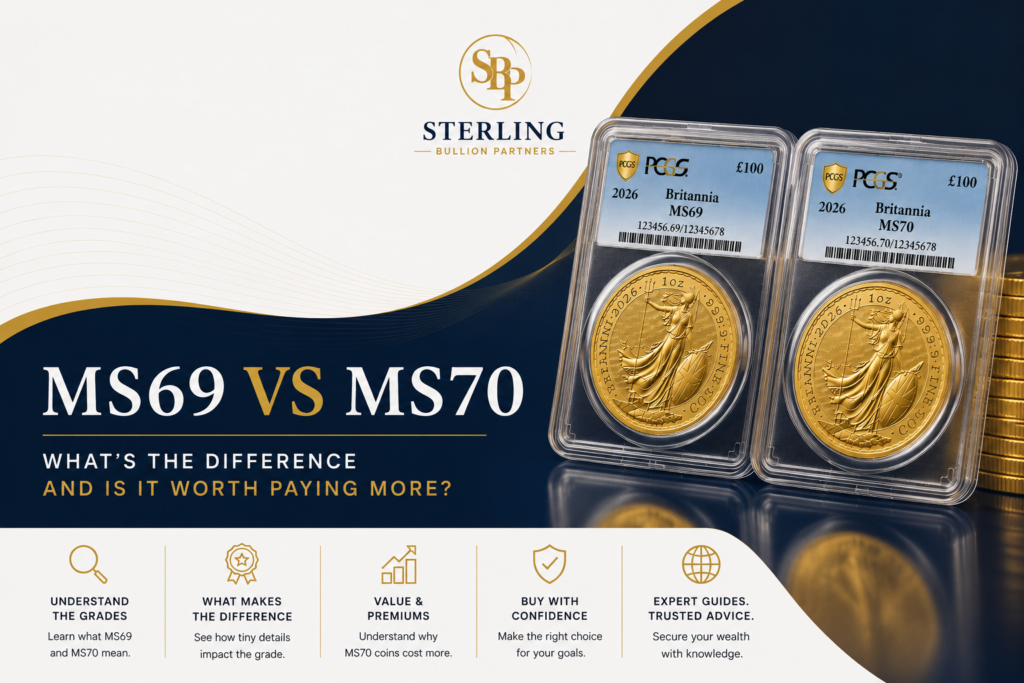
MS69 vs MS70: The Difference between Near‑Perfect and Perfect
Jul
MS69 vs MS70: The Subtle Difference between Near‑Perfect and Perfect Mint State Coins
About this guide
Purpose: This guide helps new and experienced collectors understand the difference between the two highest Mint State grades – MS69 and MS70 – on the 70‑point Sheldon coin‑grading scale. It explains what each grade means, how coins are assessed, why there can be big differences in price between them, and when it might make sense to pay the premium for a “perfect” coin. It is part of our educational knowledge centre and does not constitute financial advice. Always consider your personal circumstances and, if unsure, consult a professional before making a purchase.
Last reviewed: 9 July 2026 (updates reflect the latest grading standards and market observations)
Disclaimer: This guide is for educational purposes only. It discusses general market trends and grading definitions but does not guarantee the future value of any coin or endorse any specific grading company. Tax treatment depends on individual circumstances and may change in future.
Contents
- Introduction
- What is the Sheldon Scale?
- MS69 vs MS70 – Definitions
- How graders distinguish between MS69 and MS70
- Price differences and market dynamics
- Who chooses MS70 over MS69?
- Comparison table: MS69 vs MS70
- Common mistakes to avoid
- Frequently Asked Questions
- Conclusion
- Related guides
Introduction
When collectors talk about Mint State coins, they refer to coins that have never been circulated and therefore retain all of their original mint lustre. The Sheldon scale, first devised in 1949 and later adopted by grading services, ranges from 1 (poor) to 70 (perfect). Modern grading companies use this scale to assign numerical grades to coins, with MS (Mint State) for circulation issues and PR/PF for proofs. The top of this scale – MS69 and MS70 – can seem confusing: both grades describe uncirculated coins, so why is there often a significant price difference between them? This guide unpacks what each grade means and how to decide which is right for you.
Quick answer
An MS69 coin is virtually flawless but may have one or two tiny, non‑detracting contact marks visible under magnification, whereas an MS70 coin is considered “perfect” and shows no post‑production imperfections even at 5× magnification .
Most modern bullion coins produced by major mints can achieve MS69 easily, and some achieve MS70. The difference between the grades is so subtle that even experienced collectors struggle to tell them apart without magnification. The choice between MS69 and MS70 often comes down to personal preference, budget and the population of coins graded at each level.
What is the Sheldon Scale?
The Sheldon Coin Grading Scale is a 70‑point numerical system used by grading companies such as PCGS, NGC and ANACS to describe a coin’s condition. It originates from Dr William H. Sheldon’s 1949 study of early American cents and was later adapted by the American Numismatic Association for all US coin types. Under the adapted scale, circulated coins fall between 1 and 58, and uncirculated coins fall between MS60 and MS70. A coin graded MS60 exhibits noticeable marks and may have a weak strike, whereas MS70 is described as having no trace of wear, handling, scratches or contact marks when viewed at 5× magnification . Proof coins use the same numerical scale but include a PF/PR prefix to distinguish them from circulation strikes.
Did you know?
The Sheldon scale is logarithmic rather than linear. The difference in quality between MS69 and MS70 is far smaller than the difference between, say, MS60 and MS61. Coins become exponentially harder to improve as you approach the top of the scale.
Why the top grades matter
For collectors who build sets or compete in registry programmes offered by grading companies, achieving the highest possible grade can be important. Registry sets rank collectors based on the rarity and grade of their coins, with top‑population coins (the finest known examples) earning more points. This competition drives demand and premiums for MS70 coins, especially when the number of coins graded MS70 is low relative to MS69.
MS69 vs MS70 – Definitions
Both MS69 and MS70 describe coins that have never been in circulation and retain full mint lustre. The difference comes down to the presence and severity of tiny imperfections.
MS69 – “near perfect”
Coins graded MS69 are described as having a sharp strike with full original lustre and no more than two small non‑detracting contact marks or flaws. There are no hairlines or scuff marks, and overall eye appeal is exceptional . In other words, the coin is virtually perfect; any imperfections do not detract from the coin’s overall appearance and are often invisible without magnification.
MS70 – “perfect”
An MS70 coin is considered “perfect as minted”. To achieve this grade, a coin must show no trace of wear, handling, scratches or contact with other coins at 5× magnification . The surfaces should be flawless, with no marks or spots; the strike must be complete and sharp; and the lustre must be full and unbroken. MS70 coins are rare for older issues, as few coins survived historical minting and handling processes in perfect condition . Modern minting technology, however, makes it possible for many bullion coins to receive MS70 grades.
Proof coins: PF69 vs PF70
Although this guide focuses on Mint State coins, it is worth noting that proof coins use the same numerical grades with a PF or PR prefix. The grading criteria are analogous: PF69 indicates one or two minute imperfections, whereas PF70 denotes a perfect proof coin. Proofs are struck multiple times with specially polished dies to achieve mirror‑like fields and frosted devices; therefore any blemish is more obvious and can cause the grade to drop from 70 to 69.
How graders distinguish between MS69 and MS70
Professional grading involves evaluating multiple factors under magnification and under strict lighting conditions. The five primary components of grade are strike quality, surface preservation, lustre, colour/toning and eye appeal . The difference between MS69 and MS70 is often determined by minute surface marks, incomplete strike details or disturbances in the lustre.
Strike and design details
- Sharpness: A coin with a fully struck design, crisp edges and clear relief elements is more likely to achieve MS70. Weak strikes or areas of flattening may limit a coin to MS69.
- Die marks: Even if a coin’s surface is flawless, marks on the dies can transfer to the coin. These raised “die polish” lines are typically not counted against the grade, but they must be distinguished from scratches or scuffs.
Surface preservation
- Contact marks: Minor contact marks may occur during minting, particularly when coins are ejected from dies or stored in tubes. For MS69, no more than two small, non‑detracting contact marks are permissible . MS70 coins should exhibit no such marks .
- Hairlines and scuffs: Light hairlines caused by cleaning or handling will drop a coin below MS69. Scuffs, milk spots or other blemishes will also reduce the grade.
- Planchet flaws: Raised planchet issues (gas bubbles, lamination, etc.) may appear on modern coins. While some early coins have inherent planchet defects, most modern coins with such flaws will not achieve MS70.
Lustre and toning
- Original lustre: The natural “frosty” or “satiny” sheen that results from microscopic flow lines on the coin’s surface must remain intact. Any break in lustre, such as from friction or dips, typically prevents a 70 grade.
- Colour and toning: Attractive natural toning can enhance the eye appeal of an MS69 coin. However, unnatural or uneven toning may lower the grade.
Eye appeal and subjective factors
Even after technical standards are met, eye appeal plays a role. Two coins with similar technical merits may receive different grades if one has superior overall aesthetics. The difference between MS69 and MS70 often comes down to the grader’s judgement about whether minor imperfections meaningfully detract from the coin’s appearance.
Why grading is subjective
No two coins are exactly alike, and grading is performed by human experts. As a result, a coin submitted to different services or at different times might receive different grades. This subjectivity is why some collectors crack coins out of slabs and resubmit them, hoping for an upgrade from 69 to 70.
Price differences and market dynamics
Premiums for MS70 coins
In theory, a one‑point jump from MS69 to MS70 represents the transition from “near perfect” to “perfect”. In practice, the price difference between the two grades is driven more by market demand and population data than by the tiny physical difference. According to numismatic analysts, collectors sometimes pay a high premium for an MS70 coin when it is first released, but over time this premium can decline substantially as the number of coins graded 70 increases . The author Louis Golino notes that it is wise to track how the premium on a particular coin evolves before buying .
Changing premiums over time
Golino observes that there are times when MS70 coins can be bought for only a small premium over raw coins, particularly after the initial hype dies down . Conversely, rare coins in MS70 can be worth substantially more than their MS69 or raw counterparts; the article highlights the proof‑only 1995‑W Silver Eagle, which has a value in MS70 roughly ten times greater than in original government packaging or MS69 . These examples illustrate that premiums are not consistent across all coins.
Factors influencing price differences
- Population reports: Grading companies publish population reports showing how many coins of a particular type have been graded at each level. A low population of MS70 coins relative to MS69 may drive a premium, whereas a large number of MS70 coins will reduce scarcity.
- Collector demand: Registry set competition encourages collectors to seek the highest grades available. Coins with small populations of MS70 examples often command higher prices among registry participants.
- Issue and mintage: Modern bullion coins are struck in large numbers and to high standards, making MS70 examples common. Older coins may never achieve MS70 due to historical minting processes, so MS69 may be the highest available grade. Rare commemorative issues with low mintages may attract a premium regardless of grade.
- Market timing: Early in a coin’s release, grading services see high submission volumes and many MS70 grades. Early buyers may pay premiums based on initial scarcity that evaporates as more coins are graded. Waiting for population data to stabilise can help avoid overpaying .
Is paying for MS70 a “value trap”?
Some commentators caution that paying large premiums for modern MS70 coins can be risky. Golino points out that many collectors and dealers cannot tell the difference between MS69 and MS70 without magnification . Grading fees are significant, and if a coin does not achieve MS70, the grading costs may not be recoverable . For registry set competitors and those pursuing the finest known examples, the premium may be justified. For investors seeking exposure to gold or silver, paying a premium for MS70 may not offer additional intrinsic value over MS69.
VAT and Capital Gains Tax considerations
For UK buyers, it is important to remember that the VAT and Capital Gains Tax (CGT) treatment does not depend on whether a coin is MS69 or MS70. Britannias, Sovereigns and other UK legal‑tender gold coins remain VAT‑free and exempt from CGT for UK residents as long as they are legal tender, regardless of grade . Certified coins (MS69 or MS70) may attract higher premiums, but the tax advantages of legal‑tender bullion are unaffected.
Who chooses MS70 over MS69?
The decision to buy an MS70 coin instead of MS69 depends on your goals:
- Registry set collectors: Many collectors participate in grading company registry competitions where higher grades score more points. Owning an MS70 coin may improve a registry ranking and provide bragging rights.
- Commemorative and rare issues: When a coin has a low mintage or significant historical significance, and MS70 examples are scarce, the price premium may be justified. Rare coins that exist in MS70 may be sought after by numismatists.
- Gift purchases: MS70 coins can make impressive gifts due to the “perfect” designation. Some people buy perfect coins for special occasions, knowing they will likely retain their condition.
- Investors and stackers: Those primarily interested in the precious metal content often choose MS69 (or even ungraded coins) because the premiums are lower. An MS69 coin is still near perfect and contains the same amount of gold or silver as an MS70. Paying more for an MS70 may not increase resale value in the bullion market.
Comparison table: MS69 vs MS70
|
Attribute |
MS69 |
MS70 |
|---|---|---|
|
Grade description |
Sharp strike, full lustre, no more than two tiny non‑detracting contact marks |
Perfect: no post‑production marks or handling at 5× magnification |
|
Imperfections allowed |
One or two minor surface marks; no hairlines or scuffs |
None; surfaces must be flawless |
|
Rarity for modern bullion |
Common; many modern coins achieve MS69 |
Less common but still plentiful for some issues; depends on mint quality and population reports |
|
Rarity for older coins |
Often the highest achievable grade; MS69 examples of 19th‑century coins can be scarce |
Extremely rare or non‑existent for most pre‑20th‑century coins |
|
Price premium over raw coin |
Typically modest; reflects grading fee and near‑perfect status |
Can be significant, especially for low‑population coins; premiums may fall as population increases |
|
Suitability |
Ideal for collectors who want high quality without paying top premiums; good for investors seeking near‑perfect bullion |
Suited to registry collectors, gifts and collectors of rare issues where perfect examples are scarce |
|
Risk factors |
Minimal: MS69 coins hold value close to bullion content plus small premium |
Higher: premium may not be recoverable if population increases or if demand falls |
Common mistakes to avoid
Paying excessive premiums for modern MS70 coins
Modern bullion coins often achieve MS70 grades in large numbers. Paying a high premium for a newly released MS70 coin can result in a loss if more 70s are graded later . Consider waiting until population reports stabilise and premiums settle.
Assuming an MS70 coin is always a better investment
While some rare coins in MS70 are much more valuable than their MS69 counterparts , many modern issues do not justify the price difference. Focus on coins you enjoy owning, not just the numerical grade.
Submitting all coins for grading expecting a 70
Grading fees can be high, and only a small proportion of submitted coins grade MS70. If a coin grades below 70, the added cost may not be recovered on resale. It can be more economical to buy certified gold coins that have already been professionally graded.
Overlooking population reports
Before paying a premium for an MS70 coin, check the grading company’s population data to understand how many coins exist at each grade. A large population of MS70 coins will reduce scarcity and value.
Frequently Asked Questions
How can I tell the difference between an MS69 and an MS70 coin?
The difference is extremely subtle. MS69 coins may exhibit one or two microscopic contact marks that do not detract from the coin’s appearance . MS70 coins show no such marks even under 5× magnification . Most collectors cannot distinguish between the two grades without specialised equipment and training .
Do MS70 coins always increase in value more than MS69 coins?
No. Many modern coins achieve MS70, and premiums can drop as more coins are graded . Some rare issues, however, command significant premiums in MS70 . Always research population reports and market trends before paying a high premium.
Should I have my coins graded in the hope of getting MS70?
It depends on the coin. Grading fees are substantial, and only a fraction of coins will achieve MS70 . Consider the coin’s potential value in MS70, the current population, and your reasons for grading. For modern bullion coins, buying an existing MS69 or MS70 may be more cost‑effective.
Are proof (PF70) coins better than Mint State (MS70) coins?
Proof and Mint State coins are struck differently. Proof coins are made for collectors and graded with PF/PR prefixes. A PF70 coin is perfect just like an MS70 coin, but the markets for proof and bullion differ. PF70 coins can be rarer due to lower mintages, but they may also carry higher premiums.
Does the grading service matter for MS69 vs MS70?
Leading services such as PCGS, NGC and ANACS follow similar grading standards. Some collectors believe one service is slightly stricter than another, which can affect population reports and premiums. Our PCGS vs NGC guide discusses the differences between these grading companies in detail.
Do MS69 and MS70 coins receive the same tax treatment in the UK?
Yes. UK legal‑tender gold coins (e.g. Britannias and Sovereigns) are exempt from VAT and CGT regardless of grade . Silver coins and foreign coins may be subject to different taxes.
Conclusion
The difference between MS69 and MS70 is microscopic. Both grades represent coins that have never circulated and retain full lustre and eye appeal. MS69 coins allow one or two tiny, non‑detracting marks , whereas MS70 coins are considered perfect . For most modern bullion issues, MS69 provides a near‑perfect example at a much lower cost. Paying the premium for MS70 makes sense for collectors competing in registry sets, buying gifts, or acquiring genuinely rare coins where population reports show few examples in the top grade. As always, research population data, be wary of hype, and buy coins because you enjoy them – not simply because of a number on a plastic slab.
Related guides
- Understanding Coin Grading – A detailed explanation of the Sheldon scale, grading factors and the history of third‑party grading.
- Bullion vs Certified Coins – Comparing bullion coins to certified and graded coins, including proofs and mint sets.
- PCGS vs NGC – A side‑by‑side look at the two leading grading services, their history, fees, designations and market perceptions.
- Britannia vs Sovereign – Exploring the differences between Britain’s two most popular gold coins.
- Gold Coins vs Gold Bars – Should you choose coins or bars? A comprehensive comparison of liquidity, premiums, taxes and storage.
