

Guides
Are Gold Coins Capital Gains Tax Free in the UK?
Sep
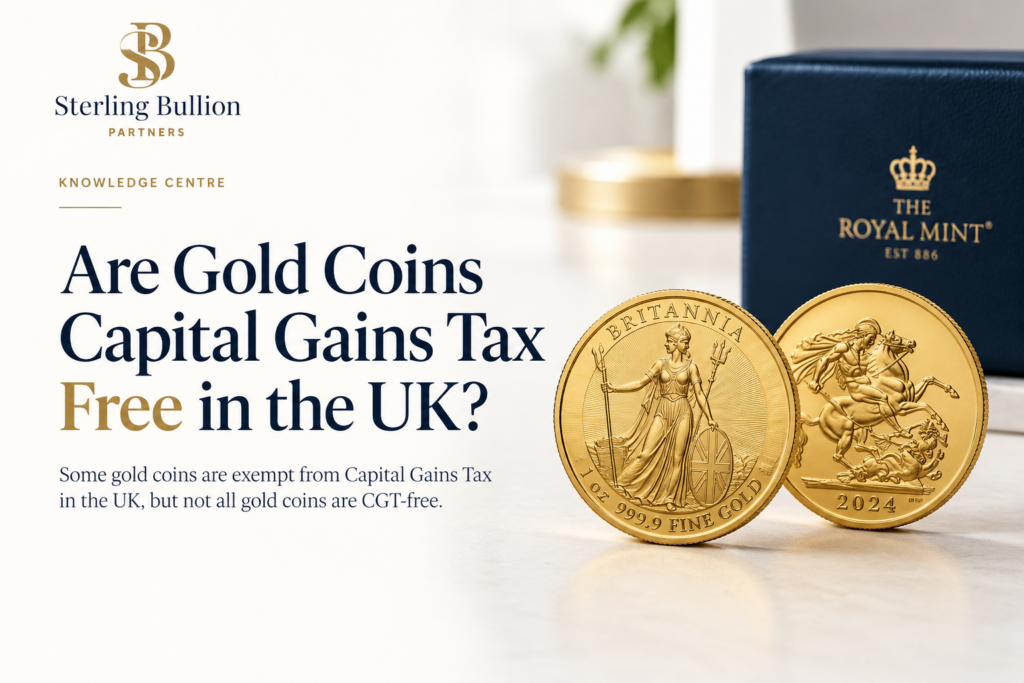
Some gold coins are exempt from Capital Gains Tax in the UK, but not all gold coins are CGT-free.
The key distinction is whether the coin qualifies as sterling currency.
HMRC specifically confirms that Sovereigns minted in 1837 and later years and Britannia gold coins are sterling currency and are exempt from Capital Gains Tax.
This means that, under current UK rules, a gain made when disposing of qualifying Gold Britannias or post-1837 Gold Sovereigns is not subject to CGT.
Other gold coins and gold bars can be treated differently.
For UK buyers choosing between different forms of physical gold, this can be an important distinction.
⸻
At a Glance
Are Gold Britannias CGT-free? Yes. HMRC confirms that Britannia gold coins are sterling currency and exempt from Capital Gains Tax.
Are Gold Sovereigns CGT-free? Sovereigns minted in 1837 and later years are treated by HMRC as sterling currency and exempt from CGT.
Are all Royal Mint gold coins CGT-free? No. The relevant issue is the legal status of the particular coin, not simply whether The Royal Mint produced it.
Are foreign gold coins CGT-free? Not automatically. HMRC specifically gives Krugerrands as an example of currency that is not sterling and is therefore a chargeable asset.
Are gold bars CGT-free? Gold bars do not benefit from the sterling-currency exemption.
What is the CGT Annual Exempt Amount? For individuals, the Annual Exempt Amount is £3,000 for the 2026/27 tax year.
Are gold coins VAT-free as well? Qualifying investment gold coins are exempt from VAT, but VAT and Capital Gains Tax are separate tax rules.
⸻
Why Are Some UK Gold Coins Exempt from Capital Gains Tax?
The exemption is connected to their status as sterling currency.
HMRC’s Capital Gains Manual states that Sovereigns minted in 1837 and later years and Britannia gold coins are currency and, like all sterling currency, are exempt under the relevant provision of the Taxation of Chargeable Gains Act 1992.
You can read the rule directly in HMRC’s Capital Gains Manual guidance on coins and currency.
This distinction is important.
The CGT exemption does not exist simply because:
- the coin contains gold
- the coin was produced by The Royal Mint
- the coin is collectable
- the coin is professionally graded
- the coin has increased in value
It is the coin’s legal status under the relevant tax rules that matters.
⸻
Are Gold Britannias Capital Gains Tax Free?
Yes.
HMRC specifically identifies Britannia gold coins as sterling currency and confirms that they are exempt from Capital Gains Tax.
This makes the Britannia particularly relevant to UK buyers because its tax treatment differs from many foreign bullion coins and from gold bars.
Gold Britannias have been issued in several sizes, including:
- 1oz
- 1/2oz
- 1/4oz
- 1/10oz
The important CGT point is not the market value of the coin or the amount by which the gold price has risen.
It is the Britannia’s status as sterling currency.
For buyers comparing Britannias with another established British gold coin, see our Britannia vs Sovereign guide.
⸻
Are Gold Sovereigns Capital Gains Tax Free?
Yes, for Sovereigns minted in 1837 and later years.
HMRC treats these Sovereigns as sterling currency and therefore exempt from Capital Gains Tax.
HMRC specifically draws the line at 1837.
That means it would be inaccurate to say that every Sovereign ever produced is automatically CGT-free.
HMRC explains that coins including pre-1837 Sovereigns that are no longer legal tender are not treated as currency for these purposes. Different CGT rules can therefore apply.
For modern buyers, however, post-1837 Sovereigns provide an established form of British gold coin with the sterling-currency CGT exemption.
⸻
Are All Royal Mint Gold Coins CGT Free?
No.
This is an important misconception.
A coin is not automatically exempt from Capital Gains Tax merely because it was produced by The Royal Mint.
What matters is the legal status of the particular coin.
Britannias and post-1837 Sovereigns are specifically identified by HMRC.
Other Royal Mint issues should be considered according to their own legal status rather than simply assuming that every Royal Mint gold product receives identical treatment.
For substantial disposals or unusual historic coins, professional tax advice may be appropriate.
⸻
Are £5 Gold Coins Capital Gains Tax Free?
Many modern Royal Mint £5 gold coins are issued with UK legal-tender status, but the correct approach is to establish the status of the specific issue rather than assuming that every gold coin carrying a £5 denomination receives identical treatment.
This is especially important because the term £5 gold coin can refer to different types of product, from modern commemorative issues to historic Five Sovereign pieces.
Where a coin qualifies as sterling currency, the sterling-currency exemption can apply.
Where it does not, different rules may apply.
The coin’s denomination, legal status and date therefore matter independently of its gold content, mintage or certification.
⸻
Are Foreign Gold Coins CGT Free in the UK?
Not automatically.
This is one of the clearest differences between qualifying British coins and many overseas bullion coins.
HMRC specifically gives Krugerrands as an example of coins that are currency but not sterling and are therefore chargeable assets.
The fact that a foreign gold coin is legal tender in its country of origin does not make it sterling currency.
This can create a meaningful difference for UK buyers comparing, for example:
Gold Britannia
with
South African Krugerrand
Both are internationally recognised gold coins.
But their UK Capital Gains Tax treatment is different.
⸻
Are Gold Bars Capital Gains Tax Free?
Gold bars do not receive the sterling-currency exemption available to qualifying UK legal-tender coins.
A gold bar is not sterling currency.
Gains on the disposal of gold bars can therefore fall within the normal Capital Gains Tax regime, subject to the individual’s circumstances, available losses and Annual Exempt Amount.
This is one of the important distinctions between owning gold in bar form and owning qualifying British legal-tender gold coins.
Our Gold Coins vs Gold Bars guide examines the broader differences between the two formats.
⸻
What Is the Capital Gains Tax Allowance in 2026/27?
For the 2026/27 tax year, the Capital Gains Tax Annual Exempt Amount for an individual is:
£3,000
For chargeable assets, an individual’s overall taxable gains are considered against the available Annual Exempt Amount and other applicable CGT rules.
However, qualifying Britannias and post-1837 Sovereigns are different.
If the disposal is exempt because the coins are sterling currency, you are not simply relying on the £3,000 Annual Exempt Amount.
The qualifying gain itself is exempt.
That distinction can become increasingly important where holdings have risen substantially in value.
You can check the current figures on HMRC’s Capital Gains Tax rates and allowances page.
⸻
What Are the Capital Gains Tax Rates in 2026/27?
For chargeable gains, the main individual CGT rates are generally:
18% to the extent the taxable gain falls within the individual’s available basic-rate band
and
24% above that level.
These rates apply to chargeable gains.
They do not turn an otherwise exempt disposal of qualifying sterling currency into a taxable disposal.
Individual circumstances differ and tax rules can change, so anyone facing a material potential tax liability should consider obtaining professional advice.
⸻
CGT-Free Gold Coins vs Gold Bars
The distinction becomes particularly clear when comparing qualifying UK coins with bars.
|
Qualifying UK Legal-Tender Gold Coins |
Gold Bars |
|
|---|---|---|
|
Contains physical gold |
Yes |
Yes |
|
Can qualify as investment gold for VAT |
Yes |
Yes |
|
Sterling currency |
Yes, where applicable |
No |
|
Sterling-currency CGT exemption |
Yes, where applicable |
No |
|
Value linked to gold |
Yes |
Yes |
|
Can carry collector premium |
Yes |
Generally less relevant |
For a UK buyer planning to hold physical gold over a long period, the CGT treatment can therefore become increasingly relevant if the value of the holding rises significantly.
⸻
Capital Gains Tax vs VAT on Gold Coins
Capital Gains Tax and VAT are completely separate taxes.
This distinction is frequently misunderstood.
Capital Gains Tax
CGT concerns gains arising when an asset is disposed of.
Qualifying sterling currency, including the Sovereigns and Britannias specifically identified by HMRC, is exempt.
VAT
VAT concerns the tax treatment of the supply of the gold.
UK rules provide a VAT exemption for investment gold that meets the relevant statutory requirements.
HMRC publishes separate guidance covering the definition and VAT treatment of investment gold coins.
The key point is:
VAT exemption ≠ CGT exemption
A coin can qualify as investment gold for VAT purposes without benefiting from the sterling-currency CGT exemption.
⸻
Are All Gold Coins VAT Free?
No.
The UK VAT exemption applies to gold that meets the definition of investment gold.
HMRC defines an investment gold coin as either a coin appearing on its recognised list or a gold coin that meets specified requirements.
Broadly, those requirements include a coin that:
- was minted after 1800
- has a purity of at least 900 thousandths
- is or has been legal tender in its country of origin
- is normally sold at a price not exceeding 180% of the open-market value of its gold content
This means a collectable gold coin should not automatically be described as VAT-exempt merely because it is made of gold.
Again:
CGT exemption and VAT exemption are separate tests.
⸻
Are Britannias and Sovereigns VAT Free?
Qualifying Gold Britannias and Sovereigns generally fall within the UK’s investment-gold VAT regime.
This means qualifying British gold coins can potentially combine two separate UK tax characteristics:
VAT exemption on qualifying investment-gold supplies
and
CGT exemption for qualifying sterling currency
But those advantages arise under different rules and should not be treated as the same exemption.
⸻
Are Proof Gold Coins Capital Gains Tax Free?
A coin being a Proof does not determine whether it is exempt from CGT.
Proof describes how the coin was manufactured and presented.
CGT treatment depends on the underlying coin’s legal status.
Therefore, the correct question is not:
“Is it a Proof?”
It is:
“Does this particular coin qualify as sterling currency for CGT purposes?”
This is particularly relevant in the modern British collectable market because many coins are Proof issues.
Their Proof finish, mintage, grade and certified population may influence their collector value, but those characteristics are separate from the legal basis of any CGT exemption.
For collectors comparing high-grade Proof coins, our PF69 vs PF70 guide explains how grade and certified population can affect the market for an individual coin.
⸻
Are Certified NGC or PCGS Gold Coins CGT Free?
Professional grading does not determine a coin’s Capital Gains Tax treatment.
NGC or PCGS certification can authenticate a coin and establish its grade, but encapsulating a coin does not change the underlying coin into a different form of currency.
For example, a qualifying Gold Britannia does not lose its relevant sterling-currency status simply because it has been professionally graded.
Likewise, grading a foreign gold coin does not transform it into sterling currency.
Tax status and certification therefore measure completely different things.
Our PCGS vs NGC guide explains what professional certification actually tells collectors about a coin.
⸻
Does the CGT Exemption Apply Only to Bullion Britannias and Sovereigns?
The tax principle is based on the coin’s status as currency rather than whether a dealer describes it as bullion, Proof or certified.
That distinction matters because the same underlying British coin type can appear in different finishes and certification states.
A bullion coin may primarily track its gold content.
A low-mintage Proof or high-grade certified example may carry a substantial collector premium.
But the market value of the coin and its tax status are separate questions.
Our guide Why Do Gold Coins Sell for More Than the Gold Price? explains how mintage, grade, population and collector demand can contribute to value beyond the underlying gold content.
⸻
Does the CGT Exemption Apply to the Whole Gain?
Where the coin itself qualifies for the sterling-currency exemption, the exemption concerns the gain on the qualifying asset.
This can be particularly relevant to collectable coins because their market value may move for reasons beyond the gold price.
A scarce Proof Sovereign, for example, may rise in value because of a combination of:
- gold price
- original mintage
- numerical grade
- certified population
- collector demand
- market availability
The tax treatment concerns the qualifying coin as the asset being disposed of rather than attempting to divide the price into a gold component and a collector component.
⸻
Do You Pay Capital Gains Tax When Selling Sovereigns?
For qualifying post-1837 Sovereigns falling within HMRC’s sterling-currency exemption, the gain is exempt from Capital Gains Tax.
That is the central rule for an individual disposing of qualifying Sovereigns held as assets.
Different considerations can arise in unusual circumstances, including where activity amounts to trading rather than simply holding and disposing of personal assets.
⸻
Do You Pay Capital Gains Tax When Selling Britannias?
Qualifying Britannia gold coins are also sterling currency and are specifically identified by HMRC as exempt.
This is one of the characteristics that distinguishes UK Britannias from many foreign bullion coins and gold bars for UK buyers.
⸻
What About Old Gold Coins?
Historic coins require more care.
HMRC states that coins that are not legal tender are not treated as currency for these purposes.
It specifically mentions pre-1837 Sovereigns.
Those coins may instead fall within the CGT rules for chattels, where separate rules and exemptions can apply.
Anyone disposing of a valuable historic collection should therefore avoid assuming that the treatment of a modern Britannia automatically applies to every historic British gold coin.
⸻
Why Does CGT Status Matter When Buying Gold?
For a small holding or limited gain, the distinction may have little practical impact.
But it can become more significant as:
- the size of the holding increases
- the gold price rises
- the ownership period lengthens
- the gain becomes substantial
Consider two assets that each rise significantly in value.
Asset A: qualifying UK sterling gold coins.
Asset B: gold bars.
The gain on Asset A can fall within the sterling-currency exemption.
The gain on Asset B does not benefit from that exemption and may need to be considered within the owner’s wider CGT position.
That does not mean coins are automatically superior to bars.
Bars can offer attractive premiums and may suit buyers primarily seeking larger quantities of physical gold.
But CGT treatment is a genuine structural difference UK buyers should understand before choosing the form in which they hold gold.
⸻
Why Are Sovereigns and Britannias Popular With UK Gold Buyers?
Their appeal comes from a combination of characteristics rather than one factor alone.
Recognised British coinage
Sovereigns and Britannias are well-established British gold coins.
Physical ownership
The buyer owns a tangible gold asset.
Range of sizes
Different denominations provide flexibility in the amount of gold purchased or eventually sold.
Secondary-market recognition
Both types are widely recognised within the UK gold market.
CGT treatment
Qualifying Sovereigns and Britannias benefit from the sterling-currency exemption.
Collector potential
Certain dates, designs, Proof issues and certified examples can carry value beyond their underlying gold content.
This combination gives British legal-tender gold coins a distinctive position within the UK physical-gold market.
⸻
Common UK Gold Tax Mistakes
Several misconceptions are worth avoiding.
“All gold is CGT-free”
Incorrect. The sterling-currency exemption does not apply to every form of gold.
“All gold coins are CGT-free”
Incorrect. HMRC distinguishes sterling currency from non-sterling coins.
“If it is VAT-free, it must also be CGT-free”
Incorrect. VAT and CGT are governed by separate rules.
“Every Royal Mint coin is automatically CGT-free”
Too broad. The legal status of the particular coin matters.
“The CGT allowance is £6,000”
Incorrect for 2026/27. The individual Annual Exempt Amount is £3,000.
“Grading a coin changes its tax status”
Incorrect. NGC or PCGS certification does not determine whether the underlying coin qualifies as sterling currency.
⸻
Frequently Asked Questions
Are gold coins Capital Gains Tax free in the UK?
Some are. HMRC specifically confirms that Britannia gold coins and Sovereigns minted in 1837 and later years are sterling currency and exempt from Capital Gains Tax.
Are Gold Britannias CGT free?
Yes. Britannia gold coins are specifically identified by HMRC as exempt sterling currency.
Are Gold Sovereigns CGT free?
Sovereigns minted in 1837 and later years are specifically identified by HMRC as sterling currency and exempt.
Are Proof Sovereigns CGT free?
Proof status does not determine CGT treatment. Where the underlying Sovereign qualifies as sterling currency, producing it to Proof quality does not itself change that status.
Are Proof Britannias CGT free?
Proof is a manufacturing finish rather than a tax classification. The legal status of the underlying Britannia is what matters.
Are all Royal Mint gold coins CGT free?
No. The legal status of the specific coin matters. Being made by The Royal Mint alone does not create the exemption.
Are foreign gold coins CGT free in the UK?
Not automatically. HMRC specifically states that non-sterling currency such as Krugerrands is a chargeable asset.
Are gold bars CGT free?
No. Gold bars do not benefit from the sterling-currency exemption.
Is investment gold VAT free?
Qualifying investment gold is exempt from VAT under separate rules.
Are all gold coins VAT free?
No. The coin must satisfy HMRC’s investment-gold requirements or appear on the relevant recognised list.
What is the CGT allowance in 2026/27?
The individual Annual Exempt Amount is £3,000.
Does grading affect whether a gold coin is CGT free?
No. NGC or PCGS certification does not itself create or remove the sterling-currency exemption.
Do I pay CGT when selling Sovereigns?
Qualifying post-1837 Sovereigns are exempt under HMRC’s sterling-currency rules.
Do I pay CGT when selling Britannias?
Qualifying Britannia gold coins are specifically identified by HMRC as exempt sterling currency.
⸻
Final Thoughts
Not all gold coins are Capital Gains Tax free in the UK, but qualifying British sterling gold coins occupy an important position under the rules.
HMRC specifically confirms that post-1837 Sovereigns and Britannia gold coins are sterling currency and exempt from Capital Gains Tax.
That creates an important distinction between these coins and assets such as gold bars or many foreign gold coins.
It is also important to keep CGT and VAT separate.
CGT concerns gains when assets are disposed of.
VAT concerns the tax treatment of supplies, with qualifying investment gold benefiting from its own exemption.
For UK buyers comparing different forms of physical gold, tax treatment should therefore be considered alongside:
- purchase premium
- gold content
- liquidity
- original mintage
- collector demand
- certified population
- market availability
Tax should not be the only reason to choose a particular gold coin.
But where two forms of physical gold otherwise meet a buyer’s objectives, the CGT exemption available to qualifying sterling coins can be a significant structural advantage.
Individual circumstances can differ and tax rules can change, so anyone uncertain about their own position should check current HMRC guidance or obtain appropriate professional tax advice.
