

Guides
Why Do Gold Coins Sell for More Than the Gold Price?
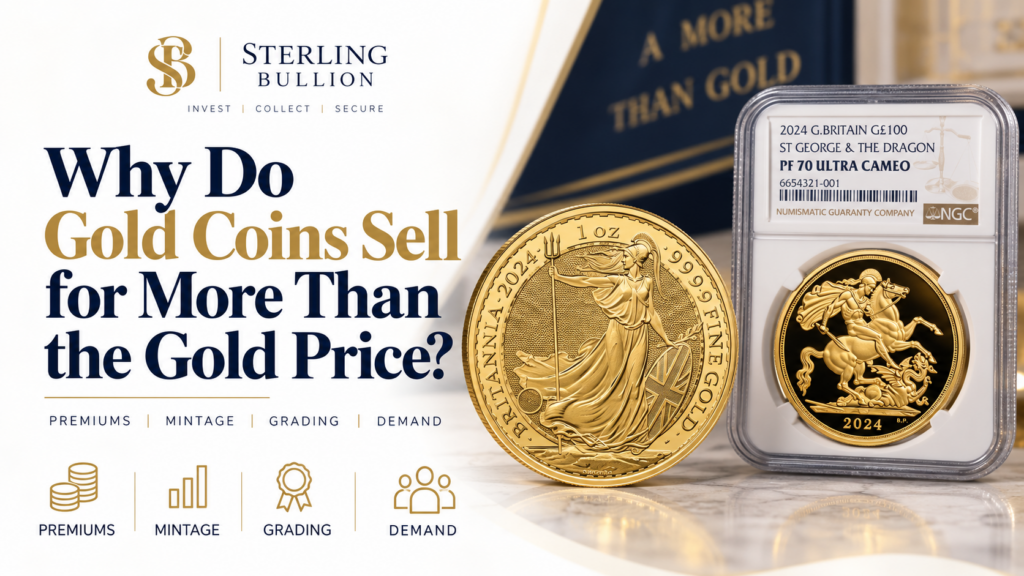
Sep
Gold coins often sell for more than the value of the gold they contain.
That difference is known as a premium, but not all premiums are created in the same way.
For a standard bullion coin, the premium largely reflects the cost of manufacturing, distribution, handling and supplying a physical gold product.
For a Proof, collectable or independently certified gold coin, the price can also reflect factors such as original mintage, grade, certified population, condition rarity, collector demand and market availability.
This is why two gold coins containing exactly the same amount of gold can sometimes sell for very different prices.
The key is understanding what you are actually paying for beyond the gold content.
⸻
At a Glance
Gold price: The market price of gold, normally quoted per troy ounce.
Metal value: The approximate value of the fine gold contained within a particular coin.
Premium: The amount paid above the underlying metal value.
Bullion premium: Primarily reflects manufacturing, distribution, operating costs and market supply and demand.
Collector premium: Can reflect factors including scarcity, finish, historical significance and collector demand.
Certified coin premium: Can additionally reflect independently verified grade, certified population, condition rarity and market demand.
Does every gold coin sell above its gold value? Physical gold products normally carry some form of premium when purchased, but the size and nature of that premium varies considerably.
Does a higher premium mean a better coin? No. The reason for the premium needs to be understood.
⸻
What Is the Gold Price?
The gold price normally refers to the market price of gold quoted per troy ounce.
One troy ounce is approximately 31.1035 grams.
When people compare the price of a gold coin with “the gold price”, they are usually comparing the retail price of the coin with the value of the fine gold it contains.
For example, if a one-ounce gold coin contains one troy ounce of fine gold and the gold price were hypothetically £3,000 per ounce, its underlying gold content would be worth approximately £3,000.
But buying a physical one-ounce coin for exactly £3,000 would be unusual.
The physical product generally costs more.
The Royal Mint explains in its guide to bullion premiums that physical bullion normally carries a premium above the underlying metal price.
⸻
What Is a Gold Coin Premium?
A premium is the difference between the value of the precious metal contained within a product and the price being charged for the physical product.
A simple way to think about it is:
Gold value + premium = purchase price
If a coin contains £3,000 worth of gold and sells for £3,150, the £150 difference represents a 5% premium over its underlying metal value.
But this simple calculation becomes more interesting when we move away from ordinary bullion.
A rare Proof coin might contain the same £3,000 worth of gold but trade for £4,000, £5,000 or considerably more.
At that point, the buyer is no longer paying purely for gold.
They are buying a particular coin.
That distinction is fundamental.
⸻
Why Does Bullion Sell Above the Gold Price?
Even standard bullion coins have to be manufactured.
Gold must be sourced, refined and formed into blanks. Dies have to be produced, machinery operated and designs struck into the metal. Coins then need to be inspected, handled, packaged, insured, transported and ultimately supplied to customers.
Those processes cost money.
The Royal Mint confirms that premiums are added above the underlying metal value on bullion products and that the size of the premium varies between products and providers. You can read its full explanation of how bullion premiums work.
Premiums can also vary because of:
- product size
- manufacturing complexity
- supply and demand
- availability
- distribution costs
- market competition
- dealer operating costs
This explains why a smaller bullion product often carries a higher percentage premium than a much larger bar, even though both contain the same type of metal.
For buyers whose primary objective is obtaining physical gold close to its underlying metal value, this premium is usually an important consideration.
Our guide to Bullion vs Certified Coins explains the difference between buying primarily for gold content and buying a professionally certified individual coin.
⸻
Why Can Two Gold Coins With the Same Gold Content Have Different Prices?
Because gold content is only one characteristic of a coin.
Imagine two one-ounce British gold coins.
Both contain one troy ounce of fine gold.
The first is a widely available bullion coin.
The second is a limited-mintage Proof coin that has been independently certified PF70 by NGC and has a relatively small certified population.
The intrinsic gold content may be virtually identical.
The products are not.
The second coin may have characteristics the first does not:
Limited original production
Only a restricted number may have been authorised or issued.
Proof manufacture
The coin may have been specially produced for collectors rather than produced primarily as bullion.
Independently verified grade
A third-party grading company may have authenticated the coin and assessed its condition.
Condition rarity
Only a proportion of the coins submitted may have achieved the highest numerical grade.
Certified population
The number known within a particular grade may be relatively small.
Collector demand
Collectors may actively compete for a limited number of available examples.
These factors can create value beyond the underlying gold.
⸻
Bullion Premium vs Collector Premium
It is useful to distinguish between two very different types of premium.
Bullion Premium
A bullion premium primarily exists because turning raw gold into a finished retail product costs money.
The buyer is still primarily acquiring gold.
Collector Premium
A collector premium can develop because people value a particular coin for reasons beyond its precious-metal content.
These can include:
Scarcity
A small original mintage can restrict supply.
Quality
Proof manufacture and exceptional condition may be particularly desirable.
Historical importance
A particular monarch, anniversary, design or event may increase collector interest.
Certified grade
A PF70 or MS70 example represents the highest numerical grade within the relevant NGC grading category.
Certified population
Only a limited number may have achieved a particular grade.
Demand
Scarcity matters commercially only if people actually want the coin.
The Royal Mint itself identifies factors such as metal content, quality of finish, exclusivity, presentation and craftsmanship when explaining why collectors may pay more for a coin.
This is why asking only:
“How much gold is in it?”
can provide an incomplete picture of a collectable coin.
⸻
Does a Low Mintage Make a Gold Coin Worth More?
It can contribute to scarcity, but low mintage alone does not guarantee a higher value.
A coin with an original mintage of 250 has a fundamentally more restricted original supply than a coin with a mintage of 250,000.
But mintage is only the starting point.
A low-mintage coin with little collector demand may not achieve a substantial premium.
Conversely, a coin with a larger mintage but strong collector demand can develop a healthy secondary market.
This is why scarcity needs to be considered alongside demand.
Our Coin Population vs Mintage guide explains why mintage should be treated as an important starting point rather than a complete measure of rarity.
⸻
How Does Grading Affect the Price of a Gold Coin?
Independent grading can provide information that does not exist with an ordinary raw coin.
NGC and PCGS assess coins, authenticate them, assign numerical grades and encapsulate them within tamper-evident holders.
For some collectable coins, this makes it possible for the market to distinguish between examples of the same underlying issue based on certified condition.
NGC uses the internationally recognised 1 to 70 grading scale and defines a 70-grade Mint State or Proof coin as having no post-production imperfections visible at 5x magnification. You can see the full definition on NGC’s official grading scale.
Suppose a particular Proof coin has:
Maximum Coin Mintage: 500
and the NGC population shows:
PF69: 120
PF70: 25
The mintage tells us about the original supply.
The population tells us something different: how many examples NGC has certified at particular grades.
A collector specifically seeking a PF70 example is therefore looking at a much smaller certified pool than the original mintage figure alone suggests.
That is condition rarity.
It can influence market pricing when sufficient collector demand exists.
⸻
Why Can PF70 or MS70 Coins Cost More?
PF70 and MS70 represent the highest numerical grades used by NGC for Proof and Mint State coins respectively.
But the number 70 does not automatically justify a large premium.
The important question is:
How difficult is this particular coin to obtain in grade 70?
Imagine two coins.
Coin A
Original mintage: 500
PF70 population: 20
Coin B
Original mintage: 20,000
PF70 population: 12,000
Both holders may say PF70.
But the certified availability is completely different.
This is why we look at the grade together with the population, rather than simply assuming every 70-grade coin is rare.
Our PF69 vs PF70 guide explains when the premium for a perfect Proof grade can make sense.
For Mint State coins, our MS69 vs MS70 guide covers the equivalent comparison.
⸻
What Is a Certified Population?
A certified population records how many examples a grading company has certified within particular categories or grades.
It is not the same as the number of coins that exist.
If NGC reports a PF70 population of 20, that does not mean only 20 examples of that coin survive.
It means NGC’s Census records that number within the relevant certification category at the point the data is checked.
Other examples might:
- remain ungraded
- be graded PF69 or another grade
- have been certified by PCGS
- remain in original Royal Mint packaging
- be held privately and never submitted for grading
Population reports are therefore valuable research tools, but they have to be interpreted correctly.
Our guide What Is a Coin Population Report? explains how NGC and PCGS population figures work and why they change over time.
⸻
Can a Gold Coin Be Worth Several Times Its Gold Content?
Yes.
Once collector demand develops around a scarce or important coin, its market value can become increasingly disconnected from its intrinsic gold content.
At that point, the gold remains valuable, but it is no longer the only thing being purchased.
The buyer may also be paying for:
rarity
condition
historical significance
certified grade
certified population
collector demand
availability
This is why calculating the gold weight alone cannot establish what every collectable gold coin should trade for.
The same principle exists throughout collecting.
The material from which an object is made provides part of its value.
The identity and scarcity of the object can provide another part.
⸻
Does Proof Finish Add Value?
Proof manufacture can contribute to a coin’s collector appeal, but a Proof coin is not automatically valuable simply because it is a Proof.
The Royal Mint explains that Proof coins are produced to a particularly high standard and identifies factors such as finish, exclusivity and craftsmanship as reasons collectable coins can command higher prices. Its explanation is available in Why Pay More for a Coin?.
But again, context matters.
A Proof coin with:
large production numbers + low collector demand
may behave very differently from one with:
low mintage + high grade + small certified population + strong demand
This is why no single characteristic should be used to assess a coin in isolation.
⸻
Does Certification Automatically Make a Gold Coin More Valuable?
No.
Putting an ordinary coin into a grading holder does not magically create rarity.
Certification can:
authenticate the coin
verify its condition
standardise its grade
protect it within a holder
allow comparison against population data
But the underlying coin still matters.
A certified example of a very common coin with a very common grade may command only a modest premium.
A scarce coin in an exceptional grade may behave very differently.
The value comes from the combination of the coin and its certification, not merely the existence of the holder.
For a broader comparison of the two major grading companies, see our PCGS vs NGC guide.
⸻
Why Does Collector Demand Matter?
Because rarity without demand does not automatically produce a high market price.
Imagine only ten examples of a particular certified coin exist.
That sounds extraordinarily scarce.
But if only five collectors want one, the small population may not create strong competition.
Now imagine there are 100 certified examples but 2,000 active collectors seeking the coin.
The market dynamics can be completely different.
This is why genuine market value develops from the relationship between:
supply + scarcity + demand
rather than scarcity alone.
When assessing a premium, the question should therefore not simply be:
“Is it rare?”
It should also be:
“Do collectors actually want it?”
⸻
Why Does Availability Matter?
Mintage and population figures are useful, but they do not tell you how many coins are actually available to purchase.
Suppose 50 PF70 examples are recorded.
If 45 are sitting in long-term private collections and rarely appear for sale, the effective market supply may be extremely limited.
Another coin could have the same population of 50 but appear at auction or through dealers regularly.
The published population is identical.
The practical availability is not.
This is why buyers should look beyond headline numbers and consider how frequently comparable examples actually reach the market.
⸻
Why Can Older Gold Coins Carry Large Premiums?
Older coins introduce additional factors.
Over time:
- coins can be lost
- coins can be melted
- coins can be damaged
- examples can disappear into long-term collections
- high-grade survivors can become increasingly difficult to find
For historic coins, the surviving population can therefore be dramatically lower than the original mintage.
This differs from many modern Proof coins, where a high proportion of the original issue may still survive in excellent condition.
Age alone does not make a coin valuable.
But age + genuine scarcity + condition + historical importance + collector demand can create substantial premiums.
⸻
Are Higher Gold Coin Premiums Always Worth Paying?
No.
A premium should have a reason behind it.
Before paying substantially above a coin’s gold value, a buyer should understand what supports the difference.
Useful questions include:
What is the original mintage?
How restricted was the original supply?
What is the grade?
Is the coin genuinely exceptional in condition?
What is the certified population?
How many examples have achieved the same grade?
How often does the coin appear for sale?
Published population and real-world availability are not always the same.
Is there established collector demand?
Scarcity alone is not enough.
What have comparable examples sold for?
Asking prices and completed market transactions are different things.
What proportion of the price is attributable to the coin rather than its gold?
The larger the premium, the more important this analysis becomes.
⸻
Bullion vs Collectable Gold Coins
The simplest way to understand the difference is to ask what primarily drives the price.
|
Bullion Gold Coin |
Collectable or Certified Gold Coin |
|
|---|---|---|
|
Gold content |
Major driver |
Important underlying component |
|
Manufacturing premium |
Yes |
Yes |
|
Original mintage |
Sometimes relevant |
Often important |
|
Proof finish |
Usually no |
Can be important |
|
Independent grade |
Usually no |
Can be important |
|
Certified population |
Usually not relevant |
Can be important |
|
Condition rarity |
Usually not primary |
Can be important |
|
Collector demand |
Secondary |
Often important |
|
Historical significance |
Usually secondary |
Can be important |
|
Market availability |
Relevant |
Often highly relevant |
This does not mean one type of coin is universally better.
They serve different objectives.
A buyer primarily seeking physical gold close to its underlying metal value may prefer a low-premium bullion product.
A collector seeking scarce, independently graded British gold coins may place considerably greater importance on mintage, grade and population.
For a fuller comparison, see Bullion vs Certified Coins.
⸻
What Are You Really Buying?
This is ultimately the most useful question.
With ordinary bullion, you are primarily buying:
physical gold in a recognised coin format
With a collectable certified coin, you may be buying:
gold + a particular issue + scarcity + condition + certification + collector demand
That is why comparing every gold coin purely by its price per gram or price per ounce can be misleading.
It is an excellent comparison for bullion.
It is not always sufficient for numismatic or certified coins.
⸻
Frequently Asked Questions
Why are gold coins more expensive than the gold they contain?
Physical coins carry premiums above their underlying metal value. For bullion, premiums primarily reflect manufacturing, distribution and operating costs. Collectable coins can also carry premiums related to scarcity, finish, grade, population and collector demand.
What does premium mean on a gold coin?
The premium is the amount by which the coin’s selling price exceeds the value of the fine gold it contains.
Why do gold coins cost more than gold bars?
Coins can be more expensive to manufacture on a per-ounce basis and different bullion products carry different premiums. Product size, manufacturing requirements and supply and demand can all affect the premium.
Does a low-mintage gold coin always sell for more?
No. Low mintage restricts original supply, but collector demand, condition, certified population and market availability also matter.
Does grading increase the value of a gold coin?
Grading does not automatically make a coin more valuable. It authenticates and establishes the condition of the individual coin. A high grade can become commercially significant when the underlying coin is desirable and relatively difficult to obtain at that grade.
Why are PF70 coins more expensive?
PF70 represents NGC’s highest numerical Proof grade. A premium can develop when PF70 examples are scarce relative to demand, but PF70 coins are not automatically rare.
Does a low NGC population make a coin valuable?
Not automatically. A low population shows that relatively few examples have been certified in the relevant category. Original mintage, demand and market availability still need to be considered.
Can a coin be worth more than its gold content?
Yes. Collectable coins can trade above their intrinsic gold value because buyers may also value rarity, condition, historical significance, grade and collector demand.
Are Proof gold coins worth more than bullion coins?
They can be, but not simply because they are Proofs. Proof manufacture, mintage, condition, collector demand and availability all influence the market.
Does the gold price still matter for collectable gold coins?
Yes. The gold provides an underlying intrinsic value, but a collectable coin’s total market value can also contain a numismatic premium.
Can a coin premium fall?
Yes. Premiums are influenced by supply, demand and market conditions. A premium paid at purchase is not guaranteed to be maintained when the coin is eventually sold.
Should I buy the gold coin with the lowest premium?
If your primary objective is acquiring physical gold as close to the underlying metal price as possible, a lower premium can be attractive. If you are buying a collectable or certified coin, the lowest premium is not necessarily the only consideration because you are evaluating the individual coin as well as its gold content.
⸻
Final Thoughts
Gold provides the intrinsic foundation of a gold coin’s value.
But it does not always provide the complete value.
A standard bullion coin normally sells above its metal value because producing and supplying a physical gold product carries costs.
With collectable and certified coins, additional factors can become increasingly important:
original mintage
Proof quality
numerical grade
certified population
condition rarity
historical significance
collector demand
market availability
This is why two coins containing exactly the same amount of gold can trade at very different prices.
The correct question is therefore not simply:
“How much gold does this coin contain?”
It is:
“What am I paying for beyond the gold and does the evidence support that premium?”
For bullion, the answer may largely be manufacturing and distribution.
For a scarce, high-grade collectable coin, the answer can include something much more difficult to replicate: a particular coin, in a particular condition, with a particular level of certified availability and collector demand.
That is the distinction that matters.
