

Guides
Proof Gold Coins vs Bullion Coins: What’s the Difference?
Sep
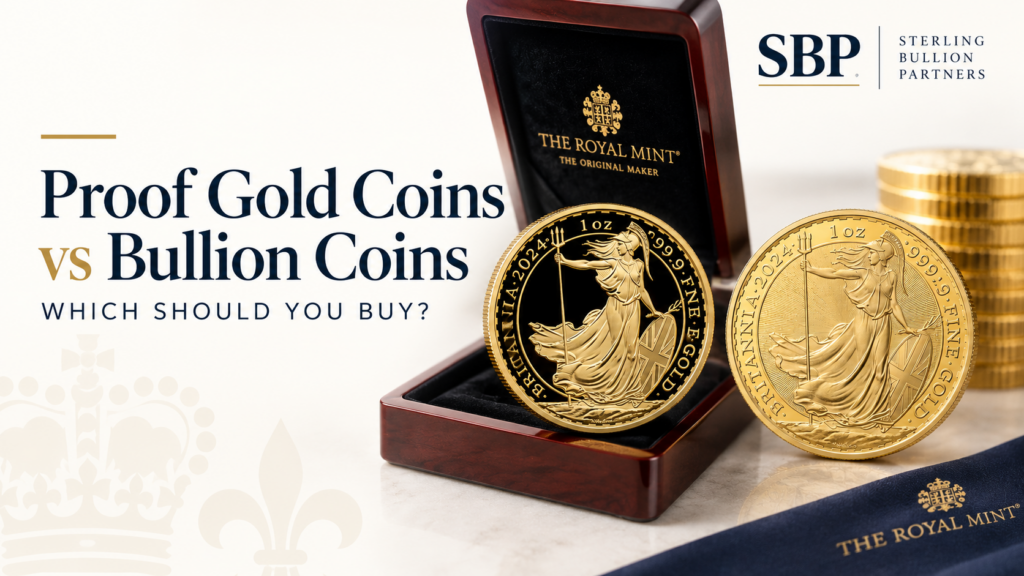
Proof gold coins and bullion gold coins can contain the same amount of gold but are produced for very different purposes.
Bullion gold coins are primarily produced for buyers seeking physical precious metal. Their market price is therefore closely connected to the value of the gold they contain, plus a premium.
Proof gold coins are specially produced collector coins. They receive more attention during manufacture, are often issued in more restricted quantities and typically carry a higher premium than comparable bullion coins.
The Royal Mint treats Proof and Bullion as distinct striking standards and, for the 2026 Sovereign, explains that Proof coins are struck three times with specially polished dies while Bullion Sovereigns are produced in larger quantities and primarily derive their value from their precious-metal content. The Royal Mint’s Proof or Bullion Sovereign guide explains the distinction directly.
Neither is automatically better.
The important question is:
What are you trying to own?
If the priority is acquiring physical gold efficiently, bullion will often make more sense.
If the priority is owning a particular collectable coin where mintage, finish, condition, grade and collector demand matter, a Proof coin can represent a very different proposition.
⸻
At a Glance
What is a Proof gold coin? A specially produced collector coin struck to a higher production standard, often using specially prepared dies and multiple strikes.
What is a bullion gold coin? A precious-metal coin produced primarily for buyers seeking physical gold and generally priced closer to its underlying metal value.
Do Proof coins contain more gold than bullion coins? Not necessarily. Comparable Proof and bullion versions can contain the same quantity of fine gold.
Why are Proof gold coins more expensive? Their price can reflect specialist manufacture, restricted mintage, presentation and collector demand in addition to the gold they contain.
Are Proof coins rarer than bullion coins? Often they have lower mintages, but rarity needs to be assessed for the individual coin.
Can Proof coins be graded? Yes. NGC and PCGS both grade Proof coins.
Can bullion coins be graded? Yes. Eligible bullion coins can receive Mint State grades such as MS69 and MS70.
Which is better? Neither universally. Bullion generally suits gold-content-led buying while selected Proof coins can suit buyers interested in collectability and scarcity.
⸻
What Is a Proof Gold Coin?
A Proof coin is not simply an ordinary coin that has been polished.
Proof refers to a specialist method and standard of manufacture.
The Royal Mint produces coins to several distinct striking standards, including Proof, Brilliant Uncirculated and Bullion. Its official striking standards guide explains these differences.
Proof coins are generally made with greater attention to the preparation of dies and coin surfaces and are struck to achieve a highly detailed finish.
Traditional Proof coins commonly display:
- highly reflective fields
- frosted design elements
- sharp detail
- carefully prepared surfaces
- specialist presentation
The important point is that Proof describes how the coin was produced.
It does not tell you its numerical grade and it does not automatically make the coin rare.
⸻
What Is a Bullion Gold Coin?
A bullion gold coin is produced primarily for the precious-metals market.
Its value is generally much more closely connected to:
fine gold content
the prevailing gold price
a market premium
Examples familiar to UK buyers include:
- Gold Britannias
- bullion Sovereigns
- Queen’s Beasts bullion coins
- Tudor Beasts bullion coins
Bullion coins can still feature sophisticated designs and can also become collectable.
The difference is that the core proposition is usually physical gold ownership, rather than buying a specially produced collector edition.
⸻
Proof Gold Coins vs Bullion Coins: Key Differences
|
Factor |
Proof Gold Coins |
Bullion Gold Coins |
|---|---|---|
|
Primary market |
Collectors |
Physical gold buyers |
|
Production |
Specialist Proof process |
Bullion production |
|
Finish |
Highly refined |
Standard bullion finish |
|
Typical production |
Often more restricted |
Often larger |
|
Presentation |
Frequently box and certificate |
Usually simpler |
|
Premium over gold |
Usually higher |
Usually lower |
|
Grade relevance |
Can be very important |
Relevant when certified |
|
Collector premium |
Can be significant |
Usually more limited |
|
Gold-price relationship |
Important, but not always dominant |
Generally more direct |
|
Resale assessment |
Coin-specific |
Often closely linked to gold |
These are broad characteristics rather than rules that determine the value of every individual coin.
The exact issue always matters.
⸻
Do Proof Coins Contain More Gold Than Bullion Coins?
Not necessarily.
Proof and bullion describe different production formats.
They do not inherently describe different quantities of gold.
A one-ounce Proof coin and a comparable one-ounce bullion coin can both contain one troy ounce of fine gold.
The Proof can nevertheless cost considerably more.
That additional price is not buying additional gold.
It may reflect:
- specialist manufacture
- restricted mintage
- presentation
- collector demand
- scarcity
- condition
- certified grade
This is why buyers should distinguish between intrinsic gold value and collector premium.
Our guide Why Do Gold Coins Sell for More Than the Gold Price? explains this distinction in detail.
⸻
Why Are Proof Gold Coins More Expensive?
Proof coins generally involve a more intensive production process and are usually positioned as collector products.
The Royal Mint’s current comparison of the 2026 Sovereign says Proof Sovereigns are struck three times using specially polished dies, individually inspected and issued in limited numbers. It contrasts this with the Bullion Sovereign, whose value primarily derives from its precious-metal content and which carries a lower premium. Read The Royal Mint’s direct Proof vs Bullion comparison.
But production cost is only one part of the eventual market premium.
A Proof coin’s price can also reflect:
Original Mintage
How many examples could originally exist?
Collector Demand
How many buyers actually want the issue?
Condition
How well has the individual coin been preserved?
Certified Grade
Has it achieved a particularly desirable grade such as PF70?
Certified Population
How many examples have achieved that grade?
Market Availability
How often do comparable examples actually appear for sale?
The premium therefore needs to be assessed coin by coin.
⸻
Are Proof Gold Coins Worth More Than Bullion Coins?
They can be, but not automatically.
A Proof gold coin commonly costs more initially because it is produced and presented as a collectable product.
Its secondary-market value can then depend on factors including:
- original mintage
- collector demand
- condition
- certified grade
- certified population
- historical significance
- design
- market availability
- underlying gold value
The important point is that a higher initial price does not guarantee a higher future value.
A Proof premium needs collector demand to support it.
Our guide What Makes a Gold Coin Rare and Valuable? explains why scarcity and demand need to be considered together.
⸻
Are Proof Gold Coins Rare?
Some are.
Some are not.
Proof is a method of manufacture, not a measure of rarity.
A Proof coin might have a mintage of 250, 500, 5,000 or considerably more.
Even a genuinely low mintage does not automatically make the coin valuable.
Collectors should consider:
Mintage → Grade → Population → Demand → Availability → Price
A low-mintage Proof with a very small PF70 population and strong collector demand presents a different proposition from a high-mintage Proof with thousands of certified examples.
Our Coin Population vs Mintage guide explains why these figures should not be confused.
⸻
Can Bullion Gold Coins Be Collectable?
Yes.
Bullion coins are usually bought primarily for their gold content, but certain issues can develop collector interest because of:
- restricted production
- special designs
- privy marks
- particular dates
- varieties
- discontinued issues
- unusually high grades
- small certified populations
A bullion coin can therefore acquire a premium beyond its metal value.
This does not change the fact that standard bullion is generally designed to provide a more direct route into physical gold than Proof coinage.
⸻
Proof Sovereign vs Bullion Sovereign
The Sovereign provides one of the clearest real-world comparisons.
The Royal Mint currently produces both Proof and Bullion Sovereigns.
For the 2026 issue, The Royal Mint says its Proof Sovereign is struck three times with specially polished dies and individually inspected, while its Bullion Sovereign is produced in larger quantities and primarily derives its value from precious-metal content.
A Proof Sovereign may appeal to somebody interested in:
- limited production
- specialist finish
- Royal Mint presentation
- collector demand
- professional grading
- certified population
A Bullion Sovereign may appeal more strongly to somebody interested in:
- physical gold
- lower premiums
- broad recognition
- straightforward resale
- acquiring more gold for the same budget
They share the Sovereign name.
They serve different buying objectives.
⸻
Proof Britannia vs Bullion Britannia
The same principle applies to Britannias.
A Bullion Britannia is primarily a physical gold product.
A Proof Britannia is produced for the collector market.
Depending on the particular year and denomination, a Proof Britannia may have a much smaller original mintage and a substantially higher premium.
If it is professionally graded, its grade and certified population add another layer to the analysis.
This is why comparing a Proof Britannia with the cheapest available bullion Britannia purely on a price-per-ounce basis can be misleading.
The buyer is not necessarily purchasing the same proposition.
⸻
Can Proof and Bullion Coins Both Be Graded?
Yes.
This is an important distinction because:
Proof vs Bullion
and:
Raw vs Certified
are not the same comparison.
A Proof coin can be raw or professionally certified.
A bullion coin can also be raw or professionally certified.
NGC typically uses PF for Proof coins and MS for Mint State coins.
You might therefore see:
NGC PF70 Ultra Cameo
on a Proof coin
and:
NGC MS70
on a bullion coin.
Certification does not turn a bullion coin into a Proof.
Likewise, an ungraded Proof remains a Proof.
Our Bullion vs Certified Coins guide deals specifically with the certification question.
⸻
PF70 vs MS70: What’s the Difference?
Both represent the highest numerical grade within their respective categories.
PF70 applies to a Proof coin.
MS70 applies to a Mint State coin.
The grade 70 does not mean the coins themselves are equivalent.
A Proof issue with a mintage of 300 and a PF70 population of 15 presents a very different scarcity profile from a bullion issue with an MS70 population of several thousand.
This is why the underlying coin must always be considered alongside the grade.
Our PF69 vs PF70 guide and MS69 vs MS70 guide explain the two grading comparisons separately.
⸻
Which Is Easier to Sell: Proof or Bullion Gold Coins?
Bullion can often be simpler to price and resell because its value is more directly linked to:
gold content
current gold price
market premium
Widely recognised bullion coins therefore have a broad potential market.
Proof coins require more coin-specific assessment.
A specialist buyer may consider:
- issue
- mintage
- condition
- grade
- population
- collector demand
- availability
- comparable sales
A desirable Proof can command a substantial premium.
But realising that premium depends on finding demand for the individual coin.
That is why liquidity and potential collector value need to be considered together.
⸻
Are Proof and Bullion Gold Coins Capital Gains Tax Free?
Proof or bullion status does not determine the CGT treatment.
The legal status of the underlying coin matters.
HMRC specifically confirms that Sovereigns minted in 1837 and later years and Britannia gold coins are sterling currency and exempt from Capital Gains Tax.
You can read the rule directly in HMRC’s Capital Gains Manual.
Therefore, a qualifying Proof Sovereign does not lose its underlying sterling-currency status because it was produced as a Proof.
Likewise, a qualifying Bullion Britannia can benefit from the exemption.
By contrast, HMRC specifically gives Krugerrands as an example of non-sterling currency that remains a chargeable asset.
Our Are Gold Coins Capital Gains Tax Free in the UK? guide covers the tax position in detail.
⸻
Are Proof and Bullion Gold Coins VAT Free?
Again, Proof vs bullion is not itself the VAT test.
UK VAT rules provide an exemption for qualifying investment gold coins.
HMRC states that an investment gold coin is either a recognised coin on its list or a coin meeting criteria including being minted after 1800, at least 900 thousandths fine, legal tender or former legal tender and normally sold within the permitted relationship to its underlying gold value.
You can check the rules in HMRC’s Investment Gold Coins VAT Notice 701/21A.
VAT and CGT are therefore separate questions.
⸻
Should You Buy Proof Gold Coins or Bullion Coins?
Start with your objective.
If Your Priority Is Physical Gold
Bullion will usually be the more straightforward option.
Focus on:
- fine gold content
- premium over gold
- liquidity
- dealer spread
- tax treatment
If Your Priority Includes Collectability
Selected Proof coins may deserve consideration.
Focus on:
- exact issue
- original mintage
- design
- grade
- certified population
- collector demand
- availability
- price
If You Want Both
It does not have to be an either/or decision.
Some buyers hold bullion for straightforward physical-gold exposure while also owning carefully selected Proof or certified coins for their numismatic characteristics.
The important thing is to understand which part of the price is gold and which part is the collector premium.
⸻
What Should You Check Before Buying a Proof Gold Coin?
Before paying a substantial Proof premium, ask:
What Is the Exact Coin?
Identify the year, denomination, design and issue.
What Is the Original Mintage?
How restricted was the original supply?
Is It Professionally Graded?
If so, verify the certification.
What Is the Certified Population?
How many examples have achieved the same grade?
Is There Genuine Collector Demand?
Low supply needs buyers to support a premium.
How Often Does It Appear for Sale?
Published population and actual availability are not always the same.
What Have Comparable Examples Sold For?
Do not rely solely on advertised asking prices.
What Premium Am I Paying Above the Gold?
Understand how much of the price reflects metal value and how much reflects collectability.
⸻
What Should You Check Before Buying a Bullion Gold Coin?
The emphasis is different.
Consider:
Fine Gold Content
How much gold are you acquiring?
Premium Above Gold
How much are you paying above the underlying metal value?
Recognition
Is the coin widely recognised in the secondary market?
Liquidity
How straightforward should resale be?
Dealer Spread
What is the likely difference between buying and selling prices?
Tax Treatment
For UK buyers, does the particular coin benefit from relevant UK tax treatment?
For bullion, the analysis can therefore be much more directly centred around the economics of owning physical gold.
⸻
Frequently Asked Questions
What is the difference between a Proof gold coin and a bullion gold coin?
Proof coins are specially manufactured collector coins, often produced in more restricted quantities and with a highly refined finish. Bullion coins are primarily produced for buyers seeking physical precious metal and generally trade closer to their underlying gold value.
Are Proof gold coins worth more than bullion coins?
They can be, but not automatically. Proof coins can carry premiums based on mintage, condition, grade, certified population, collector demand and availability.
Why are Proof gold coins more expensive?
Their premium can reflect specialist production, restricted issue numbers, presentation and collector demand rather than additional gold content.
Do Proof coins contain more gold than bullion coins?
Not necessarily. Comparable Proof and bullion versions can contain exactly the same amount of fine gold.
Are Proof coins better than bullion coins?
Neither is universally better. Bullion generally suits buyers focused primarily on gold content while selected Proof coins can suit collectors interested in scarcity and numismatic premiums.
Are Proof coins rare?
Some are. Proof describes the method of manufacture and does not automatically establish rarity.
Can bullion coins be graded?
Yes. Bullion coins can receive Mint State grades such as MS69 and MS70.
Can Proof coins be graded?
Yes. NGC Proof grades commonly use the PF prefix, such as PF69 or PF70.
Does PF70 mean a Proof coin is rare?
No. PF70 is a grade. The certified population and underlying coin need to be checked.
Is an MS70 bullion coin a Proof?
No. MS70 is a Mint State grade. Certification does not change a bullion coin into a Proof.
Which is easier to sell, Proof or bullion?
Recognised bullion coins can often be simpler to price and sell because their value is closely linked to gold. Proof coins can also have strong markets but require more coin-specific assessment.
Are Proof Sovereigns CGT free?
Qualifying post-1837 Sovereigns are treated by HMRC as exempt sterling currency. Proof status itself does not create or remove the exemption.
Are Bullion Britannias CGT free?
Qualifying Britannia gold coins are specifically treated by HMRC as exempt sterling currency.
Should I buy Proof or bullion gold coins?
Choose according to your objective. Bullion generally suits gold-content-led buying while selected Proof coins can suit buyers interested in collectability, scarcity and numismatic premiums.
⸻
Final Thoughts
Proof gold coins and bullion gold coins both provide ownership of physical gold, but they should not be assessed in exactly the same way.
Bullion is generally the more straightforward proposition.
Its value is primarily driven by:
gold content
gold price
market premium
liquidity
Proof coins introduce additional considerations:
original mintage
condition
grade
certified population
collector demand
market availability
This is why neither category is automatically better.
For someone primarily seeking physical gold, a useful framework is:
Gold Content → Premium → Liquidity → Tax Treatment
For someone evaluating a collectable Proof coin, the framework becomes:
Coin → Mintage → Grade → Population → Demand → Availability → Price
A well-priced bullion coin can provide an efficient way to own physical gold.
A carefully selected Proof coin can combine physical gold with genuine collector scarcity.
The right choice depends on what you want the coin to do.
