

Guides
Inherited Gold Coins: What Should You Do With Them?
Sep
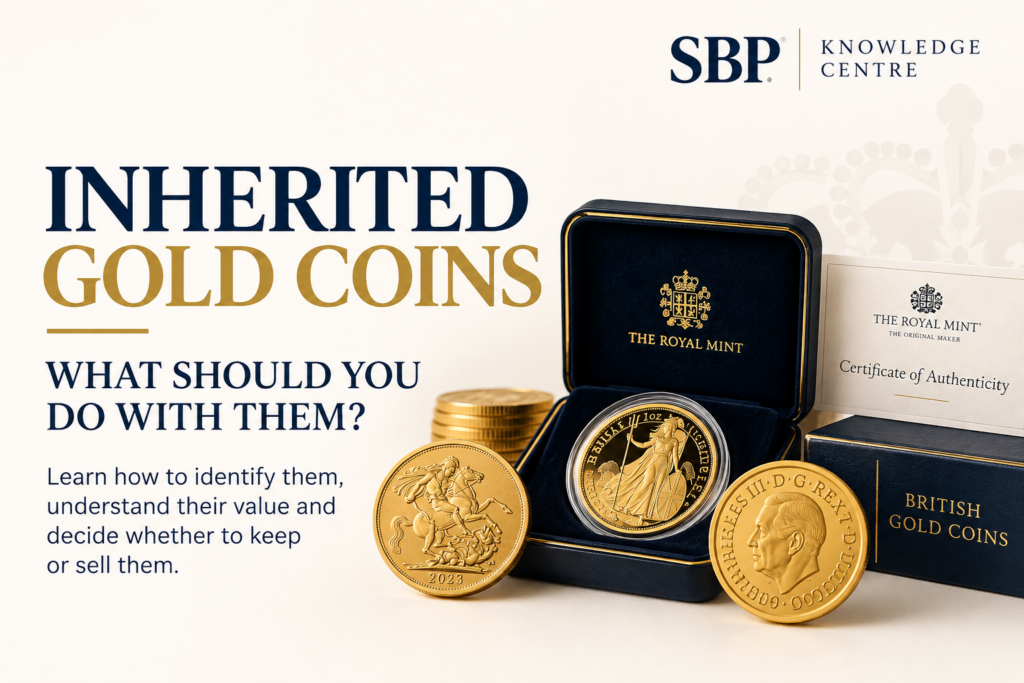
Inheriting gold coins can leave you with anything from straightforward bullion to rare Proof coins, historic Sovereigns or professionally graded NGC and PCGS pieces.
The most important thing is not to rush into selling them before you know exactly what you have.
Two gold coins containing similar amounts of gold can have very different market values. One may trade primarily for its metal content while another may carry a substantial collector premium because of its mintage, condition, certified grade, population or rarity.
Before selling inherited gold coins, identify them properly, preserve any original packaging and certificates, check whether any coins are professionally graded and establish whether their value comes primarily from the gold or from the individual coin.
⸻
At a Glance
What should you do first with inherited gold coins? Keep everything together, do not clean the coins and identify exactly what you have.
Should you sell inherited gold coins for their gold value? Not until they have been assessed. Some coins can be worth considerably more than their intrinsic gold content.
Should you clean inherited coins? No. Cleaning can permanently alter collectable coin surfaces.
Should you keep Royal Mint boxes and certificates? Yes. Original packaging and documentation can be relevant to identification and collectability.
What if a coin is graded by NGC or PCGS? Leave it in its holder and verify the certification.
Are inherited gold coins taxable? Tax treatment depends on the asset and circumstances. Inheritance Tax and Capital Gains Tax are separate considerations.
Are inherited Sovereigns and Britannias CGT-free? Qualifying post-1837 Sovereigns and Britannia gold coins are specifically treated by HMRC as exempt sterling currency.
Should you get a collection valued before selling? For a significant or mixed collection, yes.
⸻
What Should You Do First If You Inherit Gold Coins?
The first thing to do is avoid making irreversible decisions before you know exactly what you have.
Do not immediately sell the coins for their gold content.
Do not clean them.
Do not remove professionally graded coins from their holders.
Do not throw away Royal Mint boxes, certificates of authenticity, receipts or other paperwork.
Instead, work through the collection methodically.
1. Keep Everything Together
If the coins arrived with:
- original Royal Mint boxes
- certificates of authenticity
- presentation cases
- receipts
- invoices
- grading paperwork
- correspondence
- previous valuations
keep these with the collection.
Original packaging and documentation can help identify the exact issue and may be relevant to collectors.
2. Separate Obviously Different Types of Coins
Without opening capsules or holders unnecessarily, group coins according to obvious differences such as:
- Sovereigns
- Britannias
- commemorative £5 gold coins
- foreign gold coins
- Proof coins in presentation boxes
- NGC or PCGS-certified coins
- loose bullion coins
- gold bars
You do not need to establish their values yet.
The objective is simply to understand what types of assets are present.
3. Identify Each Coin
Record basic information including:
Year
Denomination
Design
Weight or size
Proof or bullion finish, if known
Royal Mint packaging or certificate number
NGC or PCGS grade, if applicable
Once the collection has been identified properly, valuation becomes considerably easier.
⸻
Do Not Clean Inherited Gold Coins
This is one of the most important rules.
Do not clean a potentially collectable coin.
An inherited coin may look dirty, toned or marked and cleaning it can seem like an obvious way to improve its appearance.
For collectable coins, it can do the opposite.
Cleaning can alter the original surfaces and leave hairlines, scratches or other evidence of intervention.
NGC explains that coins with problematic surface conditions can receive an NGC Details grade rather than an ordinary numerical grade.
If you do not know whether a coin is collectable, the safest approach is:
leave it exactly as you found it.
Do not polish it.
Do not use jewellery cleaner.
Do not rub it with a cloth.
Do not attempt to remove toning.
Do not wash it simply to make it look newer.
For guidance on protecting physical coins properly, see our How to Store Gold Coins guide.
⸻
How Can You Tell What an Inherited Gold Coin Is?
Start with the information physically present on the coin or its packaging.
Look for:
- date
- denomination
- monarch
- inscriptions
- issuing country
- weight where stated
- certificate
- original box
- grading label
For British coins, common inherited holdings can include:
- Gold Sovereigns
- Half Sovereigns
- Britannias
- Proof Sovereigns
- Five Sovereign or £5 gold coins
- Royal Mint commemorative gold coins
- Queen’s Beasts
- Tudor Beasts
- historic British gold coins
There may also be foreign coins such as Krugerrands, American Eagles, Maple Leafs and other international issues.
Identification needs to come before valuation because two coins that appear superficially similar can have completely different market values.
⸻
What If the Coin Is in an NGC or PCGS Holder?
If a coin is already encapsulated by NGC or PCGS, do not remove it from the holder.
The label can provide important information including:
- exact coin attribution
- year
- denomination
- numerical grade
- Proof or Mint State classification
- additional designations
- certification number
Professional certification can also make it possible to research the coin’s certified population.
NGC provides an official certification verification service and PCGS provides its own certification verification service.
These can help confirm that the details on the holder correspond with the grading company’s records.
If you are unfamiliar with the two services, our PCGS vs NGC guide explains how their certification systems and terminology differ.
⸻
What Do PF70, PF69, MS70 and MS69 Mean?
If you inherit graded coins, you may see labels including:
PF70
PF69
MS70
MS69
These are not indications of gold purity.
They are grades.
NGC uses PF for Proof coins and MS for Mint State coins.
The numerical component comes from the internationally recognised 1 to 70 grading scale.
A 70 represents the highest numerical grade.
However, a 70-grade coin is not automatically rare or extremely valuable.
You also need to understand the underlying coin and how many examples have achieved that grade.
Our PF69 vs PF70 guide and MS69 vs MS70 guide explain the differences in more detail.
⸻
How Do You Know Whether an Inherited Gold Coin Is Rare?
Do not assume that:
old = rare
or:
graded = rare
or:
PF70 = rare
Rarity needs evidence.
A useful framework is:
Coin → Mintage → Grade → Population → Demand → Availability → Price
Start by identifying the exact coin.
Then establish its original mintage.
If it is certified, check the grade and certified population.
Then investigate collector demand and how frequently comparable examples actually appear for sale.
Our What Makes a Gold Coin Rare and Valuable? guide explains this process in detail.
This step is particularly important with inherited collections because a coin can have value beyond the gold it contains.
⸻
What Is Mintage and Why Does It Matter?
Mintage generally refers to the number of examples originally produced or issued.
For collectable coins, it can be one indication of original scarcity.
A coin with a mintage of 250 started with a much more restricted supply than one with a mintage of 250,000.
But mintage alone does not establish value.
You also need to consider:
- surviving examples
- condition
- grade
- certified population
- collector demand
- availability
Modern Royal Mint issues can also have both Maximum Coin Mintage and Limited Edition Presentation figures, which should not automatically be treated as the same thing.
Our Coin Population vs Mintage guide explains how to interpret these figures correctly.
⸻
What Is a Coin Population?
If an inherited coin has been professionally graded, its certified population can be particularly useful.
Suppose you inherit an NGC PF70 coin.
You discover:
Original mintage: 500
NGC PF69 population: 120
NGC PF70 population: 18
The PF70 population provides additional information about how many examples NGC has recorded at that grade.
It does not mean only 18 examples of the underlying coin exist.
Other coins may be ungraded, graded differently or certified by PCGS.
Our guide What Is a Coin Population Report? explains how to interpret these figures properly.
⸻
How Much Are Inherited Gold Coins Worth?
There is no single answer because the collection could contain anything from ordinary bullion to genuinely scarce numismatic coins.
A gold coin’s value can include two broad components:
intrinsic gold value
and potentially:
collector or numismatic value
Intrinsic Gold Value
This is based primarily on how much fine gold the coin contains and the prevailing gold price.
Collector Value
This can be influenced by:
- original mintage
- rarity
- condition
- certified grade
- certified population
- historical importance
- collector demand
- market availability
This explains why two coins containing similar quantities of gold can have very different market prices.
Our guide Why Do Gold Coins Sell for More Than the Gold Price? explains how these additional premiums can develop.
⸻
How Do You Value an Inherited Gold Coin Collection?
A sensible valuation process has several stages.
Identify the Coins
Establish exactly what each coin is.
Establish the Gold Content
This provides an underlying reference value.
Check Original Mintage
For collectable coins, determine how restricted the original issue was.
Check Certification
If a coin is graded, verify the certification and numerical grade.
Check Certified Population
Research how many examples have achieved the same grade.
Check Market Availability
Search for genuinely comparable examples currently available.
Check Completed Sales Where Possible
An asking price tells you what a seller wants.
A completed transaction tells you what a buyer was prepared to pay.
These can be very different.
For a significant collection, evaluating the coins individually rather than applying a single price-per-gram calculation can prevent potentially valuable pieces from being overlooked.
⸻
Should You Value Inherited Gold Coins at Scrap Value?
Not until you know what they are.
For an ordinary gold item with no numismatic significance, metal value may provide an appropriate starting point.
Coins require more care.
Consider two hypothetical one-ounce gold coins.
Coin A
Common bullion issue
Widely available
No significant collector premium
Coin B
Low-mintage Proof
NGC PF70
Small certified population
Strong collector demand
Both might contain approximately the same amount of gold.
Selling both purely by weight could ignore the characteristics that distinguish Coin B.
This is why inherited coins should be identified before they are priced as metal.
⸻
Should You Keep or Sell Inherited Gold Coins?
There is no universal answer.
The decision depends on:
- what you inherited
- its current value
- whether you want to own physical gold
- whether the coins have sentimental importance
- whether you understand the collection
- whether you need the capital
- your wider financial circumstances
The important point is to make the decision after the collection has been identified and valued.
There is nothing wrong with deciding to sell inherited coins.
There is also nothing wrong with keeping them.
The mistake is making either decision without understanding what is actually in the collection.
⸻
Should You Sell an Inherited Collection All at Once?
Not necessarily.
A mixed collection can contain different types of assets.
For example:
- ordinary bullion
- scarce Proof coins
- certified PF70 coins
- common Sovereigns
- rare dates
- foreign bullion
- gold bars
- silver or base-metal collectables
The most appropriate market for one item may not be the most appropriate market for another.
Bulk-selling everything as “gold coins” may be convenient, but convenience should be weighed against whether individual pieces deserve separate assessment.
A collection should therefore be understood before deciding whether it makes sense to sell it as one group or as individual coins.
⸻
Where Can You Sell Inherited Gold Coins in the UK?
There are several possible routes.
Specialist Gold Coin Dealer
A specialist dealer can be particularly useful where a collection contains a mixture of bullion, Proof and certified coins.
Bullion Dealer
This can be appropriate for straightforward bullion holdings where value is primarily determined by gold content.
Auction House
Rare historic or specialist numismatic coins can sometimes be suited to auction, although fees, commission and timing need to be considered.
Private Sale or Marketplace
This can potentially achieve a different price but introduces additional work and risks around payment, authenticity disputes, delivery and security.
The right route depends on the coin.
Our How to Sell Gold Coins in the UK guide explains the main selling options and what to consider before accepting an offer.
⸻
Should You Get More Than One Valuation?
For a significant collection, yes, that can be sensible.
A valuation is ultimately an opinion of what a buyer or market may pay.
If you are considering selling, you can compare offers.
The important thing is to make sure the comparisons are genuinely equivalent.
One buyer may be quoting:
scrap or melt value
while another may be recognising:
collector value
for specific coins.
Equally, a high advertised retail price does not necessarily mean that is what somebody will pay you for the coin.
Ask:
What is the offer?
How was it calculated?
Is the coin being valued as bullion or as a collectable?
Are there fees or commissions?
Understanding the basis of the valuation matters as much as the headline number.
⸻
Are Inherited Gold Coins Taxable in the UK?
Several different taxes can potentially be relevant to an inheritance and they should not be confused.
For someone who has inherited gold coins, two questions are particularly common:
Was tax due as part of the estate?
and:
Could Capital Gains Tax become relevant if I later sell the coins?
These are separate questions.
The tax treatment depends on the circumstances and the specific assets involved.
For current estate rules, see the official GOV.UK Inheritance Tax guidance.
⸻
Do You Pay Inheritance Tax on Gold Coins?
Inheritance Tax is generally dealt with as part of the deceased person’s estate rather than as a tax charged simply because the beneficiary receives a particular gold coin.
Whether Inheritance Tax is payable depends on the value and circumstances of the overall estate, available thresholds, exemptions and reliefs.
The fact that a coin may be exempt from Capital Gains Tax because it is sterling currency does not make it automatically exempt from Inheritance Tax.
These are different taxes.
For estate-specific advice, particularly where substantial values are involved, professional tax or probate advice may be appropriate.
⸻
Do You Pay Capital Gains Tax When Selling Inherited Gold Coins?
It depends on the coin.
Certain qualifying British legal-tender gold coins benefit from an important UK tax treatment.
HMRC specifically confirms that Sovereigns minted in 1837 and later years and Britannia gold coins are sterling currency and exempt from Capital Gains Tax.
You can read the rule directly in HMRC’s Capital Gains Manual guidance on coins and currency.
Other assets, including gold bars and many foreign gold coins, do not benefit from the same sterling-currency exemption.
Our guide Are Gold Coins Capital Gains Tax Free in the UK? explains the distinction in detail.
⸻
What Is the Acquisition Value of an Inherited Asset for CGT?
This is an important point if you later dispose of an inherited asset that is subject to Capital Gains Tax.
For CGT purposes, inherited assets are generally considered using their market value at the relevant date of inheritance/death, rather than simply carrying forward the deceased owner’s historic purchase price.
HMRC provides guidance on when market value is used for Capital Gains Tax.
This can matter significantly.
Suppose someone originally bought a chargeable gold asset for £1,000 many years ago.
At the relevant inheritance valuation date it was worth £3,000.
The beneficiary later sells it for £3,500.
The deceased owner’s original £1,000 purchase price would not simply become the beneficiary’s starting figure.
The precise tax treatment depends on the circumstances, so professional advice should be sought where material sums are involved.
⸻
Why Is a Date-of-Death Valuation Important?
Because it can provide an important reference point for both estate administration and subsequent tax calculations.
If a collection contains potentially valuable coins, retain records showing how the collection was valued.
Keep:
- probate valuations
- dealer valuations
- inventories
- photographs
- grading information
- invoices relating to subsequent sales
Good records can become particularly important years later when somebody needs to establish the value used at the time of inheritance.
⸻
Are Inherited Sovereigns Capital Gains Tax Free?
For qualifying post-1837 Sovereigns, HMRC’s sterling-currency exemption applies.
The fact that you inherited the Sovereign rather than purchased it does not change the underlying coin.
However, historic Sovereigns require more care.
HMRC specifically distinguishes pre-1837 Sovereigns that are no longer legal tender.
Do not therefore assume that every historic coin carrying the Sovereign name receives identical treatment.
⸻
Are Inherited Britannias Capital Gains Tax Free?
Qualifying Britannia gold coins are specifically identified by HMRC as sterling currency and exempt from CGT.
Again, inheritance does not itself change the underlying legal status of the coin.
This can be particularly relevant where somebody inherits a substantial holding of Britannias that has risen significantly in value.
⸻
What If You Inherit Gold Bars?
Gold bars need to be considered separately from qualifying sterling coins.
A gold bar is not sterling currency and therefore does not receive the sterling-currency CGT exemption.
That does not mean tax will automatically be payable when it is sold.
The actual position depends on matters including:
- the inherited market value
- eventual sale proceeds
- allowable costs
- other gains and losses
- the applicable Annual Exempt Amount
- the individual’s wider tax circumstances
The important point is that gold bars and qualifying British legal-tender coins should not automatically be treated the same way for CGT purposes.
⸻
What If You Inherit Foreign Gold Coins?
Foreign coins also need separate consideration.
A Krugerrand, for example, is a recognised bullion coin but it is not sterling currency.
HMRC specifically gives Krugerrands as an example of currency that is not sterling and therefore remains a chargeable asset for CGT purposes.
This illustrates why the phrase:
“Gold coins are CGT-free”
is too broad.
The exact coin matters.
⸻
What If You Inherit a Large Gold Coin Collection?
Do not try to value a substantial mixed collection by applying one gold price to everything.
A large collection should ideally be inventoried systematically.
Separate the collection into categories such as:
- bullion coins
- Sovereigns
- Britannias
- Proof coins
- commemorative gold coins
- NGC-certified coins
- PCGS-certified coins
- historic coins
- foreign coins
- gold bars
- silver or other collectable coins
Then identify the potentially higher-value pieces for more detailed research.
For certified coins, record:
grading company
numerical grade
additional designations
certification number
For Proof coins in original packaging, retain:
Royal Mint box
certificate of authenticity
original capsule
any accompanying documentation
This makes it considerably easier to distinguish straightforward bullion from coins requiring specialist assessment.
⸻
What Paperwork Should You Keep With Inherited Gold Coins?
Keep as much original documentation as possible.
Useful records can include:
- Royal Mint certificates of authenticity
- original invoices
- dealer receipts
- grading submissions
- previous valuations
- auction records
- probate valuations
- correspondence relating to purchases
- original presentation boxes
- certificates accompanying limited editions
Paperwork can help establish exactly what a coin is.
For inherited assets that may eventually be subject to tax calculations, valuation records can also become important evidence of the asset’s value at the relevant date.
Do not assume an old receipt is irrelevant simply because the market value has changed.
Keep it with the collection.
⸻
Should You Remove Gold Coins From Their Original Packaging?
Generally, not until you know exactly what you have.
For bullion coins, original tubes or capsules may primarily provide protection.
For collectable Proof coins, original Royal Mint packaging and certificates can form part of the complete presentation collectors expect.
For NGC and PCGS-certified coins, the holder is particularly important because it contains the grading company’s certification.
Removing a certified coin from its holder means it is no longer being offered in that certified holder with that encapsulated certification presentation intact.
If you inherit a coin in unfamiliar packaging, identify it before opening or discarding anything.
⸻
Should You Have Inherited Gold Coins Graded?
Sometimes, but not every coin should be submitted for grading.
Grading involves cost and there is no guarantee that certification will increase a coin’s market value by more than those costs.
Before submitting a coin, consider:
- the exact issue
- original mintage
- current condition
- likely grade
- existing certified populations
- value difference between grades
- collector demand
- grading and shipping costs
For an ordinary bullion coin, grading may add relatively little.
For a scarce Proof coin where a high numerical grade could materially affect desirability, certification may be considerably more relevant.
The decision should therefore be made coin by coin.
⸻
How Can You Check the Value of an NGC or PCGS Coin?
Start by verifying the certification.
Then identify the exact coin and research:
Original Mintage
How many were originally issued?
Grade
What numerical grade has the coin achieved?
Certified Population
How many examples have been recorded at that grade?
Population Above and Below
How does the grade compare with neighbouring grades?
Current Availability
Can you actually find comparable examples for sale?
Completed Sales
What have genuinely comparable examples sold for?
The last point matters.
A dealer can advertise a coin for £10,000.
That does not prove somebody has paid £10,000 for it.
Asking prices are useful market evidence, but completed transactions can provide stronger evidence of actual buyer demand.
⸻
What If You Cannot Find the Inherited Coin for Sale Anywhere?
That can be interesting, but it does not automatically mean the coin is extremely valuable.
There are several possible explanations.
The coin might be genuinely scarce.
It might rarely come to market.
It might have limited collector demand.
The exact grade might be uncommon.
Or your search may simply be using the wrong description.
This is where combining several pieces of evidence becomes important.
Check:
- mintage
- certified population
- auction archives
- dealer availability
- grading-company records
- similar grades
- historic sales
An absence of current listings is evidence of limited current availability.
It is not, by itself, proof of a particular value.
⸻
Can an Inherited Gold Coin Be Worth Much More Than Its Gold?
Yes.
This is precisely why inherited collections should be assessed before being sold for their metal content.
Suppose two coins each contain approximately £3,000 worth of gold.
The first is a common bullion coin and trades relatively close to its underlying gold value.
The second is a low-mintage British Proof coin in PF70 with a small certified population and established collector demand.
Their intrinsic gold values may be similar.
Their market prices do not have to be.
The difference can represent the numismatic or collector premium attached to the individual coin.
That premium is not guaranteed and needs supporting market evidence, but ignoring it completely can result in an inappropriate valuation.
⸻
Are Old Sovereigns Worth More Than Their Gold Value?
Some are.
Others trade relatively close to their bullion value.
A Sovereign’s value can depend on factors including:
- year
- monarch
- mint
- variety
- condition
- rarity
- collector demand
An old date alone does not make a Sovereign rare.
Some historic Sovereigns were produced in substantial quantities.
Others are considerably scarcer.
If you inherit Sovereigns, identify the exact dates and types before assuming they are simply worth their gold content.
⸻
Are Proof Gold Coins Worth More Than Bullion Coins?
They can be, but not automatically.
Proof coins are specially manufactured collectable coins and can have characteristics very different from standard bullion.
A Proof issue may have:
- restricted mintage
- specialist finish
- original presentation packaging
- collector demand
- certified grade
- low top-grade population
But being a Proof does not guarantee a substantial premium.
The individual issue still needs to be assessed.
This is particularly important with inherited Royal Mint collections because somebody unfamiliar with coins may not immediately recognise the difference between a bullion Sovereign and a limited-edition Proof Sovereign.
⸻
What If You Inherit a Complete Coin Set?
Keep the set together while it is being assessed.
Do not immediately split it into individual coins.
Complete sets can have collector significance that individual pieces do not necessarily have on their own.
Examples might include:
- Royal Mint Proof sets
- Sovereign sets
- Queen’s Beasts collections
- commemorative series
- date runs
- themed collections
That does not mean every collection is worth more intact.
In some cases, individual coins may command stronger prices separately.
But establish what the set is and how the market treats it before breaking it apart.
⸻
What If You Inherit Coins With Certificates of Authenticity?
Keep the certificates with their respective coins.
A certificate can help establish:
- exact issue
- specification
- presentation
- limited-edition information
- certificate number
For modern Royal Mint collectables, the certificate and original presentation can be relevant to buyers seeking a complete original package.
A certificate does not automatically make a coin rare or valuable.
But losing the original documentation unnecessarily can make the collection less complete.
⸻
How Should You Store Inherited Gold Coins While Deciding What to Do?
Security and preservation both matter.
Keep coins:
- dry
- secure
- away from unnecessary handling
- in their existing capsules or holders
- away from abrasive materials
- away from household cleaning products
Avoid touching exposed coin surfaces.
If a loose coin must be handled, hold it carefully by the edge rather than placing fingers across the faces.
For a valuable collection, consider appropriate insurance and secure storage while the coins are being assessed.
Our How to Store Gold Coins guide covers the practical options in more detail.
⸻
How Should You Photograph Inherited Coins for a Valuation?
Good photographs can make preliminary identification considerably easier.
For loose or encapsulated coins, photograph:
- the front
- the reverse
- the full holder or capsule
- any inscriptions
- the grading label
- the original box
- the certificate of authenticity
Use good natural or neutral lighting and make sure the image is in focus.
Do not edit the photographs heavily or use filters that alter the appearance of the coin.
For a large collection, photograph groups first and then take individual images of potentially significant pieces.
A photograph cannot always replace physical examination, but it can help determine which coins require closer assessment.
⸻
What Information Should You Give a Gold Coin Dealer?
The more precise the information, the easier it is to assess the collection.
Useful information includes:
- number of coins
- years and denominations
- photographs
- whether coins are loose or boxed
- Royal Mint certificates
- NGC or PCGS grades
- certification numbers
- whether the collection includes bullion or bars
- any existing inventory
If you have inherited several boxes and genuinely do not know what they contain, say so.
A specialist should be able to help identify the collection rather than expecting you to understand numismatic terminology already.
⸻
What Questions Should You Ask Before Selling Inherited Gold Coins?
Before accepting an offer, ask:
How Have the Coins Been Valued?
Are they being assessed as bullion, collectables or a mixture?
Is the Offer Based Purely on Gold Weight?
That may be appropriate for some coins but not necessarily every item.
Have Any Rare or Certified Coins Been Identified?
Make sure potentially significant pieces have not simply been grouped with ordinary bullion.
Are There Any Fees?
Auction commissions, marketplace charges and other selling costs can materially affect what you actually receive.
Is the Offer for the Entire Collection?
If so, understand whether individual higher-value coins have been accounted for.
Can You Compare the Offer?
For a substantial collection, obtaining another opinion can be sensible.
The objective is not necessarily to find the highest theoretical valuation.
It is to understand what the collection is worth in the real market and what you would actually receive if you sell it.
⸻
Common Mistakes When Dealing With Inherited Gold Coins
Several mistakes are particularly easy to make.
Cleaning the Coins
Potentially damaging original surfaces in an attempt to improve their appearance.
Selling Everything by Weight
This can overlook numismatic value.
Assuming Old Means Rare
Age and rarity are not the same thing.
Assuming PF70 Means Extremely Valuable
Grade needs to be considered alongside mintage, population and demand.
Throwing Away Boxes and Certificates
Original presentation can matter to collectors.
Removing Certified Coins From Their Holders
This removes the existing encapsulated certification presentation.
Using Asking Prices as Valuations
An advertised price does not prove the coin has sold at that level.
Assuming All Gold Coins Have the Same Tax Treatment
Qualifying sterling coins, foreign coins and gold bars can be treated differently for CGT purposes.
Accepting the First Offer Without Understanding It
A good offer can only be judged properly when you know how the collection has been assessed.
⸻
A Simple Checklist for Inherited Gold Coins
If you have inherited gold coins and do not know where to begin, use this order:
1. Do not clean anything
2. Keep boxes and certificates
3. Photograph the collection
4. Identify each coin
5. Separate bullion from potentially collectable coins
6. Verify NGC or PCGS-certified coins
7. Check original mintage
8. Check certified population where relevant
9. Research genuine market availability
10. Establish a realistic valuation
11. Understand the tax position
12. Decide whether to keep or sell
13. Compare selling options before accepting an offer
This sequence reduces the risk of making a decision before you understand what you own.
⸻
Frequently Asked Questions
What should I do if I inherit gold coins?
Keep the collection intact, do not clean the coins, retain all boxes and certificates and identify exactly what you have before considering a sale.
How do I know what inherited gold coins are worth?
Identify each coin and assess its gold content, mintage, condition, grade, certified population, collector demand, availability and comparable market sales.
Should I clean inherited gold coins?
No. Do not clean potentially collectable coins. Cleaning can alter their original surfaces and potentially affect their collectability or grading.
Should I sell inherited gold coins for scrap?
Not until the coins have been identified. Some coins may trade primarily for their gold content while others can carry significant collector premiums.
Where can I sell inherited gold coins in the UK?
Options include specialist gold coin dealers, bullion dealers, auction houses and private marketplaces. The most appropriate route depends on the type of coin.
Should I get inherited gold coins valued?
For a significant collection or coins you cannot identify, obtaining a specialist valuation can be sensible.
Should I get more than one valuation?
For a substantial collection, comparing offers or opinions can help establish whether the coins are being valued appropriately.
Are inherited gold coins subject to Inheritance Tax?
Inheritance Tax is generally considered as part of the deceased person’s estate. Whether tax is due depends on the circumstances of the overall estate rather than simply on the beneficiary receiving gold coins.
Do I pay Capital Gains Tax when selling inherited gold coins?
It depends on the asset. HMRC specifically exempts qualifying sterling currency including post-1837 Sovereigns and Britannia gold coins. Other coins and gold bars can be treated differently.
Are inherited Sovereigns CGT free?
Qualifying Sovereigns minted in 1837 and later years are treated by HMRC as exempt sterling currency.
Are inherited Britannias CGT free?
Qualifying Britannia gold coins are specifically identified by HMRC as exempt sterling currency.
Are inherited gold bars CGT free?
Gold bars do not receive the sterling-currency CGT exemption. Whether CGT is actually payable depends on the gain and the individual’s wider circumstances.
What value do I use for an inherited asset for CGT?
For inherited chargeable assets, market value at the relevant inheritance valuation date is generally important for CGT purposes. Individual circumstances should be checked against current HMRC guidance.
Should I remove an inherited coin from an NGC or PCGS holder?
No. If the coin is already professionally certified, leave it in its holder while you assess the collection.
What does PF70 mean on an inherited coin?
PF identifies an NGC Proof coin and 70 is the highest numerical grade on its grading scale. PF70 does not automatically mean the coin is rare or highly valuable.
What does MS70 mean on an inherited coin?
MS means Mint State and 70 is the highest numerical grade. The coin’s mintage, population, demand and availability still need to be considered.
Are old gold coins always valuable?
No. Some old gold coins are common while some modern issues are extremely scarce. Age alone does not establish rarity or value.
Should I keep or sell inherited gold coins?
That depends on the collection, its value, your financial circumstances, your interest in owning the coins and any sentimental significance. Identify and value the collection before deciding.
Can a gold coin be worth more than the gold inside it?
Yes. Collectable coins can carry premiums related to rarity, grade, certified population, historical significance, demand and market availability.
What should I do with the original boxes and certificates?
Keep them with the coins. They can help identify the exact issue and may be relevant to collectors.
⸻
Final Thoughts
Inheriting gold coins can leave you with anything from straightforward bullion to a collection containing genuinely scarce and valuable pieces.
The most important thing is not to rush the process.
Before selling anything:
- identify the coins
- keep the original packaging
- do not clean them
- verify any NGC or PCGS certification
- check mintage and population where relevant
- understand whether the value is primarily bullion or numismatic
- research genuine market prices
- understand the relevant tax treatment
Then decide whether keeping or selling the collection is right for you.
A gold coin should not automatically be valued simply by placing it on a scale and multiplying its weight by the gold price.
For some inherited coins, that may provide a reasonable indication of value.
For others, the underlying gold can be only one part of the picture.
A low-mintage Proof, a scarce historic issue or a high-grade certified coin can have characteristics that collectors value separately from its precious-metal content.
That is why the correct order is:
Identify → Research → Value → Decide
rather than:
Inherit → Weigh → Sell
Taking the time to establish exactly what you have gives you the information needed to make a properly informed decision about the collection.
