

Guides
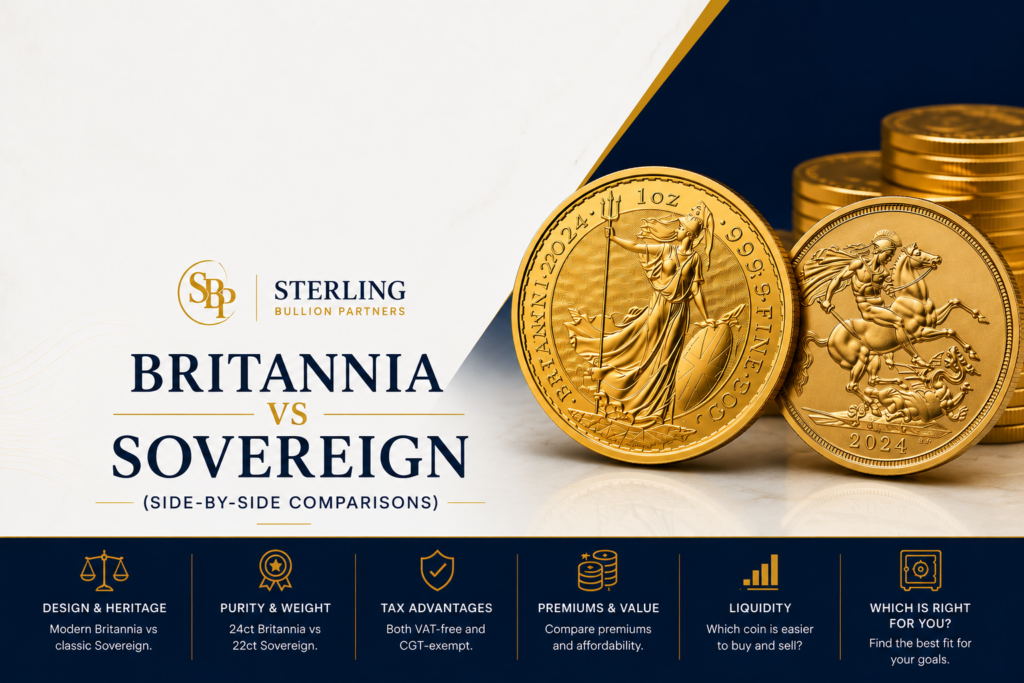
Britannia vs Sovereign: Side‑by‑Side Comparisons
Jul
Britannia vs Sovereign: Side‑by‑Side Comparisons
About this guide
This guide is part of our educational knowledge centre and is designed to help first‑time buyers, investors and collectors understand the differences between the Britannia and Sovereign gold bullion coins. It is not financial advice. We have compiled the latest information available as of 9 July 2026 and have endeavoured to make it as accurate and useful as possible. Always consult a professional adviser if you need personalised tax or investment advice.
Quick Answer
Britannia or Sovereign? There is no “better” coin – it depends on your budget, goals and personal preference. A full‑sized Britannia contains one troy ounce of 24‑carat gold and is about four times heavier than a full Sovereign . A Sovereign contains 0.2354 troy ounces of fine gold and has a lower price point, which many first‑time buyers appreciate . Both coins are legal tender, VAT‑free and Capital Gains Tax (CGT)‑exempt . Choose Britannias when you want maximum gold per coin and advanced security features, and Sovereigns when you want flexibility, smaller denominations and historic appeal.
Did You Know?
- A modern Britannia bullion coin contains one troy ounce of gold and, since 2013, is minted in 999.9 fine gold .
- Britannias introduced four innovative security features in 2021 – a latent image that changes from a padlock to a trident, micro‑text, traditional tincture lines and surface animation – making them among the most visually secure bullion coins .
- The Sovereign has been produced as a bullion coin since 1957 and contains 7.988 g gross weight with 7.32 g of pure gold . It was once known as the “chief coin of the world” for its role in international trade .
- Both coins are legal tender and therefore exempt from CGT for UK residents . They are also VAT‑free for most non‑VAT‑registered individuals .
Contents
- Key differences at a glance
- Overview of the Britannia
- Overview of the Sovereign
- Purity and weight
- Price, premiums and accessibility
- Fractional sizes and flexibility
- Design and security
- Liquidity and market demand
- Tax considerations
- Which coin is right for you?
- Common mistakes to avoid
- Frequently asked questions
- Conclusion
Key differences at a glance
The table below summarises the key specifications of the full‑sized Britannia and Sovereign. Tables are used only for concise facts; explanatory detail appears in the text.
|
Feature |
Britannia (1 oz) |
Sovereign (full) |
|---|---|---|
|
Gold content |
1 troy oz (31.104 g fine gold) |
0.2354 troy oz (7.32 g fine gold) |
|
Total weight |
~31.104 g |
7.988 g |
|
Purity |
999.9 fine (since 2013) |
916.7 fine (22 carat) |
|
Diameter |
32.69 mm (since 2014) |
22 mm |
|
Face value |
£100 |
£1 |
|
First bullion issue |
1987 |
1957 |
|
Design |
Britannia with shield, trident and olive branch |
St George & the Dragon; obverse features reigning monarch |
|
Security features |
Four advanced features – latent image, micro‑text, tincture lines and surface animation |
No special security features on bullion editions |
|
Typical buyers |
Investors seeking maximum gold per coin; those who prioritise cutting‑edge security |
Beginners and collectors who value historic appeal and smaller increments |
|
Tax status |
CGT‑free and VAT‑free |
CGT‑free and VAT‑free |
Key Takeaway
Britannias offer more gold per coin, the highest purity and modern security features. Sovereigns provide affordable entry, rich history and flexibility through smaller denominations. Both coins benefit from favourable UK tax treatment. The choice depends on how much you want to spend, how often you might sell portions of your holding and whether you value modern design or classic heritage.
Overview of the Britannia
The Britannia is the Royal Mint’s flagship bullion coin. First struck in 1987, it depicts the female personification of Britain, standing firm with a shield, trident and olive branch. The design is intended to symbolise protection, maritime strength and peace . Britannias were initially minted in 22‑carat gold but have been minted in 999.9 fine gold since 2013, making them one of the purest gold coins widely available .
Britannia coins come in various sizes, including five‑ounce, one‑ounce, half‑ounce, quarter‑ounce, tenth‑ounce and smaller fractional units. The one‑ounce coin has a diameter of 32.69 mm and contains exactly 31.104 g of fine gold . In 2021, the Royal Mint enhanced the design with four innovative security features: a latent image that shifts from a padlock to a trident when tilted, micro‑text around the edge reading Decus et Tutamen (“an ornament and a safeguard”), tincture lines that add textured patterns and surface animation that creates the impression of rolling waves . These features make the Britannia one of the most visually secure bullion coins on the market, helping investors verify authenticity by simply tilting the coin in light .
Britannias are popular with investors seeking maximum gold per coin and those who want advanced security features. Because each coin contains a full troy ounce of gold, the premium (the cost above the spot price of gold) tends to be relatively low per gram when buying larger quantities. However, the higher absolute price may be prohibitive for some beginners.
Overview of the Sovereign
The Sovereign is one of Britain’s oldest and most celebrated gold coins. It traces its origins to the Great Recoinage of 1816, but the modern bullion Sovereign was reintroduced in 1957 . Each coin features Benedetto Pistrucci’s iconic reverse design of St George slaying the Dragon and bears the portrait of the reigning monarch on the obverse . Collectors value the Sovereign’s historic significance – it served as an internationally accepted trade coin and was once described as the “chief coin of the world” due to its reliability .
A full Sovereign contains 7.988 g of total weight and 7.32 g of fine gold . The purity is 916.7 (22 carat) , meaning each coin includes a small proportion of copper or other metals, which makes the coin more durable for circulation. The coin measures 22 mm in diameter . Fractional denominations include the Quarter‑Sovereign, Half‑Sovereign, Double‑Sovereign and occasionally larger denominations for commemorative issues .
The Sovereign appeals to beginners because of its lower price point. Many investors enjoy collecting Sovereigns featuring different monarchs or historic dates. While Sovereigns do not have advanced security features, they enjoy broad recognition and a long track record of authenticity checks. Their smaller size makes them convenient for gifting, gradual accumulation and partial liquidation. However, the premium per gram is typically higher than that of a Britannia because production costs are spread over less gold.
Purity and weight
One of the most important differences between Britannias and Sovereigns is the amount of gold in each coin and the purity of that gold.
- Britannia purity: Since 2013, Britannias have been minted in 999.9 fine gold (24 carat) . Earlier issues (1987–2012) were 22‑carat but still contained a full troy ounce of pure gold . Today’s one‑ounce Britannia measures 32.69 mm in diameter and contains 31.104 g of gold .
- Sovereign purity: The Sovereign is minted in 916.7 fine gold (22 carat) and weighs 7.988 g, of which 7.32 g is pure gold . The addition of copper or other metals improves durability – important when the coin circulated widely in the past.
Because Britannias contain more pure gold, the absolute price of each coin is higher than a Sovereign. However, when you calculate the premium per gram, Britannias often provide better value for money. Many experienced buyers use Britannias as a cost‑efficient way to accumulate larger weights of gold while using Sovereigns for flexibility and collectability.
Key Takeaway
For the purest gold in coin form, choose the Britannia. For smaller denominations with a lower entry price, the Sovereign remains a trusted favourite.
Price, premiums and accessibility
The Royal Mint notes that the Britannia bullion coin is approximately four times heavier than a Sovereign and therefore costs more . This higher price means Britannias are often purchased by investors making larger lump‑sum acquisitions. However, because production costs account for a smaller portion of the total value, the premium is lower as a percentage of the gold price. That creates an economy of scale – you obtain more gold for every pound spent .
In contrast, the Sovereign’s lower price point makes it a popular entry‑level coin . Beginners can purchase a single Sovereign without committing to a larger one‑ounce coin. Sovereigns also offer flexibility for partial liquidation: you can sell one or two coins at a time rather than an entire ounce. The downside is that the premium per gram tends to be higher because the minting and distribution costs are spread over less gold.
When assessing premiums, remember that prices fluctuate with the underlying gold market. Compare premiums across several reputable dealers and watch out for special editions or proof coins, which carry much higher premiums due to collector demand. This guide focuses on standard bullion coins; proof or certified coins are discussed in a separate article.
Fractional sizes and flexibility
Both Britannias and Sovereigns are available in smaller fractions that allow buyers to tailor their purchase to their budget and future liquidity needs. Understanding the available sizes can help you decide which coin to accumulate.
Britannia denominations
Modern gold Britannias are issued in:
- One ounce (1 oz) – diameter 32.69 mm, 31.104 g of gold .
- Half ounce (½ oz) – diameter 27 mm, 15.60 g .
- Quarter ounce (¼ oz) – diameter 22 mm, 7.86 g .
- Tenth ounce (⅒ oz) – diameter 16.50 mm, 3.13 g .
- Smaller fractions such as one‑twentieth or one‑fortieth ounce are also available . These tiny coins carry high premiums but can be useful for gifts or very gradual accumulation.
Sovereign denominations
Sovereigns come in the following sizes:
- Full Sovereign – 7.988 g total weight (7.32 g fine gold) .
- Half Sovereign – roughly half the weight and gold content of a full Sovereign.
- Quarter Sovereign – approximately 2 g of pure gold.
- Double Sovereign – around 15.98 g total weight.
The Royal Mint confirms that fractional Sovereigns (Quarter‑, Half‑ and Double‑Sovereigns) are widely available . These denominations provide fine control over how much gold you purchase or sell at a time. However, note that fractionals generally carry higher premiums relative to their gold content.
Key Takeaway
Britannia denominations offer direct fractions of a troy ounce, whereas Sovereign denominations are based on multiples or fractions of the classic 7.988 g coin. For the smallest and most flexible units, fractionals of either coin can work, but understand that premiums rise as the size decreases.
Design and security
Britannia design and security
The Britannia’s obverse features the reigning monarch, while the reverse depicts Britannia with a shield, trident and olive branch – symbols of defence, maritime power and peace . In 2021, the Royal Mint integrated four innovative security features :
- Latent image: A holographic effect that shifts from a padlock to a trident when the coin is tilted, symbolising security and Britannia’s maritime connection .
- Micro‑text: A ring of microscopic lettering around the edge reading Decus et Tutamen (“an ornament and a safeguard”), created using specialist lasers .
- Tincture lines: Fine engraved lines representing heraldic colours, making counterfeiting extremely difficult .
- Surface animation: Micro‑engraving creates the effect of waves rolling behind Britannia, adding visual interest and security .
These features allow investors to verify authenticity simply by rotating the coin. The adoption of picosecond laser technology means counterfeiters would require extremely specialised equipment to replicate the design .
Sovereign design
Sovereigns are renowned for their classic appearance. The obverse displays the reigning monarch, and the reverse features St George on horseback slaying a dragon, a design by Benedetto Pistrucci that has been used on Sovereigns since 1817. The design has barely changed in more than two centuries, lending the coin a sense of stability and tradition. Sovereigns do not incorporate modern security devices, but their high recognition, precise specifications and long history of authenticity testing have made counterfeiting uncommon. Collectors often seek out Sovereigns from specific years or with particular monarchs, adding a numismatic element absent from standard Britannia bullion.
Key Takeaway
Britannias incorporate state‑of‑the‑art security technology, while Sovereigns rely on historical recognition and their milled edge for authenticity. Both coins are trusted worldwide, but Britannias offer additional peace of mind for those concerned about counterfeiting.
Liquidity and market demand
Liquidity refers to how easily you can buy or sell a coin without affecting its price. Both Britannias and Sovereigns are extremely popular and benefit from a large secondary market. The Royal Mint notes that the international popularity of these coins makes them highly sought after and that the secondary market allows owners to liquidate their investment when needed . Demand for the Britannia has grown rapidly in recent years, particularly since the introduction of its security features . The Sovereign enjoys worldwide recognition due to its long history and was once called the “chief coin of the world” .
Smaller coins such as Sovereigns can be easier to sell piecemeal because each coin carries a lower value. Britannias, while more valuable, can still be sold quickly to dealers or private buyers, especially when gold prices are favourable. Both coins are widely accepted by bullion dealers, coin shops and online marketplaces. Check buy‑back policies and premiums with your chosen dealer before selling.
Tax considerations
One of the chief advantages of Britannias and Sovereigns over many other bullion coins is their tax status. Under current UK legislation:
- VAT: Investment gold coins and bars are exempt from Value Added Tax for most non‑VAT‑registered individuals. Both Britannias and Sovereigns qualify as investment gold .
- Capital Gains Tax: Because both coins are legal tender in the UK, gains realised by UK residents on their sale are exempt from CGT . This exemption applies regardless of how much profit you make, making these coins attractive for wealth preservation.
Always ensure you purchase bona‑fide bullion coins that meet the legal definition of investment gold and keep documentation of your purchases. Tax laws can change; the allowances and rules referenced here are based on legislation in force as of 9 July 2026. Speak with a tax adviser if you require personalised guidance.
Which coin is right for you?
Choosing between Britannias and Sovereigns involves considering your budget, goals, storage capacity and personal preferences. Below are common scenarios to guide your decision:
When Britannia may suit you
- You want the most gold per coin: Britannias contain one full troy ounce of pure gold, giving you more metal per unit than any Sovereign.
- You seek cost efficiency: The premium per gram is often lower for Britannias because production costs are spread over more gold.
- Security is a priority: Britannias include advanced anti‑counterfeiting features .
- You plan larger investments: Investors making significant purchases often favour Britannias for economies of scale .
When Sovereign may suit you
- You prefer a lower entry price: A full Sovereign costs roughly a quarter of a one-ounce Britannia, making it accessible for beginners. If you’re looking for an even lower-cost way to start buying physical gold, the 2026 Quarter Sovereign Gold Coin offers the same iconic design and trusted 22-carat gold standard in a smaller denomination, making it a popular choice for first-time buyers.
- Flexibility matters: Smaller denominations allow you to buy gradually and sell small amounts when needed.
- You enjoy history and collectability: Sovereigns offer a link to centuries of British monetary history and are available with portraits of different monarchs .
- You like gifting coins: The classic design and convenient size make Sovereigns popular gifts for birthdays, weddings and graduations.
Combining both
Many experienced buyers hold a mixture of Britannias and Sovereigns. Britannias provide efficient exposure to gold, while Sovereigns offer flexibility and historic interest. Diversifying across both coins can help you manage premium costs, liquidity and collectability. As the Royal Mint notes, the choice ultimately comes down to your personal circumstances .
Common mistakes to avoid
Common Mistake: Assuming all gold coins are the same. A Britannia is roughly four times heavier than a Sovereign – failing to recognise this can lead to unexpected price differences.
Other mistakes include:
- Ignoring premiums: Focusing solely on spot price without checking dealer premiums can erode value. Always compare premiums on both coin types before buying.
- Overlooking tax status: Only legal tender Britannias and Sovereigns qualify for CGT exemption . Foreign coins may not be tax‑free.
- Buying proof coins without understanding the difference: Proof and commemorative versions carry much higher premiums due to their finish and limited mintage. This guide focuses on standard bullion coins.
- Storing coins insecurely: Despite Britannia’s advanced security features, proper storage and insurance remain essential. Use a safe or insured vault service for valuable holdings.
Frequently asked questions
Are Britannias and Sovereigns subject to VAT?
No. Both coins are classed as investment gold, so they are exempt from VAT for most non‑VAT‑registered individuals .
Do I pay Capital Gains Tax on profits from selling Britannias or Sovereigns?
Not if you are a UK resident. Because both coins are legal tender, any gains are exempt from CGT . Note that this exemption may not apply to foreign coins or bullion bars.
Which coin has better security features?
The Britannia incorporates four advanced features (latent image, micro‑text, tincture lines and surface animation) to deter counterfeiting . Sovereigns do not have these features but rely on precise specifications and longstanding recognition.
Can I buy fractional Britannias?
Yes. Britannias are available in half‑, quarter‑, tenth‑ and even smaller fractions . Keep in mind that premiums increase as the size decreases.
Are older 22‑carat Britannias still legal tender?
Yes. Britannias minted before 2013 contain 22‑carat gold (0.917) but still include one troy ounce of pure gold and remain legal tender. They may carry slightly lower premiums than newer 24‑carat issues.
Do Sovereigns come with different monarch portraits?
Yes. The obverse of a Sovereign features the reigning monarch at the time of minting . Collectors often choose Sovereigns with portraits of Queen Victoria, King George V or more recent monarchs.
How do I authenticate a Britannia or Sovereign?
For Britannias, verify the security features by tilting the coin and observing the latent image, micro‑text and wave pattern . For Sovereigns, check dimensions (22 mm diameter), weight (7.98 g) and gold content (7.32 g fine gold) . Reputable dealers can also perform electronic tests to confirm authenticity.
Conclusion
The debate between Britannia and Sovereign coins often boils down to personal priorities. Britannias offer pure gold, cutting‑edge security and lower premiums per gram. Sovereigns provide a lower entry price, historic charm and flexibility when buying or selling small amounts. Both coins enjoy VAT‑free and CGT‑free status for UK residents , making them attractive options for those seeking to own physical gold.
Whichever coin you choose, remember that gold is a long‑term investment and should form part of a diversified portfolio. Consider your budget, objectives and storage arrangements, and consult a professional adviser if necessary. For more information on related topics, explore our guides on Gold Coins vs Gold Bars, Understanding Coin Grading, Bullion vs Certified Coins and How to Store Gold Safely.
